
Also available in Português
Azores Temperature by Month: Sea, Air & What to Pack
Azores weather and temperature by month — air highs, ocean swim temps, rainfall and what to pack, season by season, from a local living on São Miguel.
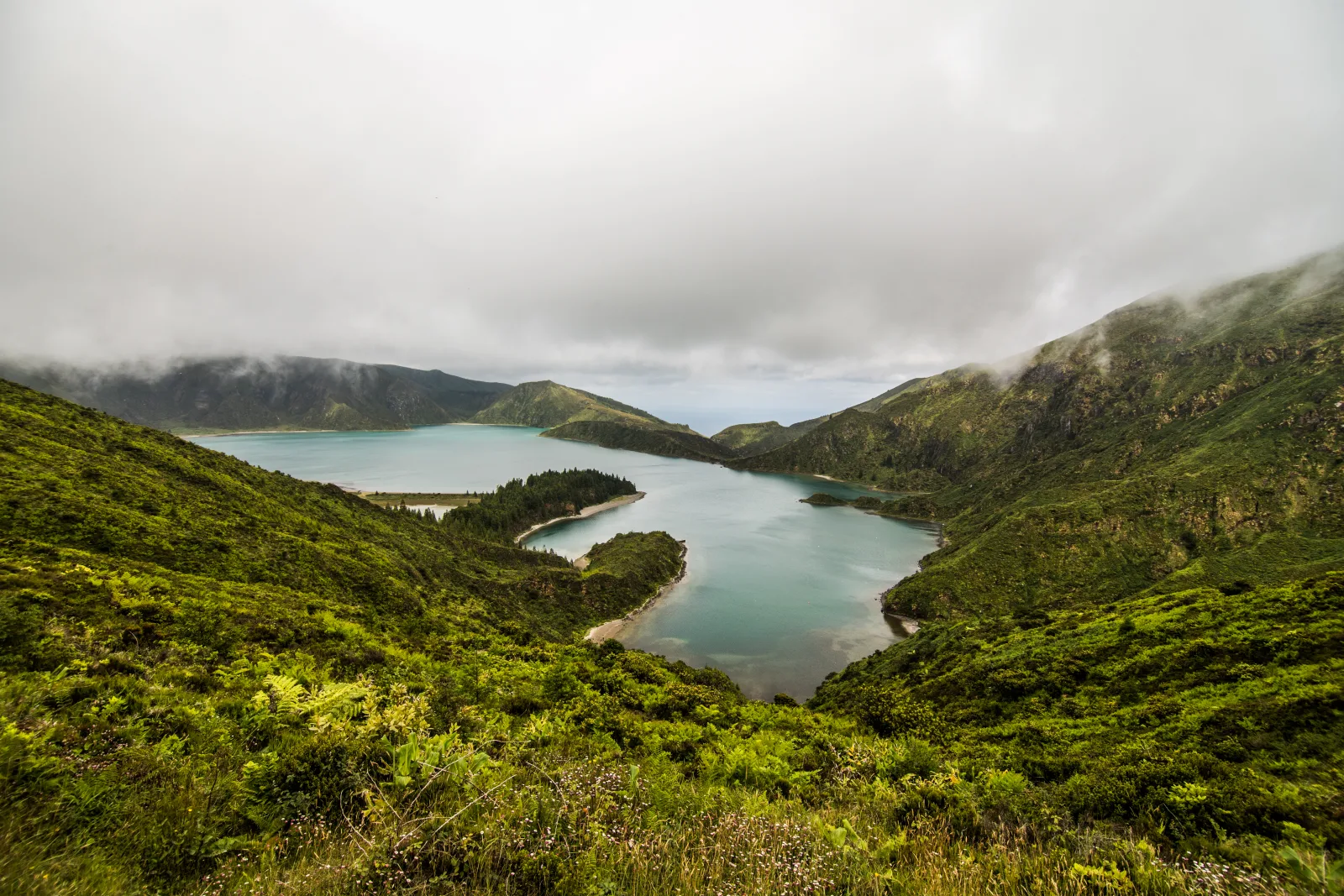
Azores temperature by month is the question that decides what to pack. The islands sit in the middle of the Atlantic at 37°N — warmer than the latitude would suggest because the Gulf Stream keeps both air and water mild. Daily highs run 16°C in winter to 25°C in summer. Ocean temperature runs 15-24°C. What surprises most visitors is how compressed the range is — the Azores never get truly hot or cold, but they get changeable fast.
I live on São Miguel and watch the weather more than is healthy. This guide is the month-by-month temperature breakdown I’d hand a friend booking their first trip — air temperatures, ocean temperatures, rainy days, microclimate adjustments by elevation, and what to actually pack for each season.
For the broader “when should I visit” question (festivals, crowds, prices), the best time to visit Azores guide is the prerequisite. This one is the data sheet.
Azores temperature by month at a glance
All data from Ponta Delgada (São Miguel), sea-level. Adjust 4°C cooler for the central highlands (Lagoa do Fogo, Sete Cidades rim).
| Month | Air (high / low) | Ocean | Rainy days |
|---|---|---|---|
| Jan | 16°C / 11°C | 17°C | 21 |
| Feb | 16°C / 11°C | 16°C | 19 |
| Mar | 16°C / 11°C | 15.7°C | 18 |
| Apr | 17°C / 12°C | 17°C | 16 |
| May | 19°C / 13°C | 18°C | 14 |
| Jun | 21°C / 16°C | 20°C | 14 |
| Jul | 23°C / 18°C | 22°C | 12 |
| Aug | 25°C / 19°C | 23.4°C | 12 |
| Sep | 24°C / 18°C | 23°C | 16 |
| Oct | 21°C / 16°C | 21°C | 18 |
| Nov | 18°C / 14°C | 19°C | 20 |
| Dec | 17°C / 13°C | 18°C | 20 |
Annual mean: 17.1°C air, 19°C ocean. Annual rainfall: ~1,010 mm spread across roughly 200 rainy days per year. The data above is averaged from Ponta Delgada on São Miguel, but the patterns hold across the archipelago — Terceira, Pico, and Faial all sit within 1-2°C of São Miguel in any given month. Santa Maria runs about 1-2°C warmer year-round and is the only Azorean island with a measurably drier climate.
Azores weather by month
Tap a month for air temperature, sea temperature, rainfall, and what it's actually like. Data from Ponta Delgada, São Miguel.
October in the Azores
21° / 16°
Air high / low
21°
Sea temp
18
Rainy days
Mild, crowds easing, water still swimmable. Strong balance of weather and space.
Central highlands (Lagoa do Fogo, Sete Cidades rim) run ~4°C cooler. Santa Maria runs 1–2°C warmer and drier than the figures above.
Air temperature in the Azores month by month
The Azores air temperature is remarkably stable. The gap between the coldest month (February, 14.5°C average) and the warmest (August, 22.5°C average) is only 8°C. By comparison, Lisbon swings from 11°C to 24°C — a 13°C range. The Atlantic acts as a thermostat.
What this means for trip planning:
- No truly hot weather — even peak August rarely exceeds 28°C
- No truly cold weather — even peak February rarely goes below 8°C at sea level
- Temperature isn’t the variable that decides what kind of trip you’ll have — rainy days are
For shoulder-month context, see the best month to visit Azores guide which weighs price, crowds, and weather together.
Ocean (water) temperature in the Azores
The ocean water temperature in the Azores runs a few degrees behind the air. The pattern:
| Season | Water temp | Comfortable for swimming? |
|---|---|---|
| Winter (Jan-Mar) | 15.7-17°C | Cold-tolerant only |
| Spring (Apr-May) | 17-18°C | Still cold |
| Early summer (Jun) | 20°C | Workable for most |
| Peak summer (Jul-Sep) | 22-23.4°C | Yes — comfortable |
| Autumn (Oct-Nov) | 19-21°C | Yes, fading |
| Early winter (Dec) | 18°C | Marginal |
The peak is August at 23.4°C and September close behind at 23°C. September is the local secret — same water temperature as August, half the crowds, slightly more rain.
For warmer-than-ocean swimming year-round, two options:
- Ponta da Ferraria — geothermal sea pool, ~28°C from underwater volcanic vents (best at low tide)
- Thermal pools at Terra Nostra, Poça da Dona Beija, Caldeira Velha — all 36-40°C year-round (more in the thermal pools guide)
Temperature in the Azores in January
The coldest month, statistically. But “coldest” in the Azores means:
| Stat | Value |
|---|---|
| Daily high | 16°C / 61°F |
| Daily low | 11°C / 52°F |
| Ocean | 17°C |
| Rainy days | ~21 |
| Daylight | ~10 hours |
What January is good for: Hot springs, storm watching, cheapest flights of the year, empty trails, dramatic light for photography. The contrast between cool air and 38°C thermal pools is genuinely spectacular.
What it’s not good for: Beach swimming, clear-day viewpoint photography (cloud is more likely than not), long hiking with consistent weather.
If you’re planning a January trip, the trade-off is real: you get the islands at 30-40% of summer prices and almost to yourself, but you trade away clear viewpoint days.
Temperature in the Azores in May
The most underrated month, in my opinion.
| Stat | Value |
|---|---|
| Daily high | 19°C / 66°F |
| Daily low | 13°C / 55°F |
| Ocean | 18°C |
| Rainy days | ~14 |
| Daylight | ~14 hours |
Why May works: the green is at its peak, azaleas and camellias are still blooming, the rainy season is ending, crowds haven’t arrived yet, and the Senhor Santo Cristo dos Milagres festival (5th Sunday after Easter) brings the cultural high point of the year to Ponta Delgada.
Caveat: hydrangeas (the iconic blue-purple roadside blooms) don’t peak until mid-July. If hydrangea photography is your goal, May is too early.
Temperature in the Azores in November
The forgotten shoulder month. Often dismissed as “rainy season starting” but actually one of the best value windows.
| Stat | Value |
|---|---|
| Daily high | 18°C / 64°F |
| Daily low | 14°C / 57°F |
| Ocean | 19°C |
| Rainy days | ~20 |
| Daylight | ~10.5 hours |
Why November is underrated: flights from Boston run 30-40% cheaper than peak summer, hotel rates drop sharply, thermal pools are at their atmospheric peak (cool air + steam + iron-rich water in the rain = postcard photography), and the whale watching season for resident sperm whales runs uninterrupted.
Caveat: rainy days return to ~20 per month, and viewpoints (Sete Cidades, Lagoa do Fogo) become a coin flip. Build flexibility into the trip.
The microclimate factor — what changes by elevation
The single biggest temperature variable in the Azores isn’t the month — it’s the elevation. Sea-level Ponta Delgada is consistently 4-8°C warmer than the central highlands.
| Location | Elevation | Typical August temp | Typical January temp |
|---|---|---|---|
| Ponta Delgada | sea level | 22°C | 14°C |
| Lagoa do Fogo | ~575m | 18°C | 10°C |
| Pico Mountain summit | 2,351m | ~10°C | -2°C (snow possible) |
| Caldeira do Faial | ~900m | 16°C | 8°C |
The microclimate effect is dramatic enough to plan around. On a typical day in July, Ponta Delgada can be 22°C and sunny while Sete Cidades rim (at ~400m) is 17°C and in cloud, 30 km away. Locals call this the vento de norte (northern wind) — moist Atlantic air rising up the volcanic slopes, condensing into cloud.
Practical takeaway: check viewpoints early in the morning before the cloud forms. The “be at Sete Cidades before 10am” rule from the Sete Cidades guide is rooted in this microclimate physics.
What to pack by month
| Season | Daytime | Evening | Notes |
|---|---|---|---|
| Winter (Nov-Mar) | Light jumper + waterproof | Light jacket + hat | Pack as for “Lisbon in winter” — layers, not heavy coat |
| Spring (Apr-May) | T-shirt + light jumper + waterproof | Light jacket | Add a sun hat for clear days |
| Summer (Jun-Sep) | T-shirt + shorts | Light jumper | Swimwear, towel, sunglasses, sunscreen (the Atlantic sun is strong) |
| Autumn (Oct) | T-shirt + light jumper | Light jacket | Like spring — transitional |
Year-round essentials:
- Waterproof jacket — every month has some rain
- Light layers — Atlantic weather changes hourly
- Good walking shoes — the islands are not for sandals
- Swimwear — even in winter, thermal pools are 38°C
- Sun protection — the UV is strong even on cloudy days at this latitude
Common temperature mistakes visitors make
1 — Packing for winter cold or summer heat. Neither happens. The Azores are mild year-round. Heavy winter coats and tank-tops are both wrong.
2 — Assuming “August = beach weather.” August has the warmest sea (23.4°C), but the wind, swell, and microclimate cloud all stay. It’s swim-comfortable, but not Costa-del-Sol comfortable.
3 — Trusting Ponta Delgada weather forecasts for the interior. The microclimate is real. A clear 22°C in PDL can be a foggy 17°C at Lagoa do Fogo. Check IPMA’s Lagoa do Fogo-specific forecast for hiking plans.
4 — Not accounting for evening cool. Even August evenings drop to 19°C and feel cooler with Atlantic breeze. Pack a light jumper.
5 — Skipping thermal pools because “it’s summer.” Thermal pools are 36-40°C year-round. In August the contrast is less dramatic than in February, but the experience is still excellent — see the thermal pools guide.
6 — Underestimating rain in shoulder months. May and October look mild on paper but still average 14-18 rainy days per month. The rain is usually short showers, not all-day storms, but plan flexible activities.
If you’d rather have a São Miguel trip with weather-aware day routing built in — knowing which mornings to chase Sete Cidades vs which to save for Furnas — Pocket Guide Azores handles that automatically.
The bottom line
Azores temperature by month is a band, not a swing. Air ranges 16°C in winter to 25°C in summer at sea level. Ocean ranges 15.7°C to 23.4°C. The microclimate effect of elevation matters more than the calendar — a clear day at Ponta Delgada can be a fog day at Sete Cidades rim, in any month.
For most visitors: May/June and September/October are the right balance of warm air, swimmable ocean, manageable rain, and reasonable crowds. For warm-ocean swimmers: August. For empty trails + thermal pools + storms: January-February.
Pack layers and a waterproof in every month. The forecast will be wrong at least once. The Azores reward flexibility, not planning around averages.
Quick Azores temperature reference for trip planning
A condensed cheat sheet for booking decisions.
| Question | Answer |
|---|---|
| Warmest air temperature month? | August (25°C high) |
| Coldest air temperature month? | February (14.5°C average) |
| Warmest ocean temperature month? | August (23.4°C), September close behind |
| Coldest ocean temperature month? | March (15.7°C) |
| Rainiest month? | December and January (~21 rainy days) |
| Driest months? | July and August (~12 rainy days) |
| Annual rainfall | ~1,010 mm |
| Annual mean air temp | 17.1°C |
| Hydrangea peak | Mid-July through mid-August |
| Whale migration peak | March-May |
| Cheapest months to visit | November-March (excluding Christmas) |
| Local’s quiet favourite | September |
Pair this temperature data with what each month actually delivers — festivals, blooms, crowds, prices — in the best month to visit Azores guide. And for what to actually do on each day, the 5-day São Miguel itinerary covers the weather-flexible day routing that the microclimate demands.
A final practical note: the Azores have their own time zone (UTC−1, AZOT). Sunrise and sunset times shift slightly differently from mainland Portugal. In August sunset is around 8:45pm local time, in December it’s around 5:30pm. Plan your viewpoint and beach time around the daylight window, not just the temperature.
What to read next
- The Azores in summer — June to August weather, swimming, and crowds in depth
- Best time to visit the Azores — month-by-month full breakdown beyond just temperature
- Best month to visit the Azores — opinionated month-by-month picks
- Thermal pools in São Miguel — for winter and shoulder-season warmth
- Best beaches in São Miguel — water temperature by beach type
- Where are the Azores? — geography that explains the microclimate
Frequently asked questions
What is the warmest month in the Azores? +
August is the warmest month in the Azores. Average daily highs reach about 25°C (77°F) and lows stay around 19°C (66°F), with ocean water temperature peaking at 23-24°C. September is essentially the same temperature as August but with fewer crowds and slightly more rain. July is close behind. If you want the warmest, calmest beach-and-swim weather, plan for late July through mid-September.
How cold does it get in the Azores in winter? +
Mildly cool, not cold. The coldest month (February) averages 14.5°C with daily highs around 16°C and overnight lows around 11°C. January is similar. Frost is rare at sea level and snow has never been recorded in the inhabited islands. The mountain interior gets colder (Pico Mountain at 2,351m occasionally has snow, and Lagoa do Fogo runs 4°C cooler than Ponta Delgada). Pack layers but not a heavy winter coat.
Can you swim in the Azores year-round? +
Technically yes, comfortably no. Ocean temperature stays between 16-24°C across the year — never freezing. From July to October the water is warm enough (20-24°C) for comfortable swimming for most visitors. November to June, the water is cool (15-19°C) and only the cold-tolerant or wetsuit-wearing swim. The exception is Ponta da Ferraria's geothermal pool — underwater volcanic springs warm it to ~28°C even in winter.
What is the water temperature in the Azores? +
Ocean water temperature in the Azores ranges from a minimum of 15.7°C in March to a maximum of 23.4°C in August. Yearly average is around 19°C. The Gulf Stream keeps the water warmer than the latitude would suggest — Ponta Delgada at 37°N has water temperatures comparable to Lisbon further south. The best months for swimming are July through October. Cold-water surfers and scuba divers operate year-round with wetsuits.
Is May warm in the Azores? +
May is mild and transitional. Air temperatures range 13-19°C, ocean water around 18°C, and rainy days drop to about 14 from 18+ earlier in the spring. Hydrangeas haven't bloomed yet (those start mid-June) but azaleas and camellias are still flowering. May is one of the most pleasant months for hiking and viewpoints because crowds are still low and the island is at its greenest. The two-degree-warmer June is the more popular choice, but May has the better balance of weather and quiet.
What's the temperature in the Azores in November? +
November is the transition into the wet season. Air temperatures range 14-18°C, ocean water cools from 21°C to about 19°C through the month, and rainy days climb back up to ~20. It's still mild by European standards (warmer than Paris or London), but you'll need a waterproof and layers. Thermal pools are excellent in November — the contrast between cool air and 38°C iron-rich water is one of the best São Miguel experiences. Flights and hotels are 30-40% cheaper than peak summer.
Are the Azores cold at night? +
No — overnight lows are mild year-round at sea level. Winter nights average 11-13°C (52-55°F). Summer nights average 17-19°C (63-66°F). Pack a light jacket or sweater for evening walks but you won't need heavy winter clothing. The exception is high elevation — Pico Mountain (2,351m) and Lagoa do Fogo rim (575m) can drop near freezing in winter, sometimes below at altitude. Sea-level Ponta Delgada is genuinely temperate all year.
How much rain does the Azores get? +
About 1,010 mm (40 inches) per year on São Miguel — broadly similar to London, more than New York, less than Lisbon's mountain regions. The wet months are October to March (~18-21 rainy days each). The driest are July and August (~12 rainy days). But 'rainy day' in the Azores usually means a few short showers, not a full-day washout. The microclimate effect is real — Sete Cidades can be in cloud while Ponta Delgada is sunny 20 km away.