
Also available in Português
Thermal Pools in São Miguel, Azores: Where to Go and What to Expect
A local's guide to São Miguel's thermal pools and hot springs — Terra Nostra, Poça da Dona Beija, Caldeira Velha and Ferraria, with prices, timing and tips.
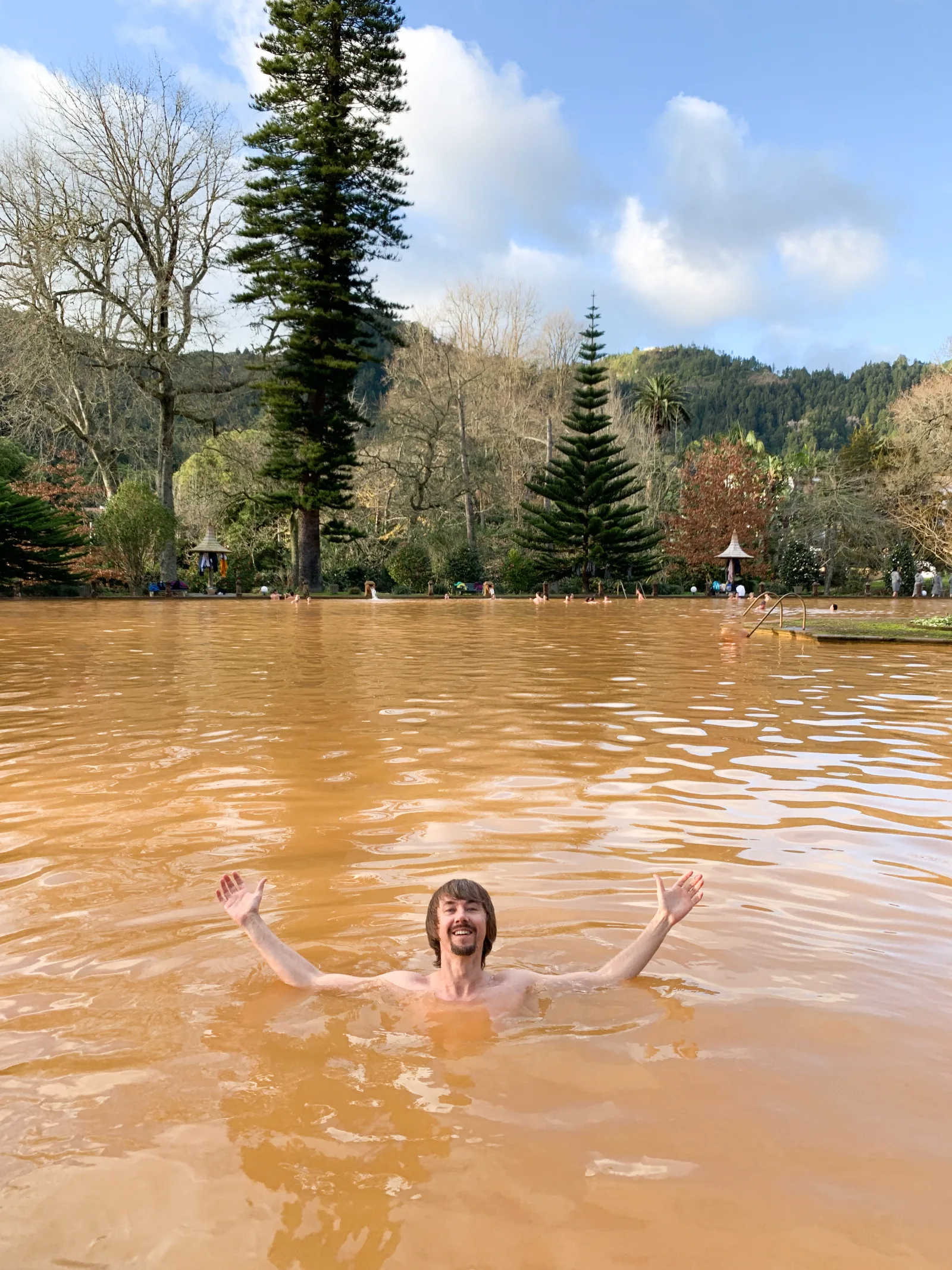
Thermal pools in São Miguel, Azores are not a tourist feature. Geothermal heat is just how the island works. The ground temperature at Furnas exceeds 100°C in places — locals have been cooking meals in the volcanic soil for generations. The pools are a side effect of all that heat, and they vary enormously: a polished garden pool at a botanical hotel, a forest waterfall that runs warm year-round, ocean-fed rock pools on the western tip where Atlantic swell mixes with steam.
The thing most guides get wrong is treating all thermal pools as interchangeable. They are not. Terra Nostra is beautiful and popular and requires some planning to enjoy properly. Caldeira Velha is a completely different experience — a natural waterfall pool in a forest reserve, quieter, less developed, more atmospheric. Termas de Ferraria on the west coast is something else again: an open-ocean thermal pool where the swell is part of the experience. Knowing which one to visit, when, and in what order changes the day significantly.
Before you go: thermal pools tips
Six practical things that apply to every pool below. Get them right and you avoid the mistakes that turn thermal bathing from the highlight of a São Miguel trip into the disappointing part.
Wear a bathing suit you do not mind losing. The iron in the Furnas water (Terra Nostra and Poça da Dona Beija) permanently stains fabric a rust-brown. Black hides it. White is destroyed in twenty minutes. Take an old set you’ve already retired from regular use — this is the single most repeated piece of advice among locals and the most ignored by visitors.
Skip the recent hair colour. The same iron and sulphur compounds that stain swimsuits will react with bleach or fresh dye and turn highlighted hair greenish. Wait at least two weeks after a salon visit before using the brown Furnas pools. Caldeira Velha and Ferraria are fine — different water chemistry.
Bring water and drink it. Thirty-five-degree water dehydrates faster than people expect, especially after twenty minutes in. The cafés inside the larger facilities charge premium prices — smaller spots may have nothing. A one-litre bottle in your bag is what locals carry.
A rental car is not optional. None of the thermal pools are on a public bus route. Caldeira Velha is 30 minutes from Ponta Delgada — Furnas is 40 — Ferraria is 50. Tours exist but lock you into their timing — and the magic of these pools depends on hitting them at the right hour. The do you need a car in Azores guide explains why renting at the airport is almost consistently the right call.
The off-season is better. Sitting in a 38°C pool while it is 12°C and raining outside is a fundamentally different and better experience than the same pool on a 28°C summer afternoon. Locals prefer November through March for the steam contrast and the empty facilities. If you can plan around peak summer crowds, do.
Book ahead in July and August. Terra Nostra, Poça da Dona Beija and Caldeira Velha all cap entry, and walk-up visits in peak season often mean queueing at the gate or being turned away in the early evening. A reservation costs nothing extra and saves the trip. Check the official sites the week of your visit.
Terra Nostra thermal pools (São Miguel, Azores)
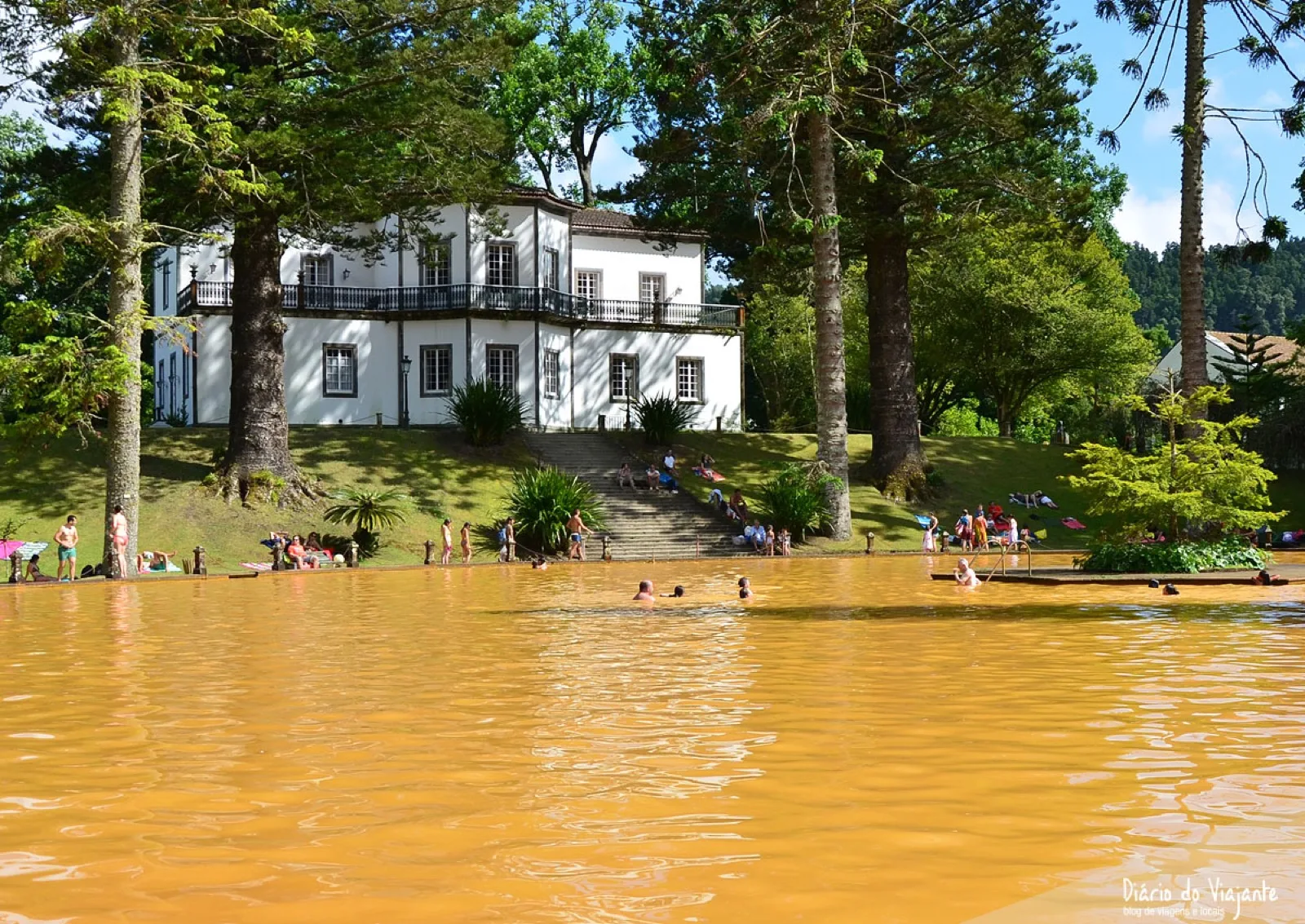
The most photographed thermal pool in the Azores. Terra Nostra sits inside a 19th-century botanical garden in the centre of Furnas village — a large oval pool filled with iron-rich water that is a deep, opaque brown. The colour is not a sign of anything wrong. It is dissolved iron and other minerals from the volcanic rock, the same water that has been feeding this pool for over a century.
| Detail | Value |
|---|---|
| Water temperature | ~35–37°C |
| Water colour | Deep brown (iron-rich) |
| Size | Large — fits 100+ swimmers comfortably |
| Garden access | Required (ticket includes pool — hotel guests free) |
| Price | ~€12–15 for garden + pool entry |
| Hours | Typically 10:00–18:00 (confirm at terranaturalgroup.com) |
| Drive from Ponta Delgada | ~40 minutes east |
The garden surrounding the pool is genuinely worth the admission on its own — tree ferns, ancient camellias, giant Gunnera, subtropical plants from across the world’s volcanic islands. The pool is the centrepiece, but you could spend two hours just walking the garden paths.
The bathing suit warning above applies in full at Terra Nostra — this is the single highest-iron pool on the island and the one most likely to ruin a swimsuit you actually like. Treat the entrance gate as the point of no return for any fabric you care about.
Local tip: Terra Nostra is busiest between 11am and 3pm in summer. Go before 10am when the gate opens, or after 4pm when the tour buses have left. The morning session is noticeably more peaceful — fewer people, the light through the garden is better, and you have the pool almost to yourself for the first hour.
The full context for a Furnas day — including the volcanic cooking pots, the lake, and the caldeiras walk — is in the Furnas guide. The thermal pool fits naturally into the afternoon after the morning attractions.
Terra Nostra hotel guests
If you are staying at the Terra Nostra Garden Hotel (the 19th-century property inside the garden), pool access is included. The hotel is expensive by São Miguel standards but the access means you can use the pool early morning and late evening — before public hours and after closing, when it is effectively private. Worth knowing if you are planning a longer stay.
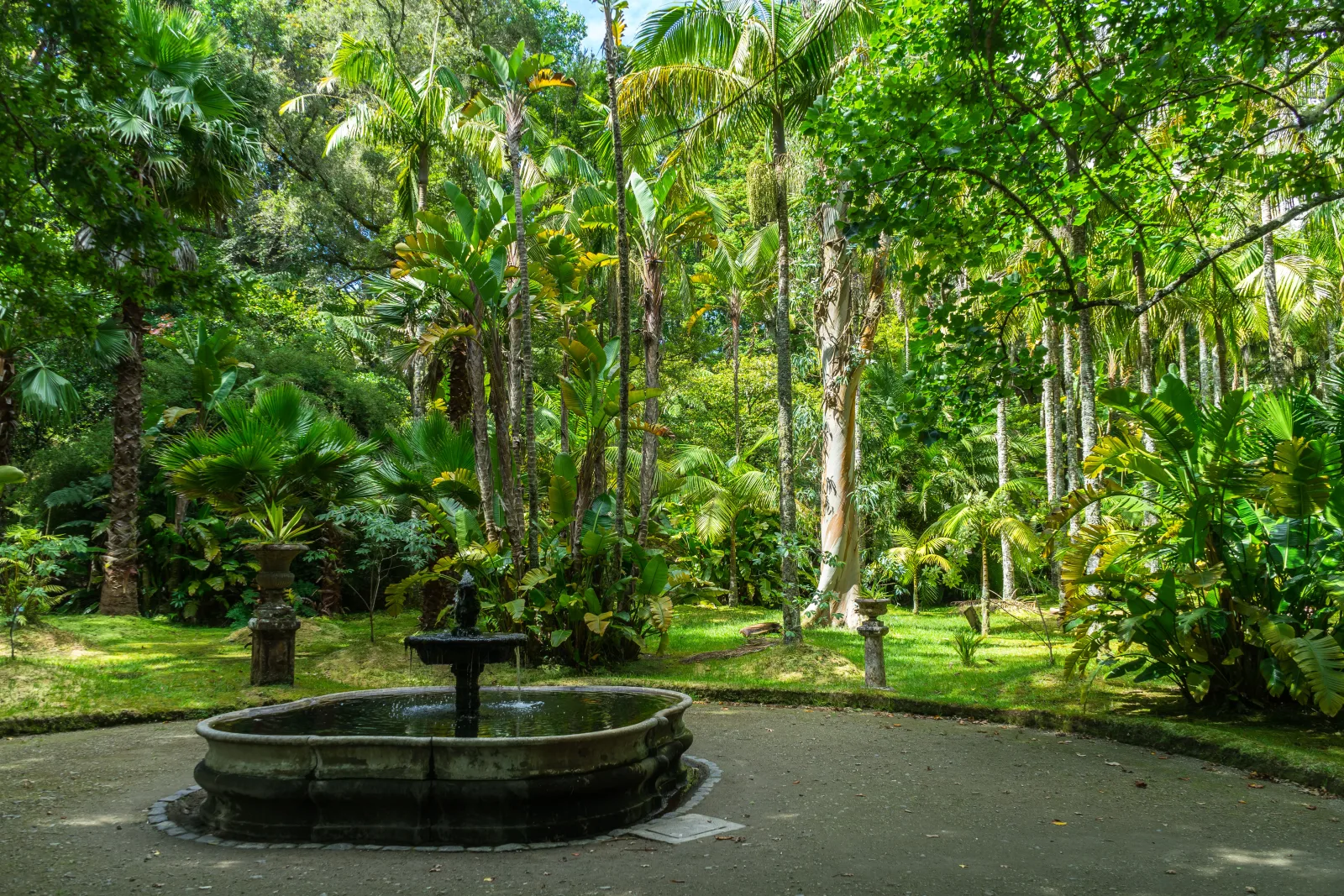
Poça da Dona Beija (Furnas, after dark)
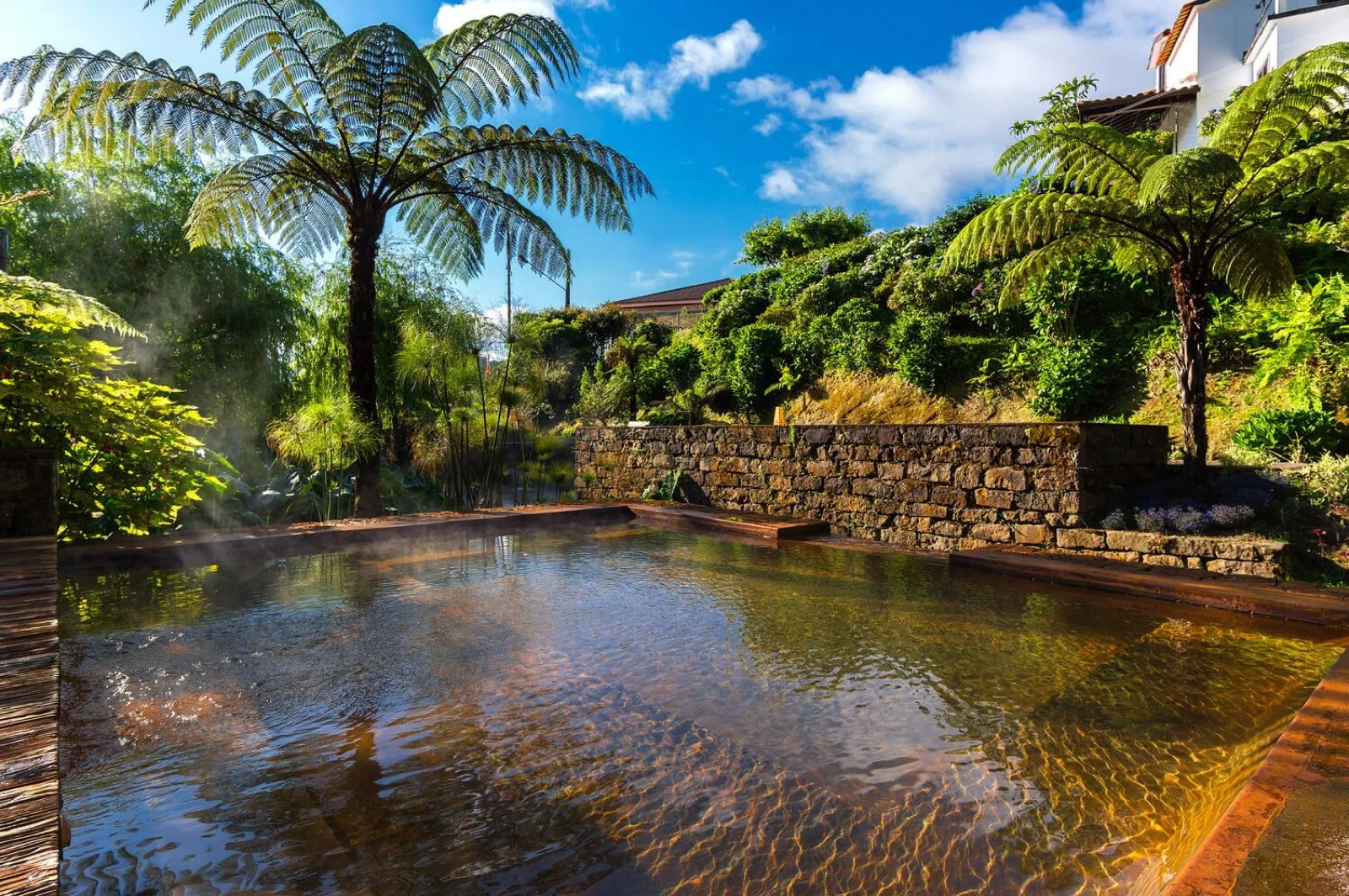
Poça da Dona Beija is a cluster of outdoor thermal pools in Furnas village, a 5-minute walk from Terra Nostra. It is smaller than Terra Nostra and less polished — a series of rock-edged pools at different temperatures, surrounded by low lighting and wooden walkways — and it is considerably better in the evening.
| Detail | Value |
|---|---|
| Water temperature | Multiple pools: ~35°C to 40°C |
| Best time | Evening — after 7pm |
| Price | ~€8–12 per person |
| Hours | Open until ~23:00 (check seasonally) |
| Bathing suit warning | Iron stains — same as Terra Nostra |
| Drive from Ponta Delgada | ~40 minutes east |
The pools sit at different temperatures so you can move between them. The hottest pools are intense in the way a sauna is intense — pleasant for 10 minutes, overwhelming for 30. Most people cycle between the warmest pool and a slightly cooler one.
The reason to go at night rather than during the day is atmosphere. In daylight, Poça da Dona Beija is a nice thermal pool surrounded by tourist groups. After dark, with the steam rising in the lamplight and the temperature dropping outside, it becomes something different — properly immersive rather than scenic.
Local tip: Furnas village has good dinner options. A solid sequence: arrive in Furnas in the late afternoon, see the caldeiras and the geothermal cooking pots at the lake (detailed in the Furnas guide), have dinner in the village, then finish the evening at Poça da Dona Beija. It makes a complete day without rushing.
Caldeira Velha (north slope, central mountains)
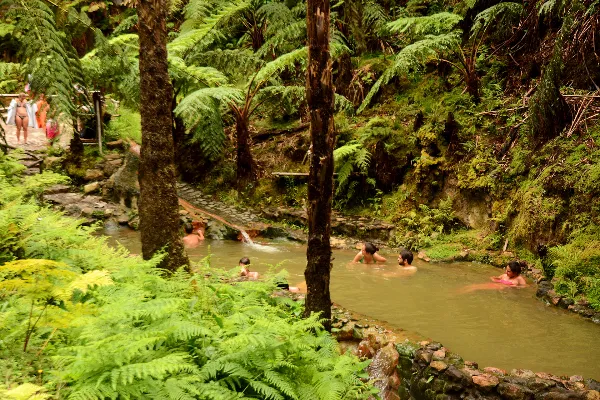
A completely different experience from Furnas. Caldeira Velha is a forest reserve on the north slope of São Miguel’s central volcanic massif, about 30 minutes from Ponta Delgada. The centrepiece is a small waterfall that drops into a shallow pool — the water emerges from the rock already warm, heated geothermally on its way to the surface, and the pool temperature sits around 26–28°C year-round.
| Detail | Value |
|---|---|
| Water temperature | ~26–28°C (waterfall pool) — warmer in smaller basins nearby |
| Setting | Forest reserve — dense subtropical vegetation |
| Entry fee | ~€10 for a 90-minute session (Parques de Azores managed) |
| Hours | Typically 9:00–20:30 in summer, shorter in winter |
| Changing rooms | Yes, basic facilities |
| Drive from Ponta Delgada | ~30–35 min northeast (EN1-1A toward Ribeira Grande, then signposted) |
| Public transport | None — car or taxi required |
The appeal of Caldeira Velha is the setting. You are inside a forest reserve, surrounded by giant tree ferns and laurel — the kind of Macaronesian forest that has been growing here since before people arrived. The pool is small and natural, nothing like the manicured oval at Terra Nostra. The waterfall is warm. The air smells of vegetation and sulphur.
Local tip: Caldeira Velha is at its best on a grey or overcast day. When the light is flat, the forest closes in and the mist from the warm waterfall makes it feel genuinely wild. On a bright, crowded summer afternoon, the magic is harder to find. Go mid-week in shoulder season (May or October) if you can.
The reserve also has a short trail system — walk past the main pool up through the forest for 15–20 minutes to reach the caldeira itself, a steaming, sulphurous vent near the ridge. Worth the detour.
Pair Caldeira Velha + north coast
Caldeira Velha is on the way to Ribeira Grande from Ponta Delgada, which makes it a natural addition to a north coast day. The best hikes on São Miguel include Sete Cidades, which sits on the opposite (western) end of the same ridge — but the driving distance means pairing Caldeira Velha with a north coast beach or the Santa Bárbara surf beach is more practical.
Termas de Ferraria (west coast)
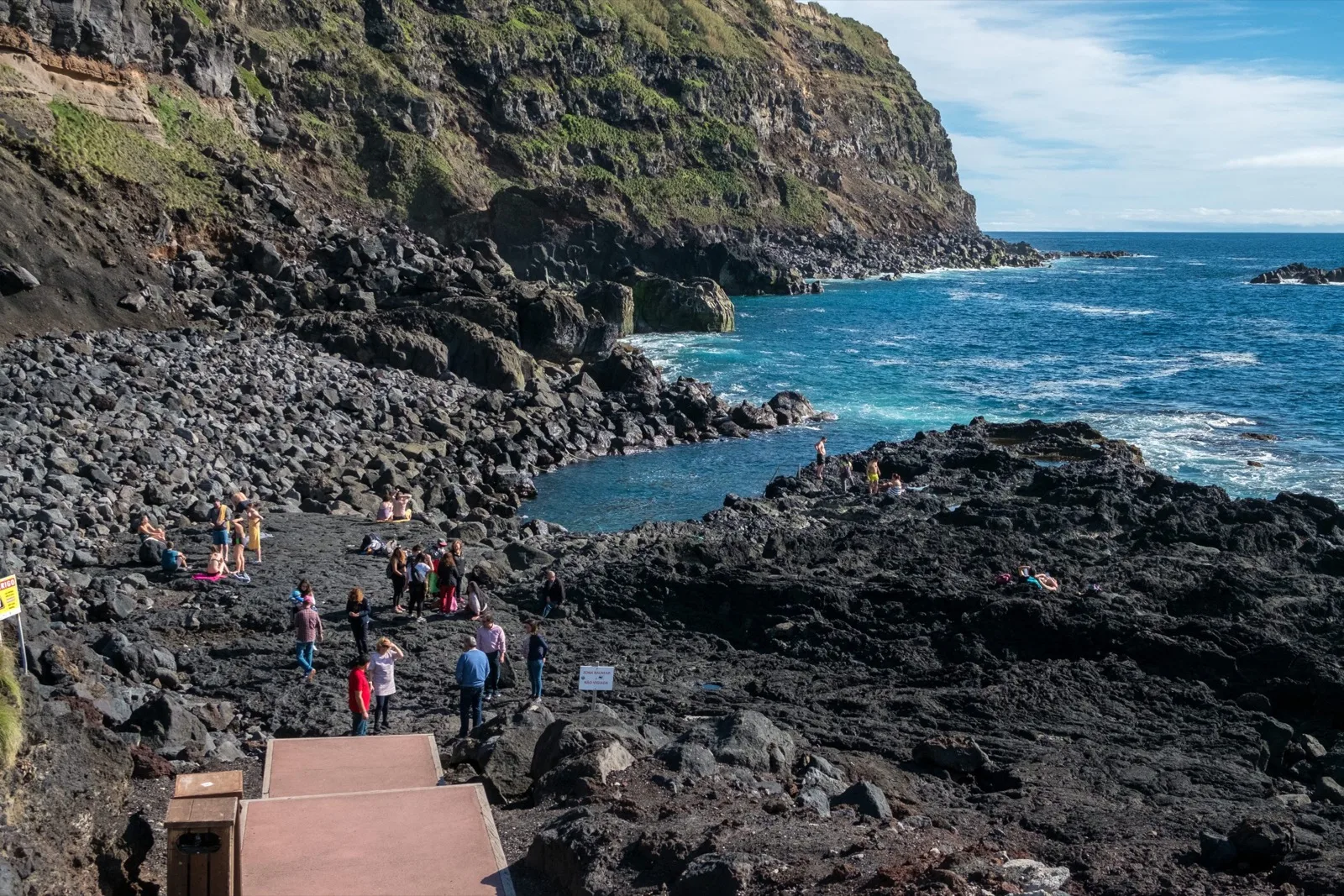
At the far western tip of São Miguel, near Mosteiros, a series of natural volcanic rock pools sits at sea level — the Atlantic swell washes in and mixes with hot geothermal water emerging from the rock. The result is pools that are warm but not uniformly so: temperature varies by where the swell is pushing cold sea water versus where the volcanic heat dominates.
| Detail | Value |
|---|---|
| Type | Natural sea pool with geothermal input + adjacent managed spa |
| Temperature | Variable — 28–40°C depending on tide and conditions |
| Entry | Managed facility (~€5–8) — natural pool free at low tide |
| Setting | Sea-level volcanic rock, open Atlantic view |
| Hours | Daylight — closed in rough weather |
| Drive from Ponta Delgada | ~50 min west |
Ferraria is the only place on São Miguel where you are effectively in an open-ocean thermal pool. The swell brings energy and unpredictability — the pools are not calm in the way that Furnas pools are calm. Some people find this exhilarating — others find it stressful. If swell conditions are rough, access may be restricted entirely.
The natural pool is in a small cove reached by a steep concrete ramp from the cliff above. The adjacent spa facility (Termas da Ferraria) has indoor pools, a restaurant, and changing rooms — useful if the natural pool is closed for swell or if you want a calmer experience after a session in the ocean.
Local tip: Time it with the tide. The natural pool is at its warmest and most usable around mid-tide either side — too high and the cold ocean dominates, too low and the pool drains and becomes a shallow puddle. Check tide tables for Mosteiros before you drive out, and check the wind too. South or east wind, calm sea: go. North or west wind, big swell: skip and visit another day.
Quick-reference comparison
| Pool | Best for | Temp | Cost |
|---|---|---|---|
| Terra Nostra | Classic experience, botanical garden | 35–37°C | ~€12–15 |
| Poça da Dona Beija | Evening, multiple pools | 35–40°C | ~€8–12 |
| Caldeira Velha | Natural forest reserve | 26–28°C | ~€10 |
| Termas de Ferraria | Sea-level geothermal | 28–40°C var | ~€5–8 |
How to plan your thermal pool days
The main mistake is trying to visit more than one pool per day. Each one is in a different part of the island, each one rewards being unhurried, and the combined driving time eats the relaxation that the pools are supposed to provide. Treat each as an anchor for a half- or full-day, not as one stop on a list.
Pool pairings that actually work
Furnas day (most popular) Plan the day around both Furnas pools. A standard sequence: morning visit to the volcanic caldeiras and the geothermal cooking pots at Furnas Lake, lunch in the village (cozido das furnas if you booked it), afternoon in the Terra Nostra garden and pool, dinner in the village, then finish the evening at Poça da Dona Beija. The two Furnas pools are five minutes apart on foot. One day, no backtracking. Combine with the Furnas guide for the full geology and the cozido logistics.
North slope day Caldeira Velha pairs naturally with the northern side of the island. Drive up through Ribeira Grande, stop at Caldeira Velha for the 90-minute session, then continue along the north coast — surf beach at Santa Bárbara, viewpoints at Sete Cidades if time allows. Back to Ponta Delgada via the Sete Cidades crater route.
West coast day Termas de Ferraria fits with a west-coast loop: Sete Cidades crater viewpoints in the early morning before clouds form, Mosteiros village for lunch, then Ferraria’s tidal pool in the afternoon when the tide is right. The tide window is the constraint — you may need to arrange the rest of the day around it rather than the other way around.
Best months for thermal pools
Thermal pools are open and at the correct temperature year-round. The question is when they are most enjoyable rather than when they are available.
| Season | Notes |
|---|---|
| Jun–Aug | Warmest air temperature — most crowded — lighter contrast between pool and air |
| Sep–Oct | Shoulder season — warm enough outside, pools less crowded, forests at their greenest |
| Nov–Mar | Fewer tourists, dramatic weather, the steam effect is most visible — Caldeira Velha especially atmospheric |
| Apr–May | Mild, uncrowded, excellent for Caldeira Velha and Ferraria |
The off-season argument is real: sitting in a 38°C pool while it is 14°C and raining outside is a genuinely better experience than sitting in the same pool when it is 28°C and sunny. If you are visiting outside peak summer, do not skip the thermal pools on the assumption they are less good — they are often more good.
What to bring
- Old bathing suit — non-negotiable for Terra Nostra. The iron stains permanently. One set aside specifically for the thermal pool is the practical solution.
- Flip flops — most facilities have rough stone or wet decking between changing rooms and pools.
- Small towel — facility towels are sometimes available for hire but unreliable.
- Water — the high temperatures dehydrate quickly, especially in the hotter pools. Bring your own — prices at facility shops are high.
- Cash — the smaller spots (the natural side of Ferraria especially) may not accept cards.
Planning an itinerary around the pools
If you are trying to slot thermal pools into a multi-day São Miguel trip — fitting them around weather, driving distances, and the rest of the island’s highlights — Pocket Guide Azores builds that itinerary automatically. It knows that Furnas needs a full afternoon, that Caldeira Velha is on the way to the north coast, and that Ferraria depends on the tide schedule. You describe the trip — it assembles the sequence.
If you want to see the pools in a completely different light, this is the one I’d recommend. It’s an evening tour: you’re picked up, taken to Poça da Dona Beija after dark with the entry ticket included, and shown Furnas at night, when the steam rising from the ground gives the whole valley an almost mystical feel. There’s also a tea tasting made with Furnas spring water, from a drinkable spring the guide knows, and dinner is included:
The short answer
São Miguel has four distinctly different thermal pool experiences. Here is where to focus depending on what you are after:
Go to Terra Nostra Garden if you want the classic experience — the famous pool, the botanical garden, the history. It is the most photogenic and the most famous for good reason. Book ahead if visiting July or August and arrive early.
Go to Poça da Dona Beija in the evening — after dark, after dinner, as the final stop of a Furnas day. Multiple pools at different temperatures, low light, steam rising, no rush. The atmosphere is better than any pool on the island at noon.
Go to Caldeira Velha if you want the natural, forest version — a warm waterfall in a subtropical reserve with almost no development around it. Pairs perfectly with a north coast day or a half-day side trip from Ponta Delgada.
Go to Termas de Ferraria for the sea-level option — geothermal water mixed with Atlantic swell in a tidal rock pool, with the open ocean as the backdrop. Best in calm conditions — check the tide schedule and the sea state before making the drive.
A few things are true of all four: bring an old bathing suit (the iron stains at Terra Nostra), drink water (the heat dehydrates), and do not try to visit more than one pool in a day. The point of thermal bathing is to slow down, not to optimise.
For how these fit into a complete São Miguel trip — alongside the best hikes, the crater lakes, and the east coast — the 5-day São Miguel itinerary shows how a Furnas day and a north slope day fit without overlap.
Frequently asked questions
What are the best thermal pools in São Miguel, Azores? +
Terra Nostra Garden in Furnas is the most famous — a large, iron-rich brown pool inside a historic botanical garden. Poça da Dona Beija, also in Furnas, is a cluster of smaller outdoor pools that's at its best after dark. Caldeira Velha, on the north slope of the central mountains, is a waterfall-fed natural pool in a forest reserve. Termas de Ferraria on the western tip lets you bathe in a coastal rock pool warmed by underwater geothermal vents.
Are the thermal pools in São Miguel free? +
Caldeira Velha (managed by Parques de Azores) charges roughly €10 for a 90-minute session. Poça da Dona Beija charges around €8–12 per person depending on session. Terra Nostra Pool requires either garden admission (around €12–15) or a hotel package. Termas de Ferraria's managed coastal facility has a small entry fee (~€5–8); the natural ocean pool itself is technically free at low tide using the public access.
Can you swim in the thermal pools year-round? +
Yes. The thermal pools in São Miguel are open year-round and the water temperature is maintained by geothermal heat regardless of season. They are arguably better in cooler months — the contrast between warm water and cool air is more pronounced, and the pools are less crowded outside July and August.
What is the water temperature at São Miguel thermal pools? +
It varies by pool. Caldeira Velha waterfall pool: around 26–28°C. Terra Nostra Garden pool: around 35–37°C. Poça da Dona Beija: 35–40°C across multiple pools. Termas de Ferraria: variable, 28–40°C depending on tide and where the geothermal vents are most active. The high iron content of the Furnas pools stains bathing suits — bring an old one.
How far is Caldeira Velha from Ponta Delgada? +
About 30–35 minutes by car, heading northeast on the EN1-1A toward Ribeira Grande. It sits on the north slope of the island's volcanic central massif, just below the main ridge road. There is no public transport to Caldeira Velha — you need a car or taxi.