
Also available in Português
The Complete Sete Cidades Guide: Best Viewpoints, When to Go & How Long You Need
A local's guide to Sete Cidades, São Miguel — the viewpoints worth your time, where to park, and the morning rule that decides whether you see the lakes at all.
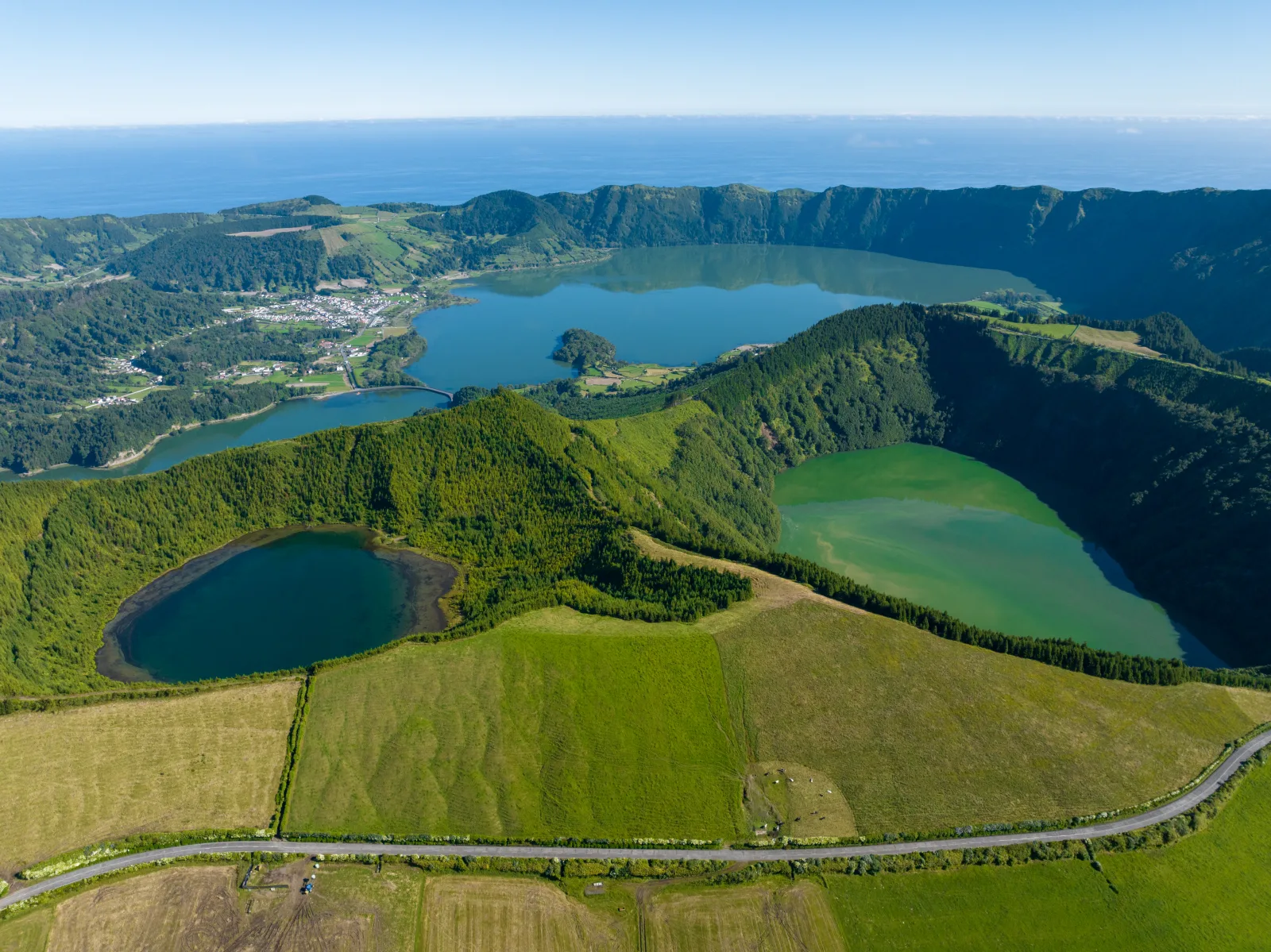
If you have only one day on São Miguel, Sete Cidades is the place to spend it. It’s a twin-lake caldera on the western tip of the island — the kind of view that gets people to book the flight in the first place — and it’s also the place tourists most often get wrong. They drive up at 1pm, find the entire crater hidden in cloud, take a photo of grey nothing, and leave disappointed.
This guide is how locals actually do it. It covers the viewpoints worth your time, the ones that aren’t, the timing rules nobody tells you, and a half-day and full-day plan you can copy.
What is Sete Cidades?
Sete Cidades is a volcanic caldera about 5 km wide, formed by a series of eruptions that hollowed out the western edge of São Miguel. Inside the crater sit two connected lakes: Lagoa Verde (green) and Lagoa Azul (blue), separated by a small bridge. A village of around 800 people lives on the lakeshore between them, and the rim of the crater forms a continuous ridge you can drive, hike, or cycle around for sweeping views in every direction.
The “Sete Cidades” name means “Seven Cities” — it comes from a medieval Portuguese legend, not from anything you’ll see today. There’s no city. Just farmland, the village, the lakes, and a perpetually dramatic sky.
When is the best time to visit Sete Cidades?
The single most important thing to understand about Sete Cidades is that it makes its own weather.
Warm air from the coast rises up the outside of the crater. When it hits the cooler air at the rim it condenses into cloud, which spills into the caldera and pools at the bottom — sometimes covering the lakes entirely while the rest of São Miguel stays sunny. This usually happens by late morning and clears (sometimes) by mid-afternoon.
The local rule is simple:
Be at the viewpoints before 10am. If you can manage 8am, even better.
Everything else flows from that. Morning light is also the best for photos — the lakes face roughly northeast, so they’re lit warmly at sunrise and harshly midday.
What if your morning is overcast? Don’t write the day off. Azorean weather can flip in an hour. Do something else for two hours (Mosteiros for breakfast, Lagoa do Canário for a different angle) and try again.
Seasonal patterns worth knowing
The microclimate physics doesn’t change month to month, but the odds do. April through June is the most reliable window — the trade winds are weaker, the cloud forms slower, and you can sometimes still see the lakes at 11am. July and August are warmer but the cloud bowl forms harder and earlier on most days. The 8am rule becomes a 7:30am rule. September and October are the best-kept secret: clear mornings are roughly as common as June, summer crowds have left, and the air is cooler.
November through March is the gambler’s season. You might land a postcard-clear morning and have the rim entirely to yourself. You might also find the entire crater swallowed in white for three days running. Plan around it: book a 5-night minimum trip in winter so you have multiple chances. The same applies to Lagoa do Fogo on the central spine, which has the same cloud behaviour.
One more pattern only locals talk about: the morning after a strong front. When a low-pressure system has just blown through and the wind shifts to north or northeast, the rim stays clearer for longer than normal — sometimes the entire day. Watch the local forecast: if it says “vento de norte” the day after rain, change your plans and head to the rim.
Which Sete Cidades viewpoints are worth it?
There are roughly a dozen labelled “miradouros” around Sete Cidades. Most travel blogs list all of them. Most of them are forgettable. Here are the four you should actually plan around, in priority order.
1. Boca do Inferno
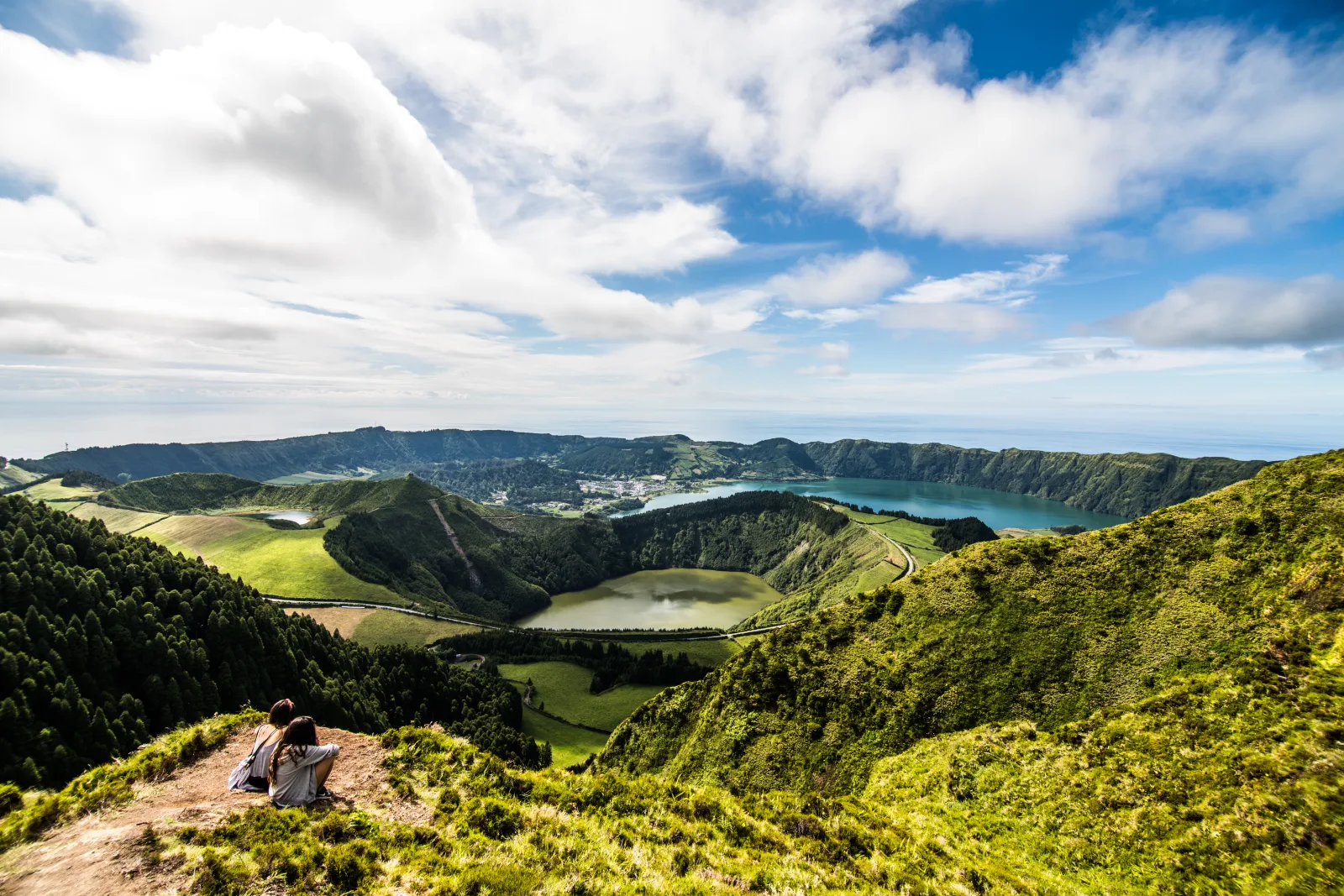
The best photo at Sete Cidades, and not the one most people stop for. Boca do Inferno (“Mouth of Hell”) sits south of the better-known Vista do Rei and frames both lakes plus the village in a single composition, with the rim ridge curving away dramatically in the distance.
Getting there: park at the small pull-off marked “Lagoa do Canário / Boca do Inferno” on the EN9-1A. From the parking, it’s a flat 15-minute walk through eucalyptus and laurel forest to the viewpoint. Wear closed shoes — the path can be muddy after rain (which is most of the time).
This one is a quick hit: budget 30–45 minutes from leaving your car to back at it.
2. Vista do Rei
The classic. Vista do Rei is where you’ll see the photo that made you want to come. It’s right on the road, easy to reach, and the view does live up to the postcard — but it gets crowded and the angle is slightly less interesting than Boca do Inferno.
Don’t miss the abandoned hotel. The Monte Palace, an enormous 1980s luxury hotel that opened, failed, and was abandoned within two years, sits at Vista do Rei in a state of artistic decay. Walking through its empty corridors and looking out over the lakes from its broken upper floors is an experience that stays with you. Officially you’re not supposed to enter — practically everyone does and there are no fences. Use your judgment, watch your footing, and don’t go alone after dark.
3. Miradouro da Grota do Inferno
Slightly off the main loop on the southern side of the caldera, this viewpoint gives you a side-on perspective most visitors never see. The crater spreads out below you and you can usually pick out the church tower in the village. Reliably quiet, even in peak August.
4. Lagoa do Canário
Technically this is a separate small lake just outside the main caldera, but the viewpoint here is one of the best in the area and almost no tour bus stops. From the parking area you walk maybe 100 meters to a wooden platform overlooking a smaller, perfectly round green lake surrounded by hydrangeas in summer.
This is the spot to come back to when Sete Cidades itself is fogged in.
Inside the crater: the village and the lake shore
Most visitors only see Sete Cidades from above. That’s a mistake. The drive down into the caldera is worth the detour for two reasons:
- You realize the scale. The lakes are bigger than they look from the rim — Lagoa Azul alone is about 300 hectares.
- There’s a real working village down there. It has a church, a couple of cafés, a small shop, and the kind of slow rhythm Ponta Delgada lost decades ago.
Park near the lakeside picnic area (there’s a free lot signposted from the main road through the village). From there you can walk along the lake shore, cross the small stone bridge between Verde and Azul, and reach the kayak rental hut (open roughly May to October, around €10–€15 for an hour).
If you’re hungry, Green Love is the village’s standout — a casual lunch spot serving local produce and fish, with seating overlooking the lake. Cash is fine, card is fine, busy on weekends.
How long do you need at Sete Cidades?
| Time available | What you can realistically do |
|---|---|
| 2 hours (drive-by) | Vista do Rei + one other viewpoint. You’ll get the photo and leave. |
| Half day | Boca do Inferno walk, Vista do Rei (with the abandoned hotel), drive into the village, lake-shore walk. This is the sweet spot for most travelers. |
| Full day | Add the rim hike (parts of it — the full loop is ~12 km), kayaking on the lake, lunch in the village, plus Mosteiros on the way back for sunset. |
Most travelers underestimate it and budget two hours. Block half a day. The Azores rewards slowness.
The rim hike (for hikers)
If you’re walking-fit and the weather is cooperating, the PR03 trail is the Sete Cidades hike. It runs along the western edge of the rim from Vista do Rei south, with the entire caldera dropping away below you on one side and the Atlantic Ocean on the other. You can do as much or as little of it as you want and turn back any time — but the first 3 km are the most scenic and take about an hour each way.
Practical notes:
- Wind on the rim is strong, even when it’s calm in the village
- Bring a layer — it’s a noticeably cooler microclimate than the coast
- There’s no shade and no water, so plan accordingly
- Trail markers are red-and-yellow stripes on rocks and posts
Mistakes to avoid
- Going at midday. I cannot say this enough. Tourists arrive at 1pm, see fog, and post a sad photo on Instagram. Be at the rim before 10am.
- Skipping the village. Most people only see Sete Cidades from above. The view from the lake shore looking up at the rim is the other half of the experience.
- Trusting the Ponta Delgada weather forecast. Sete Cidades is its own microclimate. Look at Sete Cidades-specific webcams (there’s one at the church) or just go and see.
- Doing it on a Sunday in summer. Local Azoreans go to Sete Cidades on Sundays. Combined with tour buses, the popular viewpoints can feel crowded. Tuesday or Wednesday is calmer.
- Forgetting a swimsuit. The lake water is fresh, calm, surprisingly warm in August, and you can walk in from the village shore.
A copy-and-paste half-day Sete Cidades guide
Here’s exactly how I’d do Sete Cidades on a typical day from Ponta Delgada:
07:30 — Leave Ponta Delgada (it’s about 30 minutes by car). 08:00 — Park at the Boca do Inferno / Lagoa do Canário pull-off. Walk 15 minutes in to Boca do Inferno. Stay for 20 minutes. 09:00 — Quick stop at Lagoa do Canário viewpoint on the way back. 09:30 — Vista do Rei. Walk into the abandoned Monte Palace hotel (carefully). Stay 30–40 minutes. 10:30 — Drive down into the caldera. Park near the village picnic area. 11:00 — Walk the lake shore between Lagoa Verde and Lagoa Azul. Cross the bridge between them. 12:00 — Lunch at Green Love in the village. 13:30 — Either drive on to Mosteiros for the coast, or kayak for an hour, or head back to the rim for the rim hike if the weather is still cooperating.
That’s a half-day that hits the highlights without rushing. Add Mosteiros + a sunset stop and it becomes a full day.
Guided versions of these trails are bookable online, which is the simpler option if you’d rather not sort out transport to the trailhead yourself:
What to do next
- Planning a full São Miguel trip? The 5-day São Miguel itinerary builds Sete Cidades into a full week and shows you how to sequence it with Furnas, Lagoa do Fogo, and the east coast without backtracking. Short on time? The 3-day itinerary covers just the essentials. Not sure how long to go for? The São Miguel itinerary guide compares the 3, 4, 5 and 7-day plans.
- The other must-do on São Miguel is Furnas — the volcanic village where lunch cooks underground and the hot springs are 38°C year-round. Do Sete Cidades and Furnas on separate days (they’re on opposite ends of the island).
- For the third great caldera, see the Lagoa do Fogo guide — São Miguel’s most pristine lake, with a white-sand beach you can hike down to.
- When to come for the best weather? The best time to visit the Azores guide goes month by month. The morning timing rule for Sete Cidades applies year-round, but summer gives you the widest clear window.
- For more off-the-beaten-path spots near Sete Cidades, see the São Miguel hidden gems — including Poço Azul, a natural blue pool hidden in a ravine nearby.
- For the rest of the island’s miradouros, the São Miguel viewpoints guide maps the best of them beyond the Sete Cidades rim.
- And if you’d rather not assemble all this yourself, Pocket Guide Azores builds the optimized day-by-day itinerary for you — pick the spots, get the plan.
Sete Cidades is one of the most photographed places in Portugal. Done right, it lives up to that. Done wrong, it’s a foggy parking lot. Now you know how to do it right.
Frequently asked questions
What is the best viewpoint at Sete Cidades? +
Vista do Rei is the most famous, but Boca do Inferno is the better photograph — it sits a 15-minute walk from the parking pull-off and frames both lakes with the village in between. Locals also love Lagoa do Canário, which is closer to Ponta Delgada and almost always less crowded than the main viewpoints.
How long do you need at Sete Cidades? +
Half a day is the realistic minimum to see the main viewpoints (Vista do Rei, Boca do Inferno, Miradouro da Grota do Inferno) and walk down to the village or lake shore. A full day lets you add the abandoned Monte Palace hotel, the rim hike, and a swim or kayak on the lake.
When is the best time of day to visit Sete Cidades? +
Early morning (before 10am) is the single most important rule. The caldera fills with cloud almost daily by midday — you can drive there with a clear sky in Ponta Delgada and arrive to find the lakes completely hidden. If the morning is overcast, try again two hours later: weather changes fast in the Azores.
Are the two lakes at Sete Cidades really different colors? +
Yes, but the dramatic contrast you see in photos is exaggerated by certain light conditions. The green lake (Lagoa Verde) and the blue lake (Lagoa Azul) genuinely have different hues because of differences in depth, mineral content, and surrounding vegetation reflecting onto the water — but on a flat, cloudy day they can look almost identical. Sun angle is what makes the photos pop.
Can you swim in Sete Cidades? +
Yes, both lakes are open for swimming and there's a small lakeshore area in the village with calm, shallow water. Kayak rentals are available in the village (typically May–October) and you can paddle between the two lakes through the narrow channel that connects them.
Do you need a car to visit Sete Cidades? +
Realistically, yes. There is a bus from Ponta Delgada but it runs only a few times a day and doesn't stop at any of the viewpoints — only the village. A car (or a tour) lets you actually see the caldera from the rim, which is the whole point. Most rental car companies in Ponta Delgada offer day rentals around €70–€80.