
Also available in Português
Lagoa do Fogo: How to Hike It Without the Cloud Cover
A local's guide to the Lagoa do Fogo hike on São Miguel — the Praia trail to the lake, the timing trick for clear views, and the mistakes most visitors make.
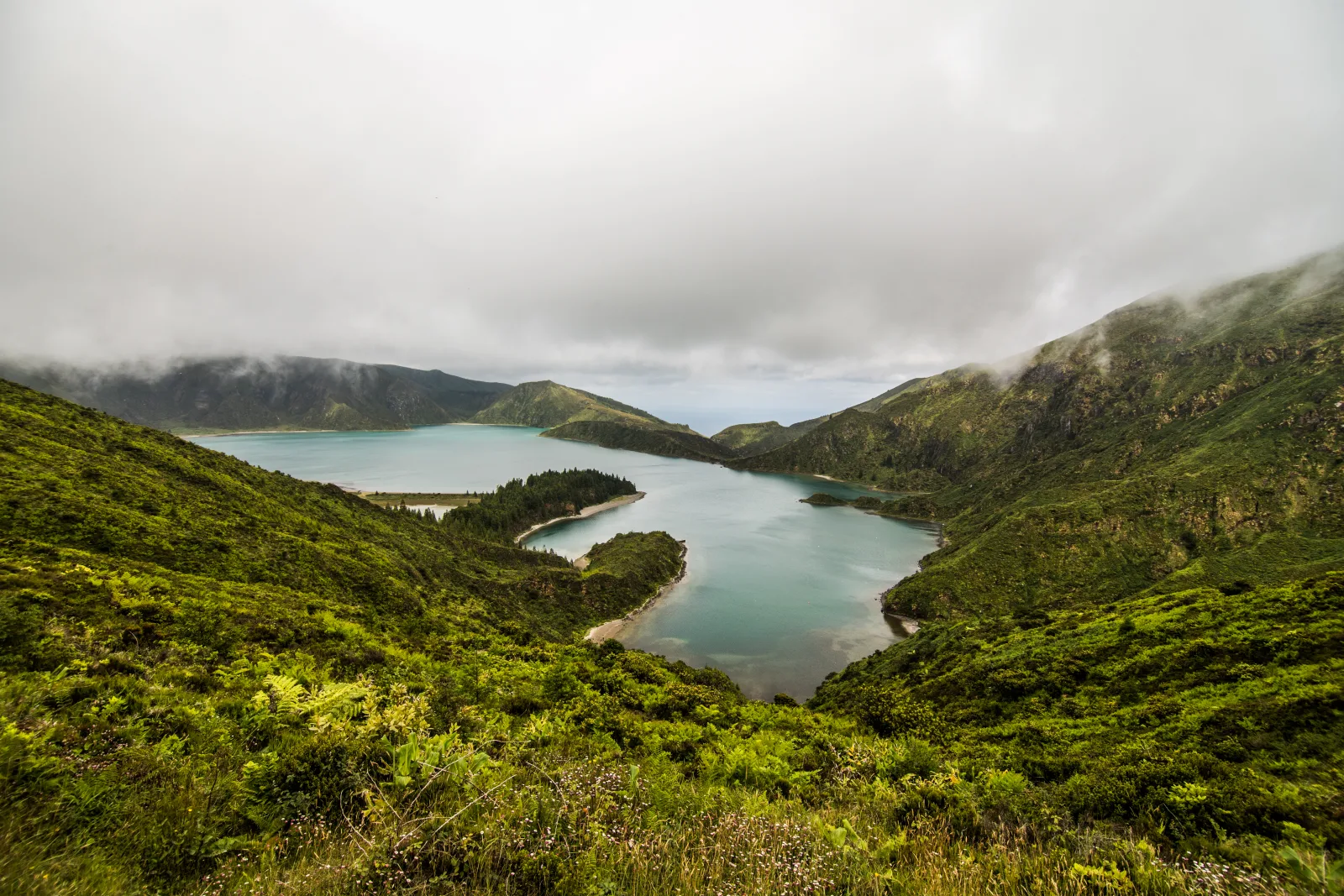
The Lagoa do Fogo hike drops 300 metres from the rim down to a white-sand beach inside one of São Miguel’s most pristine volcanic lakes. It’s also the hardest of the island’s three great calderas to actually see — the basin sits at 575m and makes its own weather even more aggressively than Sete Cidades or Furnas. Tourists drive up at noon, see a wall of white nothing, and drive away.
The locals’ secret for the Lagoa do Fogo hike is simple: go early, go fast, and have a backup plan. Here’s how.
What is Lagoa do Fogo?
Lagoa do Fogo (“Lake of Fire”) is a crater lake inside the Água de Pau stratovolcano in the center of São Miguel. The caldera is about 3 km wide, the lake sits at the bottom surrounded by steep green walls, and there’s a small white-sand beach at the southern end that you can hike down to. It was classified as a Nature Reserve in 1974, which is why there’s no development around it — no cafés, no facilities, no nothing. Just the lake, the crater, and the clouds.
That pristine quality is what makes it special. Sete Cidades has a village, roads, and Instagram crowds. Lagoa do Fogo has silence.
When should you hike Lagoa do Fogo?
Lagoa do Fogo is the most cloud-prone of São Miguel’s lakes. The caldera is higher and more exposed to Atlantic moisture than Sete Cidades, so the cloud-filling effect is faster and more frequent.
The rule: be at the viewpoint before 9am. If you can manage 8am, even better.
By 10-11am on most days, cloud has poured over the rim and pooled inside the caldera. The lake vanishes. You’re standing at a viewpoint looking at grey cotton. This happens year-round, though summer mornings give you a wider window.
The backup rule: if you arrive and it’s cloudy, don’t leave immediately. Lagoa do Fogo’s clouds are unstable — they can clear for 10-15 minutes, give you a sudden perfect view, then close again. Wait 20-30 minutes. If it’s still solid cloud after that, go do something else and try again in the afternoon (the caldera sometimes clears again around 3-4pm, especially in summer).
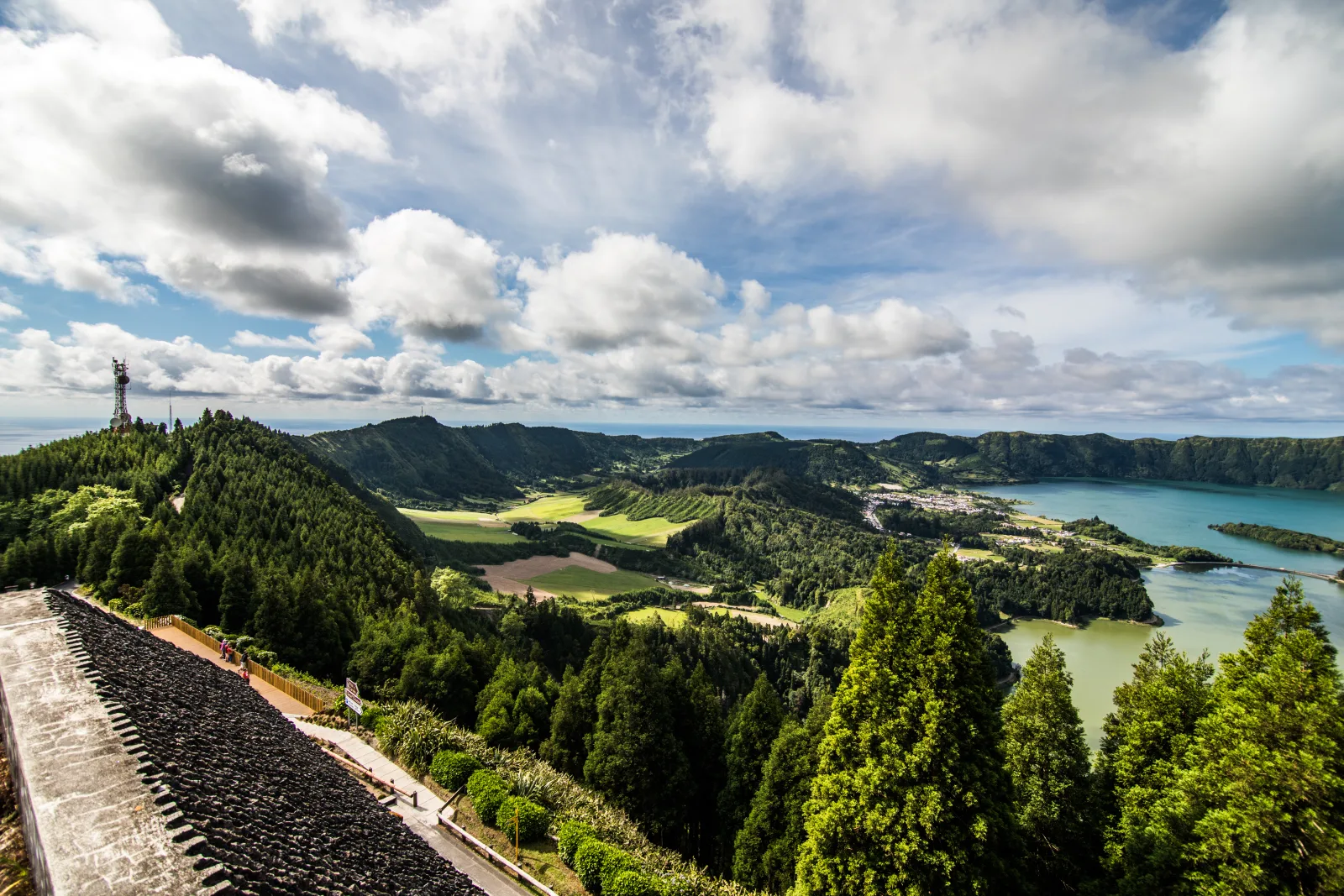
The main hike: Praia trail (PR02)
This is the hike that justifies the trip. The Praia trail descends from the rim to the lake shore — specifically to a small white-sand beach at the bottom that feels like it shouldn’t exist inside a volcanic crater.
Trail details
| Metric | Value |
|---|---|
| Distance | ~4.5 km (out and back) |
| Elevation change | ~300m descent (and the same back up) |
| Time | ~1 hour down, ~1.5 hours up |
| Difficulty | Moderate — steep in places, loose gravel, not technical |
| Markings | Red-and-yellow trail markers (PR02) |
What to expect
The trail starts from a small parking area about 1 km past the main viewpoint (follow signs for “Praia”). The path drops steeply through dense vegetation — laurel, heather, mosses — with the lake appearing and disappearing through the trees as you descend. The last section opens up onto the white-sand beach.
At the bottom:
- The beach is roughly 100m long, white volcanic sand, calm lake water lapping at the edge. On a clear day with no one else there, it’s one of the most beautiful spots on São Miguel.
- Swimming is possible — the water is cold (15-18°C in summer) but clean and safe. No undertow, no waves.
- No facilities. No toilets, no bins, no food, no shade. Bring water, sunscreen, and a bag for your trash.
The climb back
The return hike is the same path uphill. It’s noticeably harder — 300m of elevation gain on a steep trail takes 1.5 hours for most people. Go at your own pace. Bring water.
What to wear
- Proper shoes. Not sandals, not white sneakers. Trail shoes or hiking boots. The path is rocky and can be muddy after rain.
- Layers. The rim is cooler and windier than the lake shore. You’ll warm up on the climb.
- Swimsuit if you want to swim (wear it under your clothes).
- Rain jacket in your pack regardless of the forecast.
The viewpoint (if you don’t hike)
Miradouro da Lagoa do Fogo is a roadside viewpoint about 35 minutes from Ponta Delgada. It gives you the classic aerial view of the lake — the photo you’ve seen in every São Miguel article.
If you’re not planning to hike, the viewpoint is a 5-minute stop. Park, walk to the railing, take the photo, leave. It’s spectacular on a clear day and completely pointless on a cloudy one.
The viewpoint parking lot is small (maybe 15 cars) and fills up by 10am in summer. Another reason to go early.
Combining Lagoa do Fogo with Caldeira Velha
Caldeira Velha is a thermal spring in a forest setting, about 20 minutes downhill from Lagoa do Fogo on the road toward Ribeira Grande. It’s the most natural-feeling hot spring on São Miguel — a hot waterfall you can stand under, plus a small thermal pool, all surrounded by tree ferns and tropical vegetation.
The natural half-day combo:
08:30 — Drive from Ponta Delgada to Lagoa do Fogo viewpoint 09:00 — Viewpoint photos (if clear) 09:30 — Drive to Praia trailhead, start hiking down 10:30 — Beach / swim / picnic 11:30 — Hike back up 13:00 — Drive to Caldeira Velha (20 min) 13:30 — Hot spring soak (1-1.5 hours) 15:00 — Drive back to Ponta Delgada or onward to afternoon plans
This is Day 4 in our 5-day São Miguel itinerary — the interior day.
What the Lagoa do Fogo hike actually feels like
The descent is short on the map and long in your legs. The first ten minutes are gentle — paved sections, easy switchbacks, mossy laurel arching overhead. Then the trail drops sharply through volcanic gravel that wants to carry your feet downhill faster than the rest of you. This is where most twisted ankles happen. Slow down.
About a third of the way down the lake appears through gaps in the trees. By halfway you’re below the cloud line on most days, even when the rim is socked in white. The temperature noticeably drops a few degrees, the air smells of damp leaves, and the only sound is your own breathing and the occasional rustle of a Cory’s shearwater overhead.
The last section opens onto a flat ridge that runs out to the white-sand beach. The first time you see the lake at eye level is the moment that justifies the trip. The water is glassy on calm days, faintly blue rather than the bright postcard turquoise of Sete Cidades, and so still it reflects the crater walls inverted onto its surface.
Lagoa do Fogo hike vs. the other São Miguel lakes
People ask me which of the three to prioritise. The honest comparison:
| Aspect | Sete Cidades | Furnas | Lagoa do Fogo |
|---|---|---|---|
| Hike effort | Low (rim road) | Low (lake walk) | Moderate (300m down) |
| Solitude | Low | Medium | High |
| Cloud risk | High | Medium | Highest |
| Photogenic | Highest | Medium | High |
| Swimming | Permitted | Not allowed | Permitted |
If you only have one day and you’ve never seen a volcanic crater from above, Sete Cidades wins on impact. If you want a complete day with food and culture mixed in, Furnas. If you want the experience that feels closest to wilderness — where you can sit on a beach inside a crater for an hour without seeing another person — the Lagoa do Fogo hike is the one. None are interchangeable.
The Lagoa do Fogo hike is also the only one of the three where you’ll genuinely earn what you see. The other two reward arriving early. This one rewards arriving early and walking down.
Seasonal patterns for the Lagoa do Fogo hike
The trail is open year-round but the experience varies sharply.
June to September is the easiest window. Trails are dry, the beach is reachable, the water is just barely swimmable (around 17°C), and the rim is clear before 9am most days. Crowds peak in August — go on a weekday and arrive by 8am to find the trailhead lot empty.
April, May, October are the local favourites. The crater walls are at their greenest, the cloud window stretches an hour later, and you can often have the beach completely to yourself. Light rain is more frequent but the trail handles it well.
November to March is for the patient. Rain can render the path slippery and the loose gravel sections genuinely tricky. On a clear winter morning the visibility is extraordinary — you can sometimes see all the way to Pico from the rim — but those mornings are rare. Bring trekking poles, accept that 1 in 3 attempts will end at a fogged-out viewpoint, and treat any clear day as a gift. Local advice: pair a winter visit with Furnas, where bad weather doesn’t matter (the hot springs work in any conditions).
The full caldera rim trail
For stronger hikers, the caldera rim trail follows the ridge around the top of the crater. It’s about 11 km, takes 3-4 hours, and offers views in every direction — the lake below, the Atlantic to the north and south, and on very clear days, the peaks of Sete Cidades to the west.
This is a more serious hike: exposed ridgeline, wind, no shade, and potentially slippery in wet conditions. It’s not dangerous but it requires proper fitness and gear. Don’t do it if clouds are forming — you’ll be walking in fog on a narrow ridge.
What to bring on the Lagoa do Fogo hike
The trail is short by hiking standards — 4.5 km out and back — but the lack of facilities at either end means you carry everything you need. The local packing list:
- One litre of water per person, minimum. Two if it’s hot or you plan to stay long.
- A real lunch or snacks. No food anywhere on the trail or at the lake. The closest café is back near the viewpoint and closes early.
- A small dry bag. If you swim, your clothes need somewhere safe to sit on the beach. The gravel at the high-water line gets slightly damp.
- Cash. Not for the trail (no fees), but for parking on busy days and a coffee back at Caldeira Velha after.
- A printed map or offline route. Cell signal cuts out below the rim for stretches of 5–10 minutes. The PR02 markers are clear, but a backup is sensible.
- Sunscreen and a hat. The beach has zero shade. Mid-summer sessions feel longer than expected.
- A bin bag. Carry out everything you bring in. Locals have noticed a slow buildup of foreign-language wrappers near the beach over the last two years. Don’t add to it.
The single thing most people forget is the climb-back snack. By the time you’re 200 metres of elevation back up the trail, that one banana or handful of nuts feels worth more than any view at the top.
Mistakes to avoid
- Going at noon. The #1 mistake. Cloud fills the caldera by late morning. Go before 9am.
- Wearing sandals on the Praia trail. The descent is steep, rocky, and sometimes muddy. You need closed shoes with grip.
- Not bringing water. There’s nothing at the lake — no taps, no shops, no vending machines. Bring at least 1 liter per person.
- Skipping the hike and only doing the viewpoint. The viewpoint is a 5-minute stop. The lake shore is the real experience. If you drove 35 minutes up the mountain, commit to the hike.
- Planning Lagoa do Fogo and Sete Cidades on the same day. Both need clear mornings and both are on opposite sides of the island. Two separate days.
Guided versions of these trails are bookable online, which is the simpler option if you’d rather not sort out transport to the trailhead yourself:
Is it worth it?
If you get a clear view — absolutely yes. Lagoa do Fogo is the most pristine of São Miguel’s lakes and the Praia beach is genuinely one of the island’s hidden treasures. Combined with Caldeira Velha, it’s the best half-day on the island.
If you get socked in — drive down to Furnas instead (hot springs work in any weather) and try Lagoa do Fogo the next morning. Flexibility is the whole game in the Azores.
For a plan that sequences Lagoa do Fogo with the rest of São Miguel’s highlights and accounts for weather flexibility, Pocket Guide Azores builds it automatically — pick the spots, get the itinerary.
Frequently asked questions
Is the Lagoa do Fogo hike difficult? +
The main Praia trail (PR02) down to the lake shore is moderate — about 1 hour down and 1.5 hours back up, 4.5 km total with 300m elevation change. The descent is steep on loose gravel in places but not technical. Anyone with basic fitness and proper shoes can do it. The full caldera rim trail is longer (11 km) and more demanding.
What is the best time of day to visit Lagoa do Fogo? +
Early morning, before 10am. Lagoa do Fogo is even more cloud-prone than Sete Cidades — warm air from the coast rises and fills the caldera by late morning most days. Arrive at the viewpoint by 8:30-9:00am for the best chance of clear water views. If it's cloudy when you arrive, wait 30 minutes — the clouds can clear and return repeatedly.
Can you swim in Lagoa do Fogo? +
Yes. The Praia trail leads to a white-sand beach at the lake shore where swimming is permitted. The water is cold (15-18°C in summer, colder in winter) but clean and calm. There are no facilities — no changing rooms, no lifeguard, no food. Bring everything you need and carry out your trash.
How do I get to Lagoa do Fogo? +
Drive from Ponta Delgada toward Ribeira Grande (north coast), then follow signs for Lagoa do Fogo up the EN5-2A mountain road. The main viewpoint (Miradouro da Lagoa do Fogo) is about 35 minutes from Ponta Delgada. The Praia trailhead is a separate parking area about 1 km past the viewpoint. Both have small free parking lots that fill up by mid-morning in summer.
Is Lagoa do Fogo worth it if it's cloudy? +
The viewpoint is not — you'll see nothing. But the Praia hike down to the lake is still worth it even in light cloud, because you descend below the cloud layer and can see the lake from the shore. Heavy fog makes the trail less rewarding. Check the webcam or drive up to the viewpoint first; if you can see the lake at all, the hike is worthwhile.
How long do you need at Lagoa do Fogo? +
2-3 hours for the viewpoint and the Praia hike down to the lake and back. Add 1 hour if you want to swim or have a picnic on the beach. The full caldera rim trail is 3-4 hours. Most visitors combine Lagoa do Fogo with Caldeira Velha (20 minutes away) in a half-day.