
Also available in Português
Hidden Gems of São Miguel: 12 Spots Locals Actually Visit
A local Azorean's 12 São Miguel hidden gems — secret viewpoints, quiet beaches, fish restaurants, and the spots that never make standard Azores guidebooks.
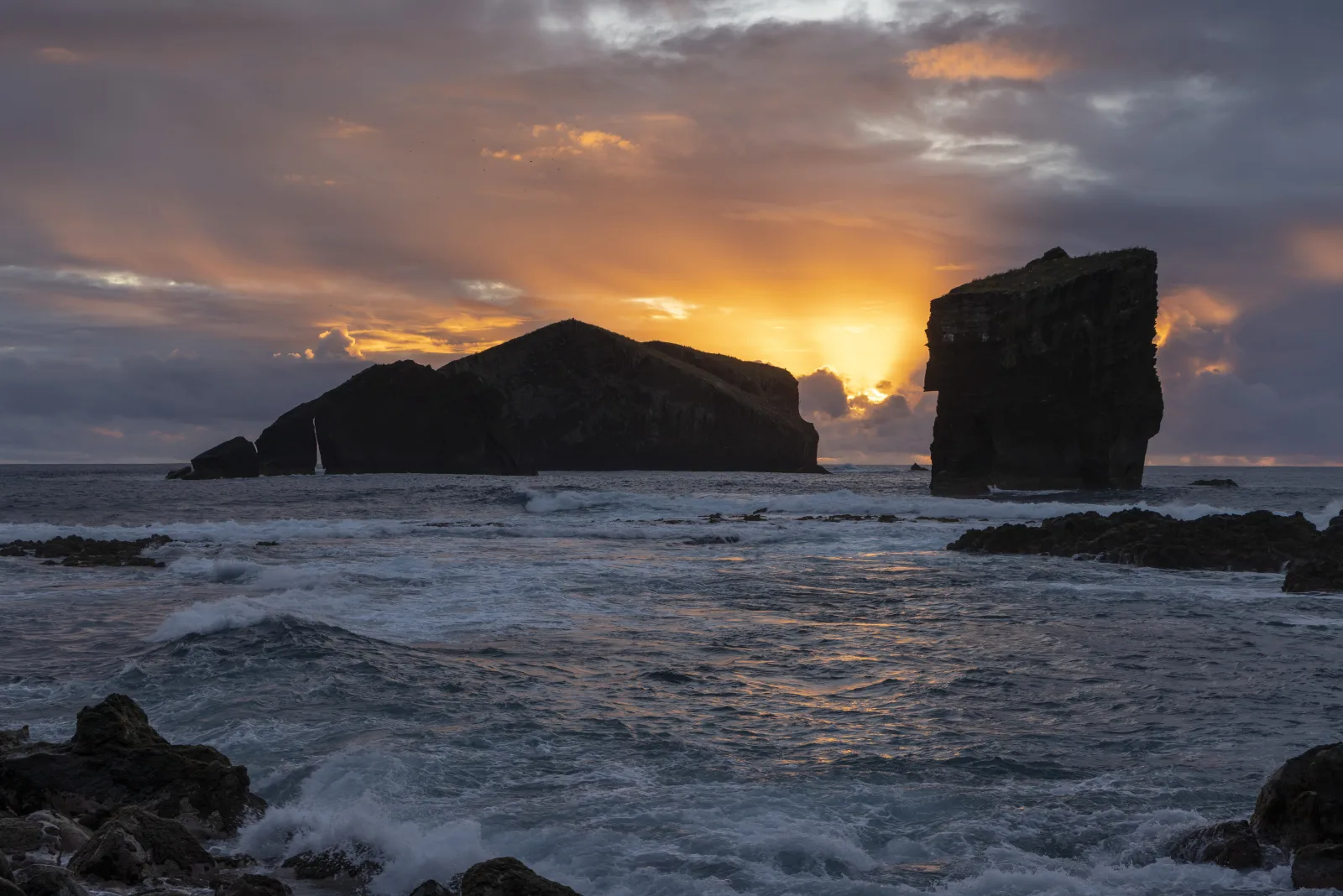
Every São Miguel article gives you the same list of headline spots: Sete Cidades, Furnas, Lagoa do Fogo, Ponta Delgada. They’re all worth seeing — we wrote full guides for Sete Cidades, Furnas, and Lagoa do Fogo. But this list is the São Miguel hidden gems version — the island is bigger than its three volcanic lakes, and the places locals actually go on a Sunday afternoon almost never make the tourist lists.
These are 12 São Miguel hidden gems. Not obscure — locals know every one. Just overlooked by the standard tourist itinerary.
1. Bar Caloura (cliff restaurant + sea pool)
A fish restaurant built into the cliff face in Caloura, a tiny coastal village about 20 minutes east of Ponta Delgada. The restaurant sits right above a natural swimming pool carved into the volcanic rock — you can swim before or after your meal. The fish is grilled fresh, the portions are huge, the prices are local, and on a weekday afternoon you might be the only tourists there.
Why it’s a hidden gem: Most visitors eat in Ponta Delgada or Furnas and never make it to the south coast villages. Bar Caloura is where Ponta Delgada locals go for a Sunday fish lunch. No Instagram hype, no tourist marketing.
How to go: Drive to Caloura, park near the church, walk down to the coast. The restaurant is signed. Cash and card accepted. No reservations needed outside August.
2. Poço Azul (the blue pool nobody mentions)
A small natural pool fed by a waterfall, hidden in a ravine near Sete Cidades. The water is a striking blue-green color from the volcanic minerals. Getting there requires a short walk (~20 minutes) on a trail that isn’t well-marked — ask at the Sete Cidades village café for directions, or search for “Poço Azul São Miguel” on Maps.
Why it’s a hidden gem: It’s not on any official tourism website. No signage, no parking lot, no entrance fee. Just a pool in a forest that locals swim in.
Note: Water level varies with rainfall. It’s best in spring and early summer when the waterfall is full.
3. Pico do Carvão (viewpoint over both coasts)
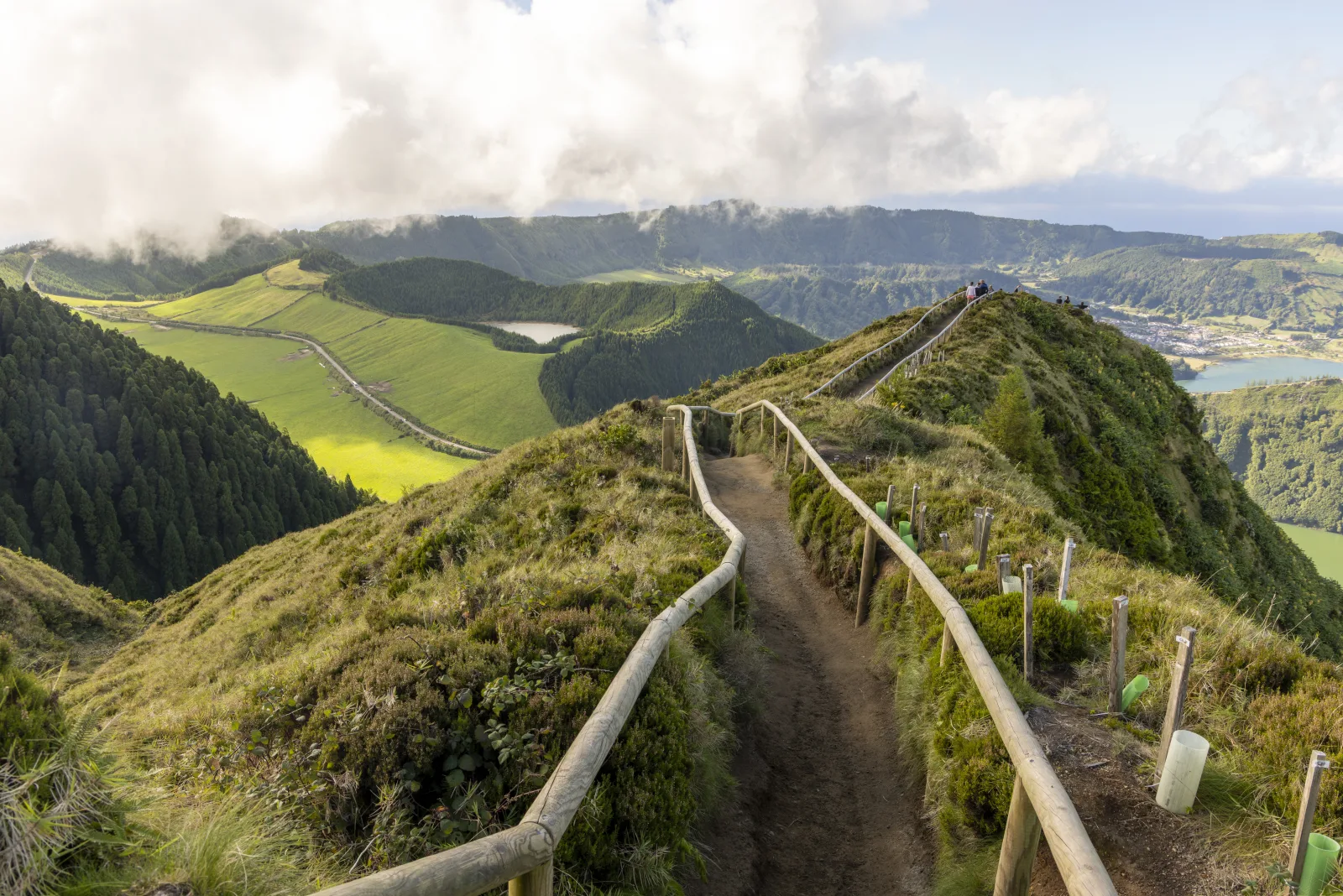
A small viewpoint on the central mountain spine of São Miguel where you can see the north and south coasts simultaneously. On a clear day, you’re standing on the narrow ridge that divides the island, with the Atlantic visible on both sides.
Why it’s a hidden gem: It’s a roadside stop on the EN1-1A between Ponta Delgada and Ribeira Grande, but almost nobody stops because it’s not a “named” attraction. No parking fee, no facilities, just a small pull-off with a spectacular view.
Best time: Morning, before clouds form on the ridge. Combine it with a drive to Lagoa do Fogo (10 minutes further).
4. Faial da Terra and Salto do Prego waterfall
A quiet village on the southeast coast and the starting point for the Salto do Prego waterfall trail — a 40-minute walk through subtropical forest to a 20-meter waterfall with a swimmable pool at the base. The trail follows a river through endemic Azorean vegetation and feels genuinely remote.
Why it’s a hidden gem: It’s a 1-hour drive from Ponta Delgada, which puts it beyond most day-trippers’ range. The village itself is beautiful — stone houses, terraced farmland, almost no tourism infrastructure.
Trail details: ~3 km each way, flat to moderate, well-marked but can be muddy. Allow 2-3 hours round trip including time at the waterfall. Wear closed shoes.
5. Mosteiros at sunset (the village, not the viewpoint)
Most visitors see Mosteiros as a quick sunset stop on the way back from Sete Cidades. That’s fine, but the village itself deserves more time. Walk the seafront, explore the natural sea pools (volcanic rock pools filled by the tide — swimmable at low to mid tide), and have dinner at Restaurante Rocha (the terrace faces directly west over the ocean and the volcanic rock stacks).
Why it’s a hidden gem: Mosteiros the sunset is famous. Mosteiros the village — with its sea pools, local restaurants, and slow fishing-village rhythm — is overlooked.
Tip: Go on a weekday. Weekends in summer bring local families from Ponta Delgada.
6. Lomba de São Pedro (the viewpoint nobody visits)
A small miradouro on the south coast, between Ponta Delgada and Vila Franca do Campo. No signage on the main road, no tourist parking, no reviews on TripAdvisor. Just a viewpoint over terraced farmland falling away to the ocean, with Ilhéu de Vila Franca visible in the distance.
Why it’s a hidden gem: It’s not on any “top viewpoints” list because it doesn’t overlook a volcanic lake. But the composition — fields, ocean, islet — is uniquely Azorean and rarely photographed.
7. Ribeira Grande (the other town)
Everyone stays in Ponta Delgada. Almost nobody explores Ribeira Grande, the island’s second town on the north coast. It has a genuine downtown with a pedestrianized main street, local shops, good cheap restaurants, a dramatic town beach with black sand, and the Teatro Ribeiragrandense (a tiny 19th-century theater that still hosts performances).
Why it’s a hidden gem: It’s 20 minutes from Ponta Delgada but feels like a different island. No tourist infrastructure, no souvenir shops, just a working Azorean town.
Best for: A lunch stop on the way to or from Lagoa do Fogo. Try Anfiteatro for generous local food.
8. The Sanguinho abandoned village
A former hamlet deep in the forests above Faial da Terra that was abandoned in the 1960s when residents moved to the coast. The stone houses are still standing, overgrown with moss and ferns, in a clearing surrounded by dense laurel forest. Walking through it feels like discovering something.
How to visit: It’s on the same trail system as Salto do Prego (see #4). Some hikers do a loop: Faial da Terra → Sanguinho → Salto do Prego → back. Allow 3-4 hours for the full loop.
9. Lagoa do Congro (the hidden lake)
A small, perfectly round crater lake hidden in a forest about 20 minutes from Furnas. No roads reach it — you walk in on a trail (~25 minutes one way) through dense vegetation, and suddenly the trees open up and there’s a green lake in a crater below you.
Why it’s a hidden gem: It’s not Lagoa do Fogo and it’s not Sete Cidades, so it doesn’t make the highlight lists. But its smallness and quietness are the point. On most days you’ll have it to yourself.
Combine with: A Furnas day. The trailhead is between Ponta Delgada and Furnas on the EN2-1A.
10. Ponta da Ferraria at low tide
Listed in some guides as a “thing to do” but rarely explained properly. Ponta da Ferraria is a thermal spring that meets the ocean — hot volcanic water bubbles up where the rocks meet the sea, creating a natural pool that’s warm at low tide and cool at high tide.
The secret: Most visitors go at the wrong time. The pool is only genuinely hot (bath-temperature) in the 2 hours around low tide. At high tide, cold ocean water floods in and it’s just a regular rock pool. Check the tide chart before you go. There are steps and a rope to help you climb in — the rocks are slippery.
Best time: Late afternoon low tide in summer + sunset from the rocks above.
11. Cerâmica Vieira (the pottery workshop)
A family-run pottery workshop in Lagoa (10 minutes from Ponta Delgada) that’s been making traditional Azorean ceramics since 1862. You can watch the potters work, browse the showroom, and buy pieces directly. The style — blue-and-white floral patterns on local clay — is distinctively Azorean.
Why it’s a hidden gem: It’s an actual working factory, not a tourist attraction. No entrance fee, no guided tour, just walk in during business hours and browse. The prices are a fraction of what souvenir shops in Ponta Delgada charge for the same ceramics.
12. The milk-fed beef at any local ‘churrasqueira’
São Miguel produces some of the best beef in Portugal — the cows graze on volcanic grassland in a mild, wet climate that keeps the pastures green year-round. Most tourists eat beef at upscale Ponta Delgada restaurants and pay upscale prices.
The local move: Find a churrasqueira (grill house) in any smaller town — Ribeira Grande, Lagoa, Vila Franca do Campo, Nordeste. Order bife à regional (regional steak, usually served on a hot stone with garlic butter and a fried egg). €10-€14 for a meal that would cost €25+ in central Ponta Delgada. The quality is the same or better because the meat is local and the turnover is high.
How to fit São Miguel hidden gems into your trip
A quick reference: where each spot sits geographically and how long it really takes to visit.
| Spot | Region | Time needed | Pair it with |
|---|---|---|---|
| Bar Caloura | South coast | 2 hours (lunch) | Caldeira Velha morning |
| Poço Azul | Central highlands | 1 hour | Lagoa do Fogo hike |
| Pico do Carvão | Central interior | 30 min | Sete Cidades drive-back |
| Faial da Terra + Salto do Prego | East coast | Half day | Nordeste loop |
| Mosteiros at sunset | West coast | 90 min | Sete Cidades morning |
| Lomba de São Pedro | North-east | 30 min | Nordeste driving day |
| Ribeira Grande | North coast | Half day | North-coast tea-plantation route |
| Sanguinho village | East coast | Half day | Faial da Terra trail |
| Lagoa do Congro | Central | 90 min | Lagoa do Fogo morning |
| Ponta da Ferraria | Far west | 90 min (low tide!) | Sete Cidades afternoon |
| Cerâmica Vieira | South coast | 30 min | Lagoa lunch stop |
| Local churrasqueira | Anywhere off-tourist | 1 hour (lunch) | Any day’s lunch |
A São Miguel hidden gems day works best built around one anchor spot plus two add-ons — not a marathon of all twelve. The roads between regions are slow on purpose. Tourists who try to hit five hidden gems in a day end up rushing all five and remembering none.
Guided options around here, if you’d rather not piece the logistics together yourself:
The São Miguel hidden gems strategy
São Miguel’s hidden gems aren’t remote or difficult to reach. Most are within 30-45 minutes of Ponta Delgada. They’re “hidden” because the standard tourist itinerary is efficient — Sete Cidades, Furnas, Lagoa do Fogo, done — and most 3-5 day visitors don’t deviate from it.
If you have 5 days or more, sprinkle 2-3 of these into the gaps. The best day for hidden gems is the buffer day — the day you left open for weather flexibility in the 5-day itinerary. If the weather is bad for viewpoints, go to Bar Caloura. If it’s perfect, drive the east coast to Faial da Terra and Sanguinho.
The hidden-gems day also rewards a different rhythm than the big-name itinerary. Sete Cidades and Furnas reward arriving early to beat the crowds. Bar Caloura, Mosteiros at sunset, the local churrasqueiras, and the Sanguinho hike all reward going late — afternoon to evening. Build your hidden-gems day around the back half of the clock, not the front.
A few last practical notes from someone who drives this island most weeks. Refuel before the east coast. Petrol stations are sparser between Furnas and Nordeste, and Sunday hours are a real thing in smaller villages. Pack a swimsuit even in winter. Bar Caloura’s pool, Ponta da Ferraria, and Poço Azul are all viable year-round if the day is clear and you’re flexible about water temperature. Don’t trust Google Maps for the trailheads. Salto do Prego and the Sanguinho trail both have unsigned starting points. Locals can point you to the right path if you ask at any café in Faial da Terra.
And if you want a São Miguel itinerary that weaves these hidden gems into an optimized route alongside the big-name highlights, Pocket Guide Azores knows them all — it’s built by someone who lives here.
For a slower, less-list-shaped take on the same territory, see the São Miguel road trip guide.
Frequently asked questions
What are the hidden gems of São Miguel? +
The best hidden gems on São Miguel include Praia dos Moinhos (a tiny sheltered beach most tourists drive past), Poço Azul (a natural blue pool hidden in a ravine), Pico do Carvão viewpoint (sees both coasts simultaneously), Lomba de São Pedro miradouro, the Faial da Terra waterfall trail (Salto do Prego), the village of Mosteiros at sunset, and several local-only restaurants away from the Ponta Delgada tourist strip.
Where do locals eat on São Miguel? +
Locals eat at places tourists rarely find: Bar Caloura (a cliff-side fish restaurant in Caloura with a natural swimming pool below), Restaurante Rocha in Mosteiros (sunset views, fresh fish, no tourists), Anfiteatro in Ribeira Grande (local crowd, generous portions), and any 'tasca' in the smaller towns. The best food on São Miguel is almost never in central Ponta Delgada.
What is the least touristy part of São Miguel? +
The east coast between Furnas and Nordeste. The villages of Faial da Terra, Povoação, and the Nordeste district see a fraction of the visitors that Sete Cidades and Furnas get. The scenery is just as dramatic (steep cliffs, hidden waterfalls, terraced farmland) but you'll often be the only car on the road.
Are there secret beaches on São Miguel? +
São Miguel isn't a beach island, but there are a few hidden swimming spots: Praia dos Moinhos (a small cove near Caloura), the natural pools at Ponta da Ferraria (thermal ocean pool, best at low tide), the Ilhéu de Vila Franca natural pool (summer only, capacity-limited), and the white-sand beach at the bottom of Lagoa do Fogo (requires a 1-hour hike down). None are secret — locals know them all — but tourists rarely make it to most of them.
Is São Miguel touristy? +
Parts of it are, parts aren't. Sete Cidades, Furnas, and Ponta Delgada's marina area get the most visitors, especially in July-August. But 70% of the island — the east coast, the interior highlands, the small fishing villages — sees very few tourists. Even at peak season, São Miguel is nothing like the Algarve, Barcelona, or the Canary Islands. It's still a genuinely quiet place.