
Also available in Português
Ribeira Grande, São Miguel: A Local's Guide
A local's guide to Ribeira Grande, São Miguel — the historic centre, Gorreana tea, the north-coast surf, Caldeira Velha, and how it fits into your Azores trip.
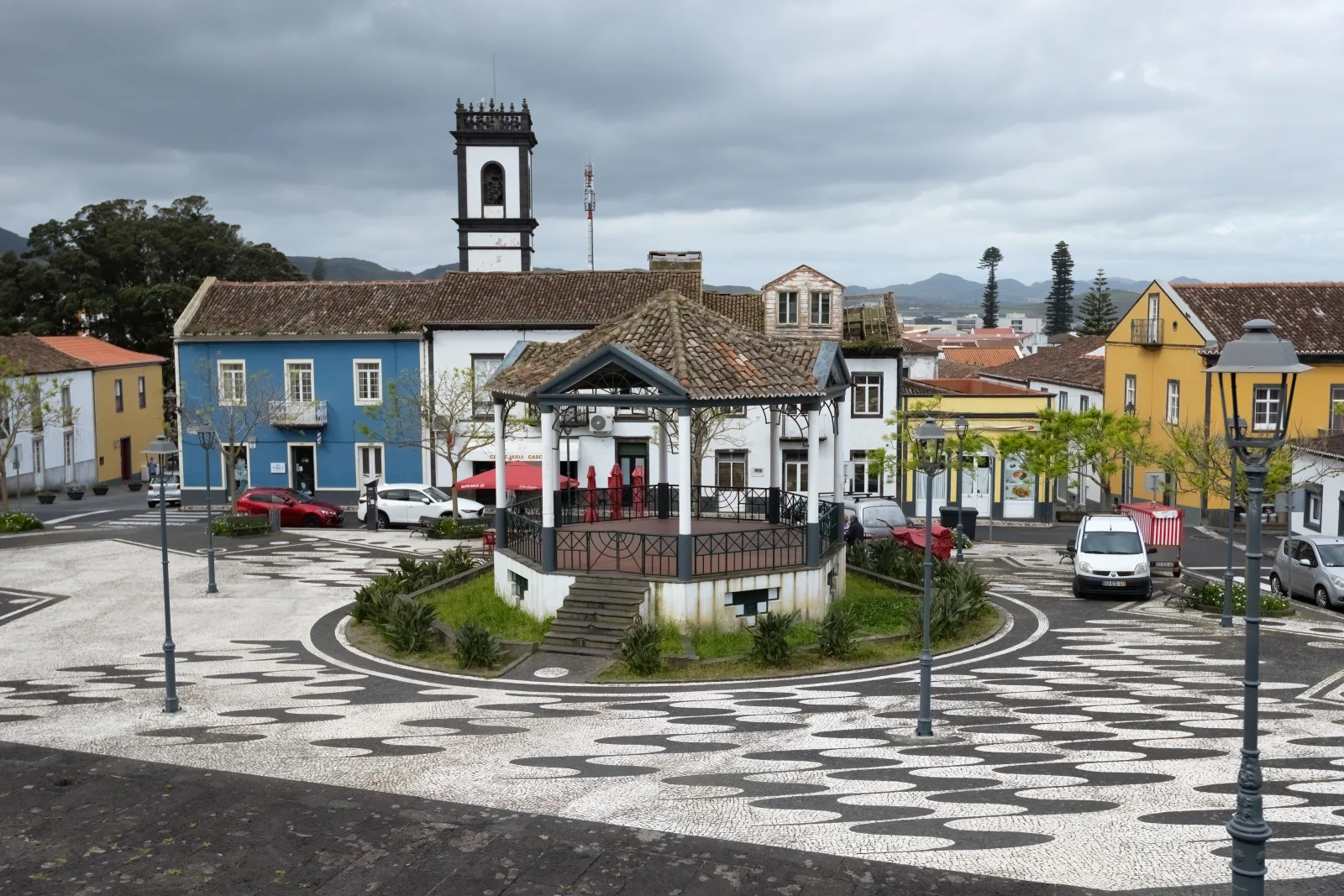
Ribeira Grande is São Miguel’s second town and the gateway to the north coast. I live on São Miguel, and Ribeira Grande is the town I tell visitors to stop in, not just drive through — most people treat it as a junction on the way to the tea plantations or Lagoa do Fogo, and miss that the town itself has the best-preserved historic centre on the island.
This guide covers Ribeira Grande as both a destination and a base — the historic core worth an afternoon, and the cluster of north-coast sights (Gorreana tea, the surf at Santa Bárbara, Caldeira Velha, Lagoa do Fogo) that make it a smart alternative to staying only in Ponta Delgada.
Where Ribeira Grande sits on São Miguel
Ribeira Grande is on the north coast of São Miguel, almost directly opposite Ponta Delgada on the south coast. The two are about 25 minutes apart by car, separated by the central volcanic highlands.
The municipality is the second-largest on the island by population, and the town spreads along a river valley that drops from the highlands to the Atlantic. The river — the ribeira grande that gives the town its name — runs straight through the historic centre, crossed by the landmark eight-arched bridge.
The drive between Ribeira Grande and Ponta Delgada passes Lagoa do Fogo, the crater lake that’s one of the island’s best sights. That alone makes the north-coast town easy to fold into any São Miguel itinerary.
The historic centre
Ribeira Grande has the best-preserved 18th-century townscape on São Miguel. The wealth came from oranges and later from the agricultural economy of the north coast, and it shows in the architecture.
Walk it in this rough order:
Start — Ponte dos Oito Arcos, the eight-arched stone bridge over the river. It’s the town’s signature image and the natural starting point.
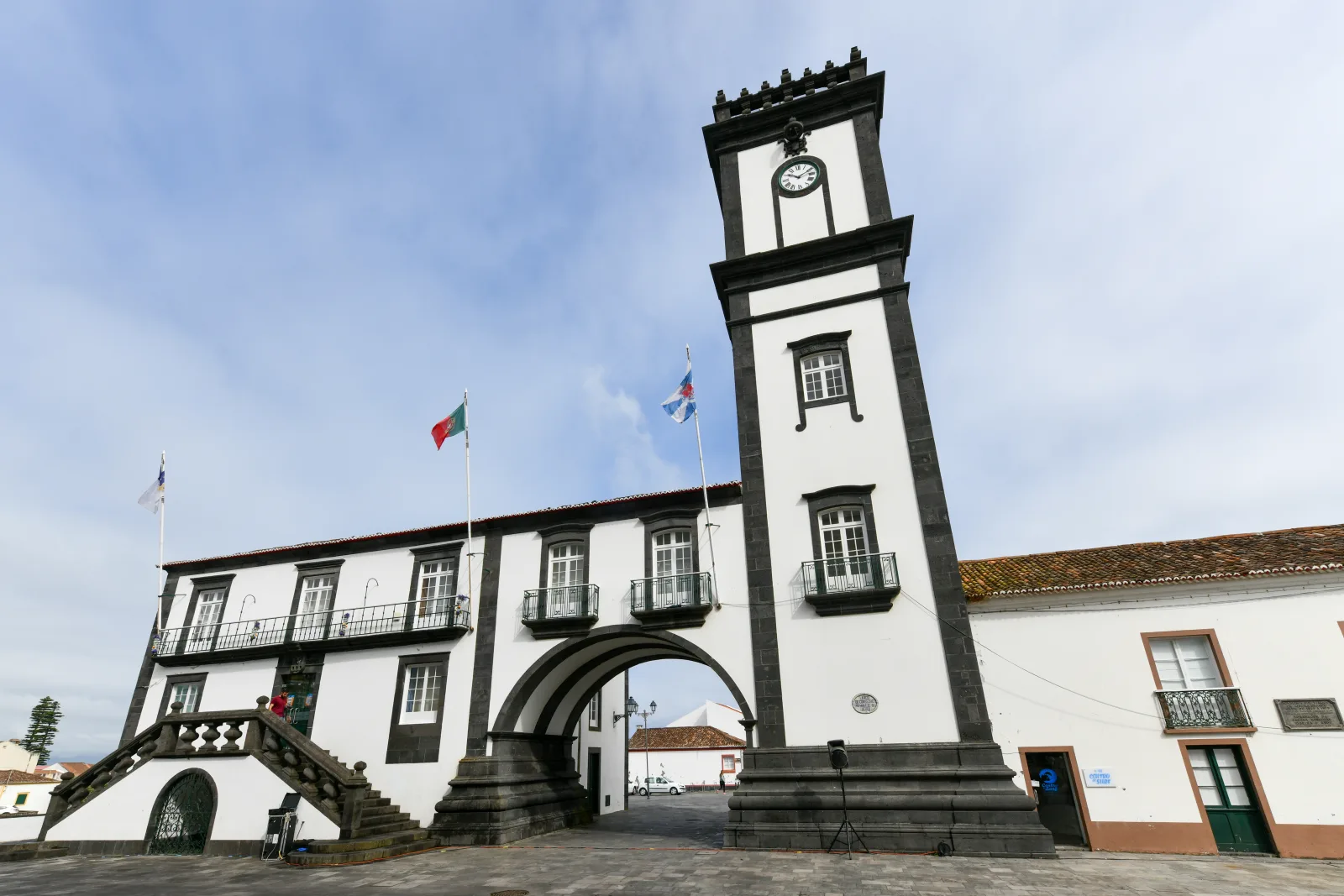
Praça do Município — the town hall square, ringed by 18th-century civic buildings, with the Câmara Municipal (town hall) as the centrepiece.
Igreja de Nossa Senhora da Estrela — the main church, sitting above a grand staircase. The baroque façade is the most photographed building in town.
Igreja do Espírito Santo — a smaller church with a distinctive ornate frontage, a short walk from the main square.
Teatro Ribeiragrandense — the old town theatre, one of the oldest in the Azores, recently restored.
The whole walk is flat, takes about 90 minutes at a relaxed pace, and works well with a coffee stop in one of the squares.
What makes the centre work is that it’s a lived-in town, not a museum. The 18th-century buildings house ordinary shops, the squares fill with locals running errands, and the cafés serve the town rather than the tourist. You get the architecture of a historic centre with the rhythm of a real place — a combination Ponta Delgada’s busier core has partly lost. Mid-morning on a weekday is the sweet spot: the town is awake, the light is good on the church façade, and the coffee terraces are open without being crowded.
Gorreana — the oldest tea in Europe
Ten minutes east of Ribeira Grande on the coastal road is the Gorreana tea plantation — the oldest tea plantation in Europe and one of only two still operating on the continent (the other, Porto Formoso, is a few minutes further along the same road).
Gorreana was founded in 1883 by the Gago da Câmara family. It still covers around 32 hectares and produces roughly 33 tons of tea a year — green and black — using Victorian-era machinery that still runs.
What to do at Gorreana:
- Factory tour — free, self-guided or with staff explanation, walking past the original rolling and drying machines
- Tea tasting — free tea at the end, with the shop selling the plantation’s green and black blends at honest prices
- The tea-field trail — the PRC28 SMI circular walk runs 3.4 km through the tea terraces, about 1.5 hours, easy, starting across the road from the factory
It’s one of the highest-value stops on the island — genuinely interesting, genuinely free, and the landscape of tea terraces rolling toward the Atlantic is unlike anywhere else in the Azores. Go early if you can: the morning light on the terraces is best, and the factory is quieter before the tour buses arrive from Ponta Delgada around mid-morning. A cup of the green tea on the factory terrace, looking out over the rows of tea bushes, is one of those small São Miguel moments that costs nothing and stays with you.
A short history of Ribeira Grande
Ribeira Grande grew on the wealth of the north coast. The town was settled early in São Miguel’s colonisation and quickly became the agricultural counterweight to Ponta Delgada — where Ponta Delgada had the harbour and the trade, Ribeira Grande had the fertile valley land.
The town’s prosperity peaked in the 18th century, built on cereal, flax, and later oranges. The orange trade with northern Europe — particularly Britain — poured money into the town, and that money built the churches, the civic buildings, and the grand staircased façades you walk past today. When the orange economy collapsed in the 19th century (a plant disease wiped out the groves), the town’s building boom stopped almost overnight — which is exactly why the historic centre is so coherently 18th-century. Nothing rich came along to replace it.
The tea industry arrived in the 1880s as one answer to the orange collapse. Gorreana and Porto Formoso both date from this period, when Azorean landowners experimented with crops that could replace citrus. Tea stuck. Pineapple, tobacco, and dairy filled in the rest.
Modern Ribeira Grande is the island’s second municipality and a town that’s slowly being rediscovered — the historic centre has been restored, the surf scene has put Santa Bárbara on the map, and the MEO Monte Verde festival brings tens of thousands to the beach each August. For the wider story of how the Azores developed — the diaspora, the agricultural cycles — see the Azores culture guide.
Porto Formoso and the eastern north coast
Gorreana isn’t the only tea plantation. A few minutes east, Porto Formoso runs a smaller, more boutique tea operation — a restored factory, a guided tour, and a tearoom with a view over the north coast. Visiting both Gorreana and Porto Formoso back-to-back makes a satisfying tea-themed morning, and the contrast between the larger industrial Gorreana and the smaller artisan Porto Formoso is genuinely interesting.
The coast east of Ribeira Grande is also worth a slow drive:
- Miradouro de Santa Iria — a cliff-top viewpoint over the rugged north coast, about 10 minutes east
- Ribeira dos Caldeirões — a waterfall park with old watermills, near Achada, on the way toward Nordeste
- Porto Formoso village — a small, photogenic fishing harbour below the tea plantation
This north-coast road, running east toward Nordeste, is one of the better drives on São Miguel — covered in full in the São Miguel road trip guide.
The north-coast surf
Ribeira Grande is the surf capital of São Miguel. The north coast catches the Atlantic swell, and the beaches around the town are where the island’s surf scene lives.
- Praia de Santa Bárbara — the main break, just west of town. Black-sand beach, consistent waves, a surf school, and a surf-focused eco-resort. It hosts national and international competitions.
- Praia do Monte Verde — east of town, another decent break, and the site of the MEO Monte Verde music festival each August
- Areal de Santa Bárbara — the broader beach stretch, good for watching the surf even if you don’t paddle out
The water is cooler than the south coast — a wetsuit is standard year-round. Beginners should book a lesson at Santa Bárbara — the break is forgiving and the schools are good.
Using Ribeira Grande as a base
The strongest argument for Ribeira Grande is as a second base — splitting a São Miguel trip between the south coast (Ponta Delgada) and the north.
From a Ribeira Grande base, within 30 minutes:
- Caldeira Velha — the forest thermal pool, 20 minutes south
- Lagoa do Fogo — the crater lake, 25 minutes south
- Gorreana and Porto Formoso tea — 10–15 minutes east
- Salto do Cabrito — the waterfall and hydro trail, 15 minutes south
- Santa Bárbara surf — 5 minutes west
- Ribeira dos Caldeirões — the waterfall park near Nordeste, 40 minutes east
For how to think about splitting your base across the island, see where to stay on São Miguel.
Where to eat in Ribeira Grande
The town has a solid, unflashy food scene:
- Alabote — the standout, a small contemporary restaurant doing refined Azorean cooking. Book ahead.
- Tony’s-style tascas — traditional spots around the centre serving grilled fish, bife à regional, and the north-coast staples
- Cavalo Branco — a long-running local favourite for hearty Azorean plates
- Bakeries — the town’s pastelarias do good queijadas and morning pastries
For the wider São Miguel food picture — the dishes, the markets, where the regional specialities come from — see the São Miguel food guide.
When to visit
| Month | Notes |
|---|---|
| Jan–Mar | Quiet, good surf swell, cool |
| Apr–May | Shoulder season, building |
| Jun–Jul | Warm, busy, hydrangeas inland |
| August | Peak — MEO Monte Verde festival in town |
| Sep–Oct | Strong balance of weather and space |
| Nov–Dec | Quiet, big Atlantic surf |
For the full month-by-month picture, see best time to visit the Azores and Azores temperature by month.
The MEO Monte Verde music festival in early August is Ribeira Grande’s biggest event — three days of concerts on the beach. The full Azorean events calendar is in the São Miguel festivals guide.
How Ribeira Grande fits a São Miguel trip
Two ways to use the town:
As a day trip from Ponta Delgada
Morning — drive over via Lagoa do Fogo, walk the historic centre Midday — Gorreana tea plantation + tasting Afternoon — Caldeira Velha thermal pool, or the Santa Bárbara surf beach Evening — back to Ponta Delgada
As a 2–3 night base
Split your São Miguel trip — a few nights south in Ponta Delgada for the city and Sete Cidades, a few nights north in Ribeira Grande for the tea, surf, Caldeira Velha, and Lagoa do Fogo. The 5-day São Miguel itinerary shows how this split works in practice.
And if you’d rather not assemble the routing yourself — which sights to cluster, how to split your base, when to hit the tea plantation versus the surf — Pocket Guide Azores is the AI travel planner that does exactly that. Built by me, from São Miguel, with enough north-coast days to know which Ribeira Grande café has the best view of the bridge.
The bottom line
Ribeira Grande is the north-coast hub of São Miguel — a genuine historic town that most visitors underrate because they only ever drive through it. Give the centre a half-day, fold in the Gorreana tea plantation, and consider basing here for part of your trip to reach Caldeira Velha, Lagoa do Fogo, and the surf without long drives.
It’s not a headline attraction. It’s the practical heart of the better half of the island.
Guided options around here, if you’d rather not piece the logistics together yourself:
What to do next
- Caldeira Velha — the forest thermal pool 20 minutes south
- Lagoa do Fogo — the crater lake on the drive over
- Where to stay on São Miguel — basing yourself north vs south
- São Miguel road trip — the full island loop including the north coast
- Rabo de Peixe — the Azores’ biggest fishing town, 10 minutes west in the same municipality
Frequently asked questions
Is Ribeira Grande worth visiting? +
Yes — it's São Miguel's second town and the natural base for the north coast. The historic centre has the island's best-preserved 18th-century architecture, the Gorreana tea plantation is 10 minutes away, the surf beach at Santa Bárbara is nearby, and Caldeira Velha and Lagoa do Fogo are both a short drive south. It's less a single attraction and more a hub — most visitors pass through it repeatedly without realising.
How far is Ribeira Grande from Ponta Delgada? +
About 25 minutes by car. Ribeira Grande sits on the north coast, almost directly across the island from Ponta Delgada on the south coast. The drive over the central highlands passes Lagoa do Fogo and is one of the more scenic short routes on São Miguel. There's also a regular bus, but a rental car is the standard way to get around.
What is there to do in Ribeira Grande? +
Walk the historic centre — the Ponte dos Oito Arcos bridge, the Igreja de Nossa Senhora da Estrela, the town hall square, and the old theatre. Visit the Gorreana tea plantation (10 minutes east). Surf or watch the surf at Praia de Santa Bárbara. Drive south to Caldeira Velha thermal pool and Lagoa do Fogo. The town itself is a half-day; combined with the surroundings it's a full day or a multi-day base.
Can you visit the Gorreana tea plantation from Ribeira Grande? +
Yes — Gorreana is about 10 minutes east of Ribeira Grande on the north-coast road. It's the oldest tea plantation in Europe, founded in 1883, and one of only two still operating on the continent. The factory tour is free, shows the original Victorian-era machinery still in use, and ends with a tea tasting. There's also a walking trail through the tea fields. Allow 1–2 hours.
Is Ribeira Grande good for surfing? +
Yes — the north coast around Ribeira Grande is the main surf zone on São Miguel. Praia de Santa Bárbara, just west of town, is the best-known break, with a surf school and consistent Atlantic swell. It hosts national and international surf competitions. The water is cooler than the south coast, so a wetsuit is standard year-round. Beginners take lessons at Santa Bárbara; experienced surfers find quieter breaks along the coast.
Where should I stay in Ribeira Grande? +
Ribeira Grande works well as a north-coast base. Santa Bárbara Eco-Beach Resort is the standout for surf-and-design travellers. There are also restored townhouses in the historic centre and rural-tourism cottages in the hills. Staying here puts you close to the tea plantations, the surf, Caldeira Velha, and Lagoa do Fogo — a strong alternative to basing entirely in Ponta Delgada.
What is the Ponte dos Oito Arcos? +
The 'Bridge of Eight Arches' is Ribeira Grande's most recognisable landmark — a multi-arched stone bridge crossing the river that runs through the town centre. It frames the historic core and is the classic photo spot. The river, the bridge, and the surrounding 18th-century buildings are what give Ribeira Grande its distinctive townscape, different from anywhere else on São Miguel.
How long should I spend in Ribeira Grande? +
The town centre itself is a relaxed half-day — the historic walk, a coffee, the church. Add the Gorreana tea plantation and you have a full day. If you base here for 2–3 nights, you can fold in Caldeira Velha, Lagoa do Fogo, the north-coast surf beaches, and the Salto do Cabrito waterfall without long drives. Many itineraries split São Miguel between a Ponta Delgada base and a Ribeira Grande or Furnas base.