
Also available in Português
Vila Franca do Campo: Town + Islet Guide
A local's guide to Vila Franca do Campo, São Miguel — what's worth seeing in the old capital, where to eat the queijadas, and how the islet boat trip works.
Vila Franca do Campo is São Miguel’s first capital and one of the island’s most historically dense small towns. I live in São Miguel and most travellers I meet treat Vila Franca as a 30-minute stop on the way to somewhere else — boat to the islet, drive on to Furnas. That’s a mistake. The town deserves a few hours of slow walking, a queijada or three, and the climb up to the Ermida.
This guide is the version I’d send a friend planning a São Miguel trip — what to see in town, how the islet fits in, where to eat, and the historical context that makes the place make sense.
Where Vila Franca do Campo sits on São Miguel
Vila Franca is on the south coast of São Miguel, roughly central — 30 km east of Ponta Delgada and 15 km west of Furnas. The municipality covers 78 km² and has just over 10,000 residents, but the actual town centre is compact: a main square, a small marina, a few parallel streets running between them, and the steep hillside rising behind.
The town’s defining geography is its position between the sea and the Serra da Tronqueira ridge — a steep volcanic slope that rises sharply north of the centre. That slope is what failed in 1522, burying the early town. The current town sits slightly seaward of the original.
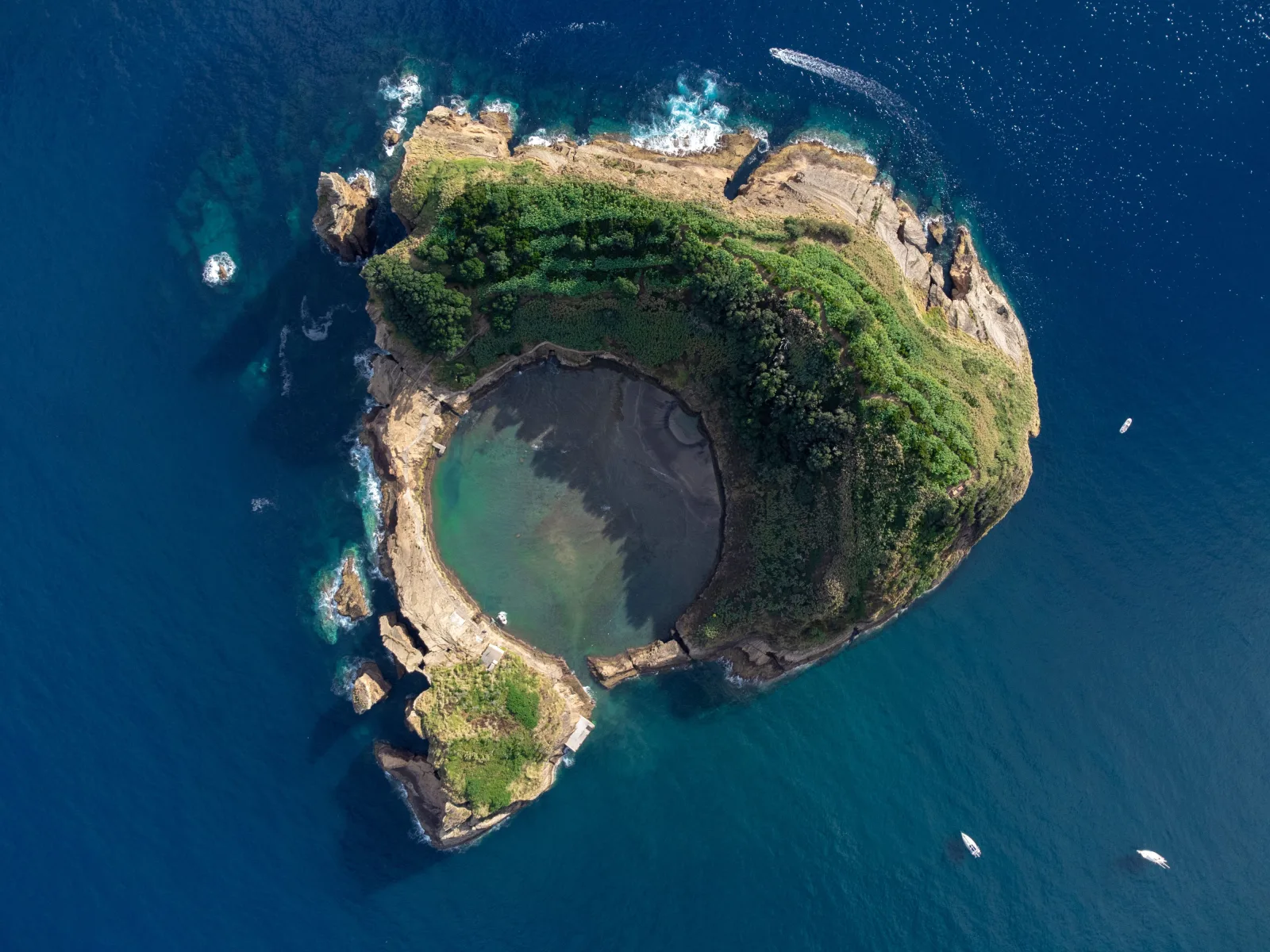
The Vila Franca islet sits 1.2 km offshore, visible from almost every south-facing street. For the full islet visit logistics, see the Ilhéu de Vila Franca guide.
A short history — the 1522 disaster and after
This is the context that makes the rest of the town legible.
By the early 1500s Vila Franca do Campo had been São Miguel’s main settlement for nearly a century — the seat of regional government, the largest harbour, the centre of the sugar and wheat trade. Around 5,000 people lived in the town and immediate surroundings, roughly a quarter of the island’s total population.
On the night of 22 October 1522, a major earthquake triggered a massive landslide from the steep slopes behind town. An estimated 6.75 million cubic metres of debris ran down a ravine at 1–3 metres per second, reaching the town centre within minutes and covering it almost completely. Contemporary accounts put the death toll between 3,000 and 5,000 — among the worst natural disasters in Portuguese history.
The survivors rebuilt over the following decades, slightly seaward of the buried original. But the political weight had shifted. Ponta Delgada, which had been a secondary settlement to the west, took over as the island capital — a position it has held ever since. Vila Franca recovered economically over the following centuries — orange plantations from the 18th century, then pineapple greenhouses in the 19th, then dairy and small-scale fishing through to the modern day — but never regained its former rank as island capital. The town’s quiet, slightly faded grandeur today is the long tail of that lost century.
Walking the town today, the post-1522 layout is what you’re looking at. The older medieval-pattern streets are buried under what’s now agricultural land north of the centre.
Things to do in Vila Franca do Campo
Main square and the parish church
The Largo da Matriz (main square) sits one block inland from the marina. It’s a small flat plaza ringed by café terraces, a couple of bakeries, and the Igreja Matriz de São Miguel Arcanjo — the parish church.
The church is interesting because its façade is built entirely from raw basalt — black volcanic stone, no plaster, unusual among São Miguel’s whitewashed churches. The current building was reconstructed after the 1522 earthquake but follows the same architectural style as its predecessor. Interior is calm, austere, worth 10 minutes.
Convento de São Francisco
A few blocks west of the main square. Founded in the 16th century, this was the first Franciscan convent on São Miguel and remains an important monument. Parts of the building are now used as a cultural centre and small museum. Entry is free, hours vary by season.
Marina and seafront
The Marina de Vila Franca do Campo is small but active — local fishing boats, the islet ferry, and a handful of pleasure boats. Walk the Avenida Manuel da Silva Leal along the seafront for the standard south-coast view. Several seafood restaurants line this stretch.
Ermida de Nossa Senhora da Paz
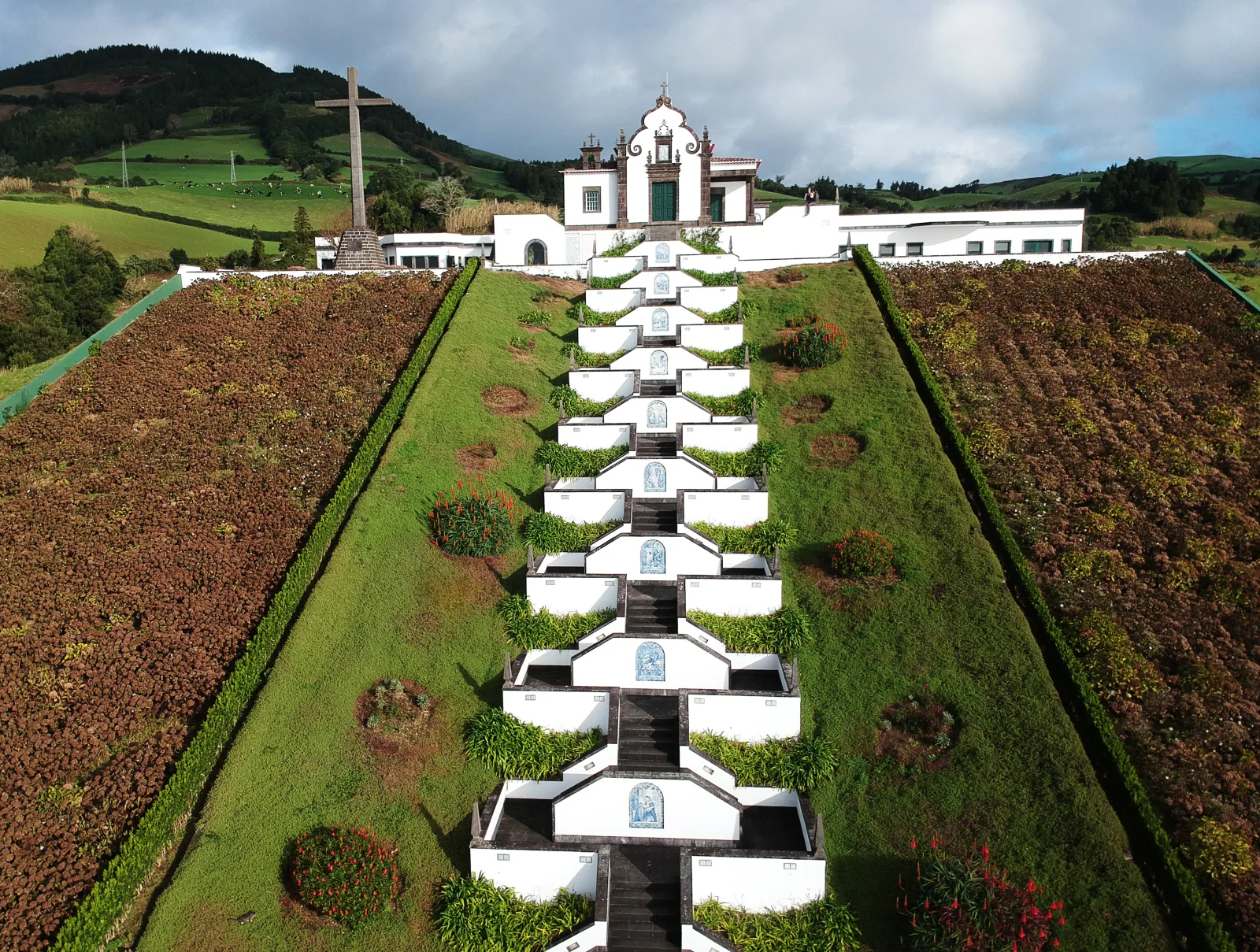
The Ermida (chapel) of Our Lady of Peace sits on a hill above town, reached by a steep 200-step staircase lined with azulejo tile panels depicting scenes from the life of Mary. The climb takes 15–20 minutes at a slow pace.
From the top: a clean view over the entire town, the marina, and the islet sitting in the bay below. This is the postcard angle of the islet. The chapel itself is small and simple, often locked outside the August festival period.
You can also drive up via a back road if the staircase is too much.
The islet boat
The boat to the Ilhéu de Vila Franca leaves from the Tagarete pier on the west side of the marina. Booking, timing, and the 2025–2026 swimming rules are covered in detail in the Ilhéu de Vila Franca guide.
What to eat in Vila Franca do Campo
Queijadas da Vila Franca
The town’s signature food. Queijadas are small sweet pastries — about the size of a tea-light — made from fresh cheese (requeijão), egg yolks, sugar, and a hint of cinnamon, baked in scalloped foil cups. They’re sweet but not cloying, with a custardy interior and a thin crisp top.
Two local producers dominate:
- Morgado dos Açores — boxed and distributed across São Miguel, available at the producer shop on the EN1-1A
- Padaria do Centro and similar town bakeries — sell warm queijadas straight from the oven each morning
A box of 6 is the standard purchase. They keep 48 hours at room temperature, but they’re best within 12.
Tasquinha da Tia Olímpia
A small traditional restaurant a couple of streets back from the marina. Cozido, bife à regional (steak with garlic and bay leaves), and grilled local fish. Cash-friendly, slow service, packed at weekends.
Casa do Cabouco
Marina-side seafood restaurant. The fish is genuinely off the local boats. Try the lapas grelhadas (grilled limpets — a São Miguel staple) and the atum mosqueado (tuna with garlic and onion).
For the broader food picture across São Miguel, the São Miguel food guide covers the regional dishes and where else to find them.
Festivals in Vila Franca do Campo
Festa de São Miguel Arcanjo
The town’s patron-saint festival, usually in early May. Procession through the streets, masses at the parish church, food and music in the main square. Smaller in scale than Santo Cristo in Ponta Delgada, but more intimate.
Festa de São João
June 23–24 — Vila Franca runs one of the larger São João celebrations on São Miguel. Bonfires in the squares, painted bezerro (heifer effigy) parades, grilled sardines, street music until 2–3am. The full Azorean festival calendar is in the São Miguel festivals and events guide.
Festa do Senhor Bom Jesus da Pedra
Late August — the end-of-summer religious festival. Procession from the Santuário do Senhor Bom Jesus da Pedra sanctuary, multi-day concerts, fireworks over the marina. The biggest event on Vila Franca’s calendar.
Where to stay in or near Vila Franca do Campo
Vila Franca isn’t a major accommodation hub — most visitors base in Ponta Delgada or Furnas and visit Vila Franca on a day trip — but there are reasonable options if you’d rather sleep in town.
- Vila Bicuda Apartments (central) — well-located self-catering apartments a short walk from both the marina and the main square. Good for couples and families wanting independence.
- Hotel Vila Nova (south-coast, 5 minutes east) — small modern hotel facing the islet. Quiet, good breakfast, walking distance to the marina via the seafront promenade.
- Várzea Quinta da Espiga (rural, 10 minutes inland) — restored farmhouse-style rural tourism. Great if you want pasture and ocean views and don’t mind driving into town for dinner.
For the broader where-to-stay framework across São Miguel — when to pick Ponta Delgada versus Furnas versus Vila Franca — see where to stay on São Miguel.
Beaches near Vila Franca do Campo
The town doesn’t have a major swimming beach in its centre, but two solid options sit within a 5–10 minute drive:
- Praia dos Moinhos (5 min east) — small black-sand cove, family-friendly, with a couple of beachfront cafés. Hosts the Azores Burning Summer music festival in late August.
- Praia da Vinha de Areia (3 min west) — long stretch of dark sand, fewer crowds, basic facilities.
- Praia de Água d’Alto (10 min west, in Lagoa) — wider beach with lifeguards in summer, the standard choice for São Miguel families.
For the full island beach picture and where each one ranks, see best beaches on São Miguel.
How long to spend in town
| Plan | Time |
|---|---|
| Quick stop (queijadas + main square) | 30 minutes |
| Half-day walk | 3 hours |
| Half-day + islet boat | 5 hours |
| Full day (town + islet + Ermida) | 7–8 hours |
Most São Miguel itineraries fit Vila Franca into either a south-coast day (Vila Franca + Furnas + Ribeira Quente) or a dedicated islet day. Either works.
How to get to Vila Franca do Campo
- From Ponta Delgada: 30 minutes by car via the EN1-1A, the south-coast road. Same time on the new VRP expressway.
- From Furnas: 25 minutes via the EN1-1A west.
- From Lagoa: 15 minutes — Vila Franca is the next significant town east.
- By bus: line 102 from Ponta Delgada, roughly hourly, ~45 minutes.
A rental car is the standard. The buses don’t coordinate with the islet boat schedule, and the south-coast drive itself is one of the more scenic stretches on São Miguel.
Combining with other São Miguel sights
Vila Franca slots naturally into a south-coast itinerary:
- Morning — Vila Franca town + islet boat
- Afternoon — drive 25 minutes east to Furnas for the thermal pools and Lagoa das Furnas
Or as part of a wider day-trip from Ponta Delgada — see day trips from Ponta Delgada for the full set of options.
And if you’d rather not assemble all this yourself — the booking for the islet, the right queijada bakery, the timing to catch the Ermida light at the right moment — Pocket Guide Azores is the AI travel planner that does exactly that. Built by me, from São Miguel, with enough trips to Vila Franca to know which café opens earliest on a Sunday.
The bottom line
Vila Franca do Campo is the most historically dense small town on São Miguel, and the only one where you can stand on a hillside, look out at a perfectly circular volcanic islet, and eat a sweet pastry that’s been baked the same way for 500 years. Most travellers spend 90 minutes here and leave. I’d give it half a day, plus the islet boat if the timing works.
Pair it with Furnas for a complete south-coast day. Pair it with the islet for a full-day single-destination trip. Either way, don’t skip the queijadas.
Guided options around here, if you’d rather not piece the logistics together yourself:
What to do next
- Ilhéu de Vila Franca guide — boat booking and islet visit
- Furnas — the natural east-coast pair
- Day trips from Ponta Delgada — where Vila Franca fits
- São Miguel food guide — queijadas in their wider context
Frequently asked questions
Why is Vila Franca do Campo historically important? +
Vila Franca do Campo was **São Miguel's first capital** — the political and economic centre of the island from the late 15th century until the 1522 earthquake destroyed the town and killed an estimated 3,000–5,000 residents. After the disaster the capital moved permanently to Ponta Delgada. Today Vila Franca is a quiet town of around 10,000 people, but the older parts of the centre still reflect its early-colonial layout.
What happened in the 1522 Vila Franca earthquake? +
On 22 October 1522, a major earthquake triggered a massive landslide that buried the centre of Vila Franca do Campo under up to 6.75 million cubic metres of debris. The slide reached town in minutes. Between 3,000 and 5,000 people died — roughly 25 percent of São Miguel's population at the time. The town was rebuilt over the following decades but never recovered its former position; the island's political weight moved to Ponta Delgada.
What is Vila Franca do Campo famous for today? +
Four things: the **Ilhéu de Vila Franca** (the offshore volcanic islet 1.2 km out), the **queijadas** (small sweet egg-and-cheese tarts that the town is the origin of), the **Festa de São Miguel Arcanjo** (the island's patron-saint festival held here in May), and the steeply rising **Ermida de Nossa Senhora da Paz** chapel above town with views of the islet.
What are queijadas da Vila Franca? +
Small sweet pastries — about the size of a tea-light candle — made from fresh cheese, egg yolks, sugar, and a touch of cinnamon, baked in shallow scalloped cups. They're the town's signature export. **Morgado dos Açores** and **Vila Franca queijada producers** sell them by the box across São Miguel, but they're freshest in Vila Franca itself. Buy a box of six and eat them within 48 hours.
How long do you need in Vila Franca do Campo? +
A half-day for the town itself. A full day if you're combining with the islet boat trip — boat over in the morning, lunch in town, walk up to the Ermida in the afternoon, drive back to your base by evening. The town is small and walkable. Most São Miguel itineraries include Vila Franca as a half-day or a stop on a south-coast drive day.
How do you get to Vila Franca do Campo? +
It sits on the south coast of São Miguel, about **30 minutes by car from Ponta Delgada** and **25 minutes from Furnas**. The main road (EN1-1A) passes the edge of town. Public bus 102 from Ponta Delgada runs roughly every 90 minutes and takes about 45 minutes, but a rental car is the standard way for visitors — the bus doesn't connect well to the islet boat schedule.
Where should I eat in Vila Franca do Campo? +
Three solid picks: **Tasquinha da Tia Olímpia** for traditional Azorean food in a small dining room, **Casa do Cabouco** for seafood with a marina view, and **Padaria do Centro** for the town's best queijadas straight out of the oven. The main square has a couple of café-bars for coffee and a quick *bifana* sandwich. Avoid the obviously tourist-facing places on the seafront — quality drops sharply.
Can you see the islet from the mainland? +
Yes — the islet sits 1.2 km offshore and is fully visible from most of Vila Franca do Campo's south-facing streets. The best mainland viewpoint is the **Ermida de Nossa Senhora da Paz**, a hilltop chapel reached by a steep 200-step staircase from the town centre. From the chapel terrace you get the postcard view — the islet centred in the bay with São Miguel's coast wrapping around it.