
Also available in Português
Lagoa das Furnas: A Local's Guide to the Furnas Lake (São Miguel)
A local's guide to Furnas lake (Lagoa das Furnas), São Miguel — the pot-burying ritual, the caldeiras, the walking trails, and the day plan that works.
The Furnas lake is the centerpiece of the most geologically alive valley in Europe. It sits in an ancient crater on the eastern interior of São Miguel, ringed by laurel forest, with a south shore that steams visibly on a cool morning. The volcano under it last erupted in 1630, and the heat is still working its way out — through fumaroles, hot mud pots, and the only kitchen in Europe where lunch is buried at dawn and dug up at noon.
I live here. I drive past Lagoa das Furnas most weeks. The thing most guides get wrong is treating it as one stop on a list — viewpoints, gardens, chapels, all jumbled together. The lake works in a specific order: caldeiras at 10:30, walk before midday, lunch in the village, viewpoint after coffee. Get the sequence right and the day rewards you. Get it wrong and you spend the afternoon in the car.
What Lagoa das Furnas actually is
A volcanic crater lake, roughly 40 km east of Ponta Delgada, sitting inside the larger Furnas caldera. The lake itself is about 2 km long. Around it: laurel forest, dairy pasture, and a scattering of historic gardens built by 19th-century Azorean nobility who used the valley as a summer retreat.
The water is fed by rainfall and underground springs. The south shore is the active part — that’s where the geothermal vents reach the surface and where the cozido pots have been buried for over a century. The north shore is calmer, with the chapel and the older gardens.
You don’t come to Lagoa das Furnas for one thing. You come for the combination — a steaming lake, a slow lunch tradition, a ridge viewpoint, and a botanical garden that took 80 years to grow.
The Furnas valley itself is classified as a protected landscape covering about 3,150 hectares. The lake is the visible centre of a much bigger geothermal system — the same heat that boils the caldeiras on the south shore feeds the thermal pools at Terra Nostra and Poça da Dona Beija five minutes up the road. The 1630 eruption that built the modern lake basin reshaped the entire valley, and you can still trace the old crater rim if you stand on Pico do Ferro and look down. Most of the trees you see ringing the lake are second-growth laurel forest — the original cover was logged in the 19th century and the regrowth tells you how aggressive the ecosystem is here. Things grow back fast on volcanic soil.
Before you go: getting to Furnas lake
The lake is reachable only by car, taxi, or organised tour. The drive from Ponta Delgada takes 45 minutes via the EN1-1A — the fast inland route. The south coast road through Vila Franca do Campo is more scenic but adds 20 minutes. In winter, take the inland route. The south road floods after heavy rain.
| Route | Drive time | When to use |
|---|---|---|
| EN1-1A inland | ~45 min | Default. All weather. |
| Coast via Vila Franca | ~65 min | Calm summer days. Sea views. |
| Tour bus | Half-day | If you don’t want to drive |
Parking is free at two main lots. The caldeiras lot on the south shore is the one most visitors use — small, fills by 10:30 in summer, and you walk straight to the geothermal vents. The chapel lot on the north shore is bigger and used by visitors doing the lake walk first.
A rental car is the right tool here. The do you need a car in Azores guide explains why public transport isn’t a real alternative for most of São Miguel. Lagoa das Furnas isn’t on a usable bus route.
The pot-burying ritual at the caldeiras
This is the one thing nobody tells you to make sure you see, and it’s the best free experience on São Miguel.
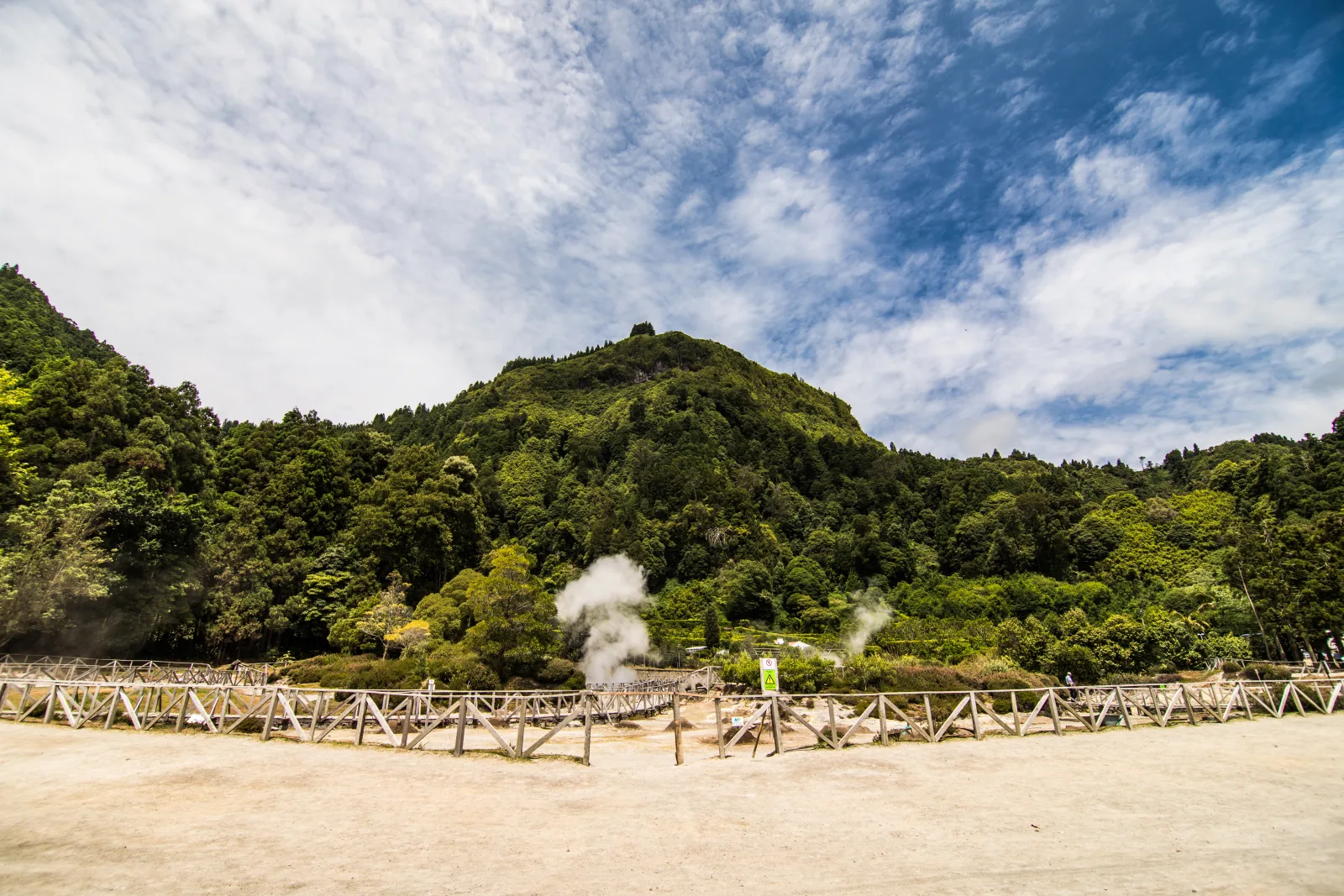
Every morning around dawn, restaurant staff from Furnas village walk down to the south shore of the lake with metal pots full of layered meat, sausage, and root vegetables. They lower the pots into holes in the volcanic ground — the vents run at 90–100°C just under the surface — and seal them with cloth, wood, and earth. The pots stay buried for six hours.
At about 10:30, the staff come back. They unearth the pots, wrap them in jute, load them onto pickup trucks, and drive them three minutes up to the restaurants. The whole ritual takes 30 to 40 minutes. It’s free, takes place on the public boardwalk between the visitor centre and the lake shore, and most days you can stand within five metres of the action.
I filmed the whole thing at the caldeiras — the pots coming up out of the ground, the steam, and the mud boiling right beside the boardwalk:
The order of unearthing is roughly fixed. Restaurante Miroma pots come up first, around 10:30. Tony’s Furnas pots around 10:45. Terra Nostra later, closer to 11:15. If you’re booked at Miroma for lunch at 13:00, you can watch your own pot come out of the ground — locals do this with their grandkids on Sundays.
The walkways near the vents are fenced. Stay on them. The ground around an active fumarole is hot enough to burn through shoes. Children should be held by hand. Otherwise the area is safe and well managed by Parque Natural.
For the dish itself, the booking rules, and where to actually eat it after the unearthing, the dedicated cozido das Furnas guide covers everything.
Walking around Furnas lake
There’s a marked trail that loops part of the lake. The full circuit isn’t possible — private land blocks the eastern shore — but the south-and-west loop is about 3 km, takes 60 to 75 minutes at a slow pace, and stays flat the entire way.
The trail passes through laurel forest, along the lake edge, and past the wooden boardwalk near the caldeiras. It’s well signposted and used by local joggers in the early morning. Mountain bikes are allowed on the wider sections.
| Trail section | Distance | Time | Surface |
|---|---|---|---|
| South shore (caldeiras) | 0.8 km | 20 min | Boardwalk + gravel |
| West shore (forest) | 1.4 km | 35 min | Soft forest trail |
| Chapel return | 0.8 km | 20 min | Gravel + paved |
The trail is at its best in autumn and winter. Spring brings hydrangeas to the slopes. Summer is busier and warmer but the forest stays cool. I’d take the loop at 11:30, after the caldeiras unearthing and before lunch — the light is good, the morning crowd has gone, and you’ve earned the cozido by the time you sit down.
What you won’t see from the trail: the eastern shore. The privately owned end of the lake is closed. If you want a complete view, go up to Pico do Ferro instead.
What’s around Furnas lake worth your time
The valley around the lake is dense with attractions, and not all of them are worth the time most guides give them. Here’s the honest ranking.
| Attraction | Worth it? | Time needed | Cost |
|---|---|---|---|
| Caldeiras (south shore) | Yes — essential | 30–40 min | Free |
| Pico do Ferro viewpoint | Yes — top 3 on island | 30 min + drive | Free |
| Chapel Nossa Sra. das Vitórias | Worth a stop | 10 min | Free |
| Mata-Jardim José do Canto | Yes if you like gardens | 60 min | ~€3 |
| Parque Grená | Skip unless you have a full day | 90 min | €10 |
Miradouro do Pico do Ferro is the viewpoint on the ridge above the lake. The road up is 10 minutes from the south shore — steep, narrow, with hairpins, but paved. From the top you get a full panorama of the lake, the village beyond, and the steam rising from the caldeiras. It’s one of the best views on São Miguel. Go before 11am or in late afternoon. By midday in summer the cloud rolls in and the view disappears.
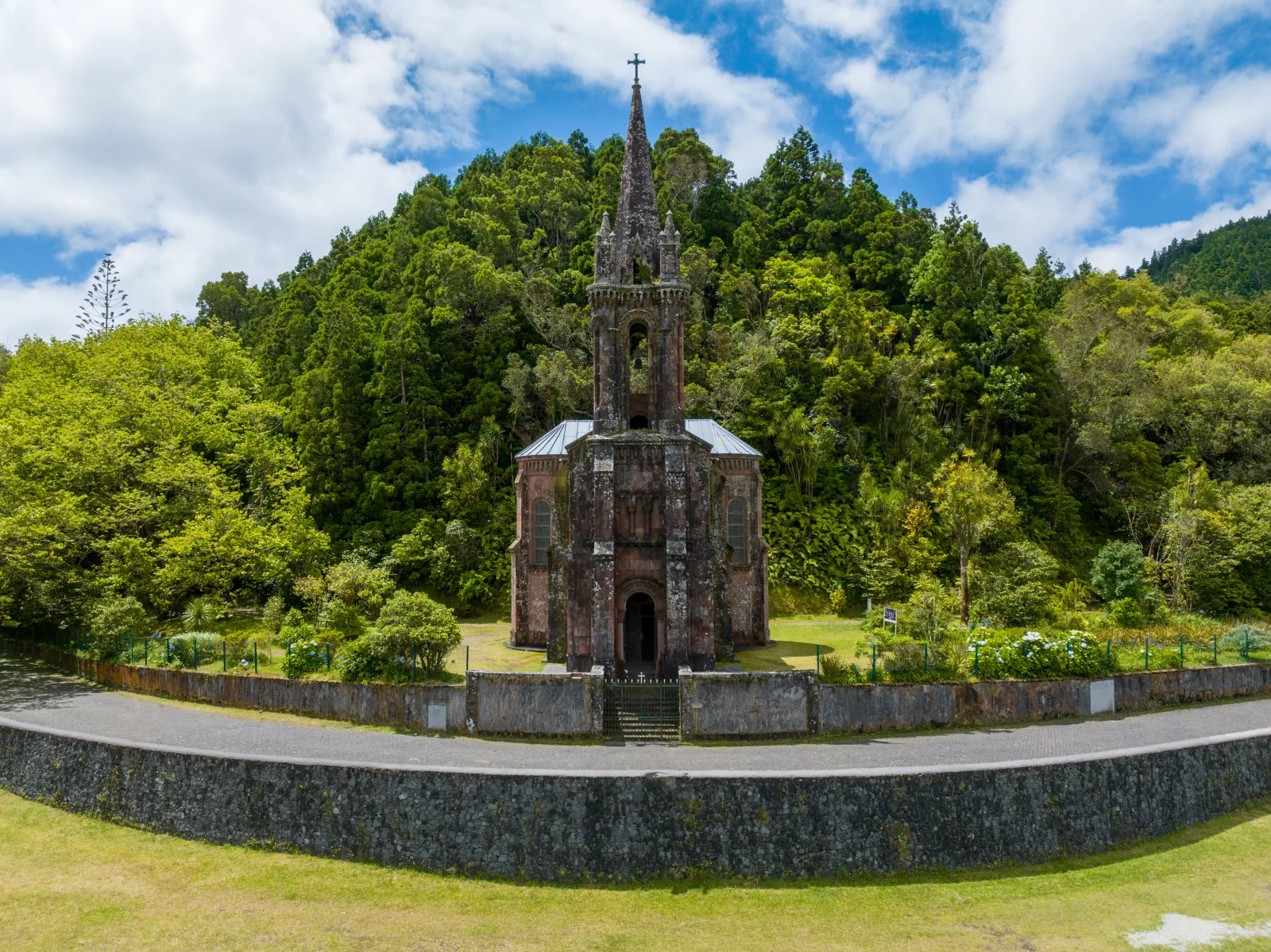
The Chapel of Nossa Senhora das Vitórias sits on the north shore, a small neo-Gothic building from the 1880s with stained glass and a quiet graveyard. It’s photogenic and takes ten minutes. Worth a stop if you’re already walking the trail.
Mata-Jardim José do Canto is a 10-hectare botanical garden on the south side, built in the 19th century in French style. The camellia collection blooms December through May and is worth the small entry fee. Locals who like quiet outdoor walks come here. Tourists in a rush usually skip it, which is fine.
Parque Grená is the bigger paid garden — 18 hectares of grounds around the ruins of an 1858 manor. €10 per person. Pretty enough but nothing you can’t find elsewhere on São Miguel. If you’ve got a half-day to fill, it works. If you’ve got a full island to see, it doesn’t.
A copy-and-paste Furnas lake day
If the lake is the anchor of your day, here’s the version I’d plan for a friend visiting for the first time. Three hours of structure, the rest is breathing room.
09:30 — Leave Ponta Delgada. EN1-1A inland route. 45 minutes. 10:15 — Park at the caldeiras lot on the south shore of the lake. 10:30 — Watch the cozido pots come out. Stay until 11:00. 11:00 — Walk the 3 km lake trail. Slow pace, 60–75 minutes. Stop at the chapel at the halfway point. 12:30 — Drive 3 minutes to the village. Park near the main square. 12:45 — Sit down for lunch at your reserved restaurant. Don’t book before 12:30 — the pots are best in the first hour out of the ground. 14:30 — Walk five minutes to Terra Nostra Garden thermal pool. €10 entry. Soak for an hour. 15:45 — Optional: drive up to Miradouro do Pico do Ferro for the lake view from above. 10 minutes each way. The afternoon light here is excellent. 17:00 — Coffee and a bolo lêvedo in the village. Start the drive back to Ponta Delgada.
That’s the day. The full version of where to eat and what to do post-lunch lives in the Furnas guide — the village context that makes the lake make sense.
If you’re slotting Furnas into a multi-day plan, Pocket Guide Azores builds the sequence automatically. It knows that the caldeiras open at 10:30, that the cozido restaurants need a day’s notice, and that the Pico do Ferro view dies in afternoon cloud. You describe the trip — it assembles the order.
Common mistakes at Furnas lake
1 — Arriving after the unearthing. Showing up at 12:30 means you walk past empty caldeiras and miss the only ritual that’s actually specific to this place. Be at the south shore by 10:15.
2 — Trying to swim. The lake is closed to swimming. The water is cold and the bottom is sediment. For a swim, walk to the thermal pools instead — Terra Nostra and Poça da Dona Beija are minutes away in the village.
3 — Skipping the viewpoint. Pico do Ferro takes 30 minutes round trip from the lake and gives you the angle that makes the rest of the day make sense. Most tourists don’t go because the road looks intimidating from below. It’s not. The view is in your top three on the island once you’re up there.
4 — Booking lunch before 12:30. The pots come out at 10:30–11:00. Eating at noon means rushing through the lake and arriving at the restaurant before the cozido is properly served. Aim for 12:45–13:00 sit-down.
5 — Treating Furnas as a quick stop. Lagoa das Furnas isn’t a viewpoint you see in 20 minutes. It’s a half-day at minimum, a full day if you stay for thermal soaks. People who try to combine it with Sete Cidades in a single day come back saying both were rushed. Do them on different days.
If you’d rather have a guide handle the driving and the timing, this guided Furnas tour covers the tea plantations, the lake and the volcanic area in one outing:
What to read next
- Furnas village guide — the wider valley context, where to stay if you want a full overnight.
- Cozido das Furnas guide — the dish, the booking rules, and how to make it at home.
- Thermal pools in São Miguel — Terra Nostra and Poça da Dona Beija, the post-lunch move.
- The 5-day São Miguel itinerary — Furnas as Day 3, with the timing rules that make it work.
Frequently asked questions
What is Lagoa das Furnas? +
Lagoa das Furnas is a volcanic crater lake on São Miguel island, sitting inside the Furnas valley about 40 km east of Ponta Delgada. The water sits in an old crater that last erupted in 1630. The south shore is geologically active — fumaroles, hot mud pots, and the only place in Europe where lunch is cooked underground using volcanic steam. Most visitors come for the caldeiras and the cozido das Furnas pots being unearthed at midday.
How do you get to Furnas lake? +
By car only — there's no direct public bus. From Ponta Delgada it's a 45-minute drive (~40 km) via the EN1-1A. Park near the south shore by the caldeiras, or at the Chapel of Nossa Senhora das Vitórias on the north shore. Taxis from Ponta Delgada cost roughly €60–€80 one way. Tour buses run as part of full-day east-island tours. The lake itself is free to walk around.
Is there an entrance fee for Furnas lake? +
The lake itself is free — you can park at the lake shore, walk the trail, watch the caldeiras, and visit the chapel without paying anything. The two paid attractions in the area are Parque Grená (€10 per person) and Mata-Jardim José do Canto botanical garden (~€3 per person). Parking near the caldeiras is free but limited in summer.
When are the cozido pots unearthed at Furnas lake? +
The pots come out of the ground between 10:30 and 11:30 most days. Restaurant staff arrive at the caldeiras with pickup trucks, dig the pots out of the volcanic vents on the lake's south shore, wrap them in cloth, and drive them up to the village for lunch service. It's free to watch and takes 30–40 minutes. Arrive by 10:15 if you want to see the full ritual.
How long does a visit to Furnas lake take? +
Plan a half-day minimum. Two to three hours covers the caldeiras, the walking trail, and the chapel. Add three more hours if you're staying for cozido lunch in the village (which is the right move). For a full day, pair the lake with the Pico do Ferro viewpoint above and an afternoon at Terra Nostra Garden's thermal pool — that's the standard local sequence.
Can you swim in Lagoa das Furnas? +
No. Swimming and water sports are prohibited in the lake to protect the ecosystem. The water itself is cold, deep, and not particularly inviting. For warm-water swimming in the area, walk five minutes from the village to Terra Nostra Garden's thermal pool (38°C) or Poça da Dona Beija (35–40°C, open until 23:00 in summer).
Is the caldeiras walk at Furnas lake safe? +
Yes, with the obvious caveat. The caldeiras are 90–100°C just under the surface — the wooden walkways are well marked and fenced, and stepping onto bare ground near a vent will cause burns. Stay on the paths. Children should be held by hand near the steaming vents. The path itself is flat and takes about 20 minutes end to end.
What's the best viewpoint for Furnas lake? +
Miradouro do Pico do Ferro, on the ridge directly above the lake. The drive up is 10 minutes from the south shore, the road is steep and narrow, and the view from the top is one of the best on São Miguel — full panorama of the lake, the village beyond, and the steam rising from the caldeiras. Go before 11am — clouds close in fast at this elevation.