
Also available in Português
Faial Island, Azores: A Local's Guide
A local's guide to Faial Island, Azores — Horta marina, Capelinhos volcano, the Caldeira, the ferry from Pico, and how many days on Faial you actually need.
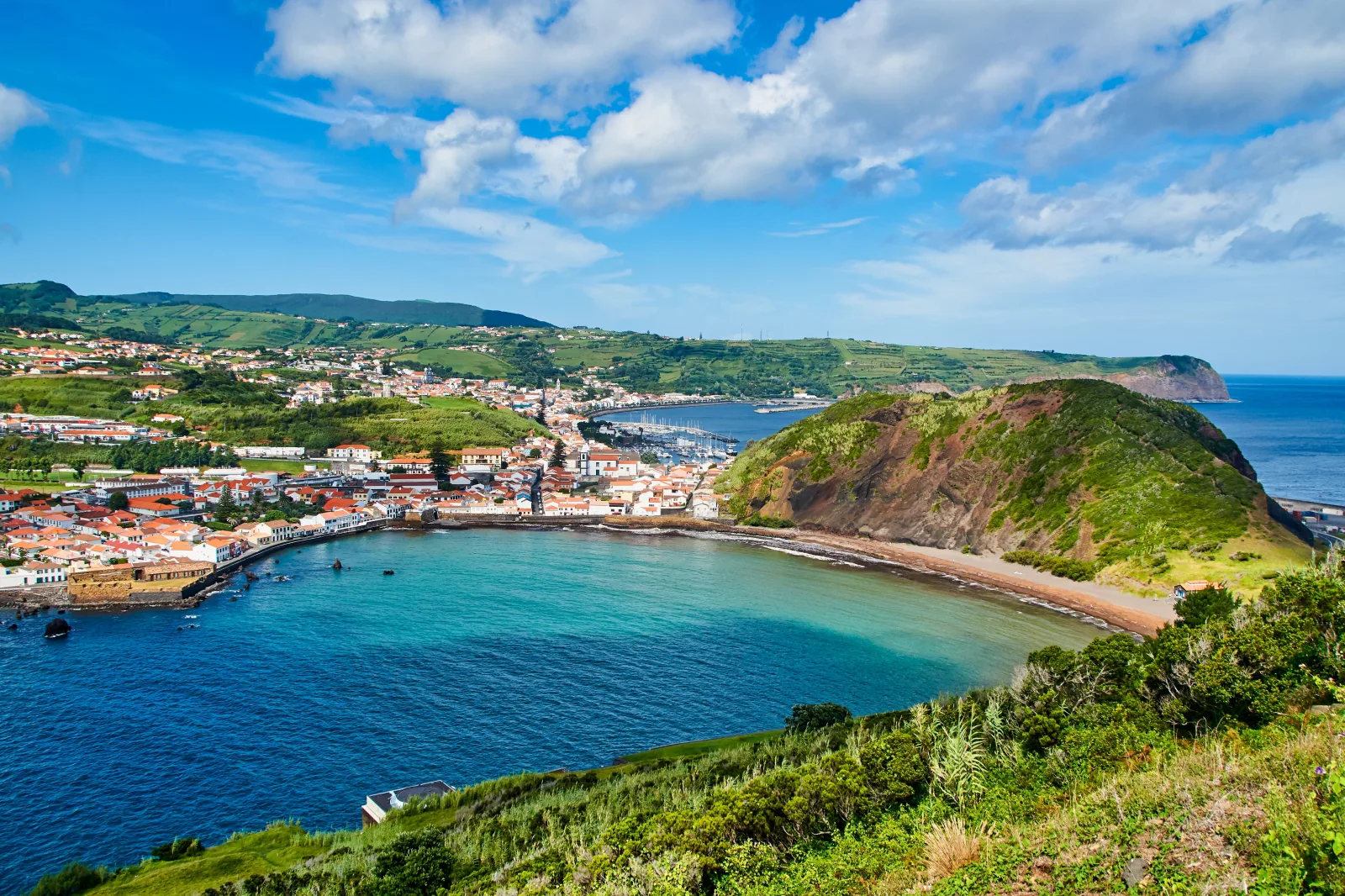
Faial is the central Azores island most travelers underrate. It’s smaller than São Miguel, less dramatic than Pico, and easier to overlook than Terceira — but it has the best small port in the archipelago, a 1957 volcano you can walk through, and a perfectly circular crater you can stand on the edge of. I live in São Miguel and visit Faial when I want a different rhythm — slower, saltier, more sailing-and-coffee than hiking-and-itinerary.
This guide is the one I’d hand a friend planning their first trip to Faial. Two days minimum, three if you can. Pair it with Pico for the proper central-group experience.
Where Faial Island sits in the Azores
Faial is part of the Central Group, sitting just 8 km west of Pico Island across a narrow channel called the Canal Faial-Pico. From Horta — Faial’s main town — you look directly at Mount Pico rising 2,351m above the water. On a clear morning it’s the most photographed view in the Azores.
Faial is roughly 173 km², triangular, with Caldeira do Faial — the volcanic crater — at the geometric center. The island has about 15,000 residents, almost all clustered along the south and east coasts. The northwest is sparsely inhabited and dominated by the Capelinhos volcanic landscape.
If you’re still picking which islands to visit, the Azores islands map and overview covers the geography of all nine. Faial almost always belongs on a multi-island trip alongside Pico.
How to get to Faial
Two practical options, both reliable.
Fly into Horta Airport (HOR)
Horta’s airport is on the east coast, 10 minutes from town. SATA Azores Airlines runs direct flights:
- Lisbon → Horta: daily, ~2h 30m
- Ponta Delgada → Horta: 1–2 daily, 45 minutes
- Terceira → Horta: 4–5 weekly, 35 minutes
- Boston → Horta: direct in summer (typically June–September)
- Toronto → Horta: seasonal direct
For a full breakdown of how the inter-island routes work, see how to get to the Azores.
Ferry from Pico (30 minutes)
The Atlanticoline ferry Madalena ↔ Horta is the smarter option if you’re flying into Pico (PIX) or building a central-group trip. The crossing:
| Detail | Value |
|---|---|
| Duration | 30 minutes |
| Frequency (summer) | 8–10 daily |
| Frequency (winter) | 3–4 daily |
| Cost (foot passenger) | ~€4–6 one way |
| Cost (with car) | ~€20–30 one way |
| Booking | atlanticoline.pt |
You don’t need to reserve foot-passenger seats in advance outside July–August. If you’re crossing with a rental car, the rental company has to be okay with it — check the policy before booking.
Day 1: Horta
Horta is the soul of Faial. It’s a working harbor that doubles as one of the Atlantic’s legendary sailing waypoints — boats stop here on the trade-wind crossing between the Caribbean and Europe, and the bars at the marina have heard more crossing stories than anywhere outside Newport.
Morning: the painted dock and the marina
09:00 — Start at Marina da Horta. Walk the entire length of the painted dock — sailors who cross the Atlantic by tradition paint their boat’s name on the pier before leaving. Some panels go back 30+ years. Plan 30–40 minutes. Bring a coffee.
10:00 — Peter Café Sport, the marina-end bar that’s been a sailing institution since 1918. Order an espresso or a gin & tonic. Read the maritime memorabilia on the walls. Upstairs is the Scrimshaw Museum — small, weird, genuinely interesting, €3 entry.
11:00 — Walk the waterfront promenade west. Igreja Matriz de São Salvador (the main church) and the small Museu da Horta sit a few blocks inland.
Afternoon: Monte da Guia + lunch
13:00 — Lunch at Genuíno, owned by Genuíno Madruga (one of the few Portuguese to sail solo around the world). Seafood, slow service, harbor view.
15:00 — Drive 10 minutes south to Monte da Guia, an extinct volcanic cone that forms the southern edge of Horta bay. Walk the rim path for views back over the town and across to Mount Pico. Praia do Porto Pim is at the base — a small sheltered beach where you can swim if the sun’s out.
17:30 — Back into Horta for a sunset drink at the marina. If Pico is clear, you’ll see the volcano silhouetted against an orange sky. This is the view.
Day 2: Caldeira and Capelinhos
The western half of Faial. Rent a car or book a half-day guided tour from Horta if you didn’t bring one over on the ferry.
Morning: the Caldeira
09:00 — Drive from Horta to Caldeira do Faial (about 25 minutes through the highlands). Park at the main lot. Walk through the short pedestrian tunnel to the Cabeço Gordo viewpoint — the rim of the crater opens dramatically. The crater is 2 km wide and 400m deep, ringed by laurel forest, with a tiny lake at the bottom.
09:45 — If the weather is clear, walk the rim trail — a 7 km loop around the entire crater edge. It’s mostly flat with some undulations, takes 2–2.5 hours, and you’ll have the place mostly to yourself.
12:30 — Drive 30 minutes west toward Capelinhos. Lunch at a roadside snack-bar in one of the western villages.
Afternoon: Capelinhos volcano
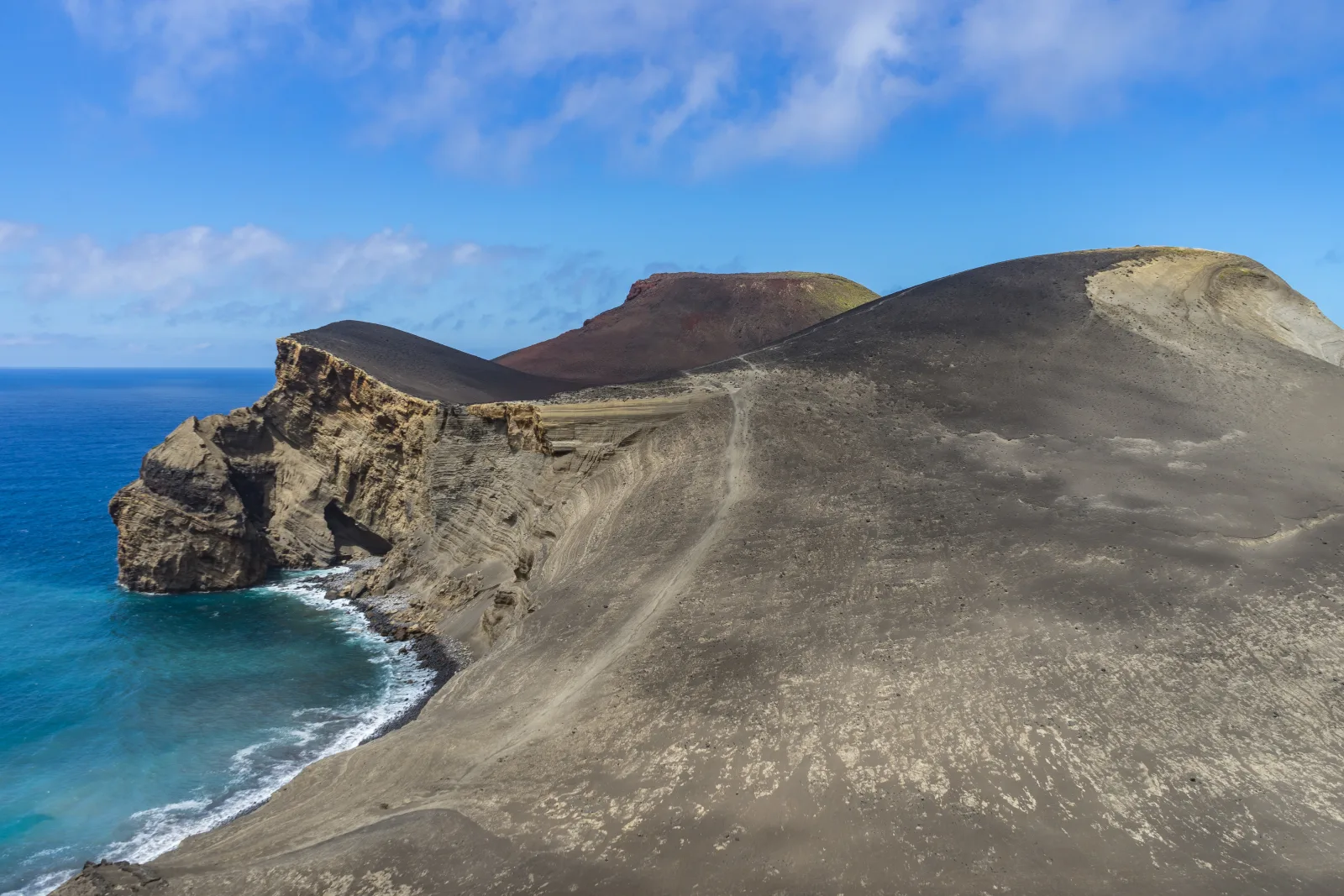
14:00 — Capelinhos Volcano and Interpretation Center. The 1957–58 eruption created 2.5 km² of new land and buried the Farol dos Capelinhos lighthouse halfway up its tower. The lighthouse is still there — half-buried in volcanic ash, standing in a moonscape.
The Interpretation Center is built underground next to the site (so it doesn’t compete visually) and tells the story of the eruption, the resulting emigration wave to North America, and the long-term geological context. €10 entry. Worth every euro. Allow 90 minutes inside, then walk out to the lighthouse.
16:30 — Drive the north coast back to Horta — the road climbs through hydrangea-lined fields with sea views the whole way. In June and July the hedges are solid blue. Stop at Ribeirinha viewpoint for the eastern coast and the Pico view.
18:30 — Back in Horta. Dinner at Canto da Doca, where you grill your own meat and fish on hot stones at the table. Touristy but genuinely fun.
Day 3 (optional): Ten Volcanoes Trail or beach
If you’ve got a third day, two very different choices.
The Ten Volcanoes hike
The PR04FAI – Capelo to Capelinhos trail (often called Dez Vulcões) runs 20 km from the Caldeira rim down to Capelinhos, passing ten volcanic cones from different eruptions. It’s 6–8 hours, fully exposed (no shade, no shelter), and exhilarating if the weather cooperates.
- Distance: 20 km point-to-point
- Duration: 6–8 hours
- Difficulty: Moderate-hard (long, exposed)
- Logistics: Arrange a pickup at Capelinhos or use the public bus back
Don’t attempt it in poor visibility. The Azores’ microclimate can drop fog onto the highlands within an hour, and there are no shelters along the route.
Or: beach day at Praia do Almoxarife
If you’d rather not hike, Praia do Almoxarife on the east coast is a long black-sand beach 10 minutes from Horta, with views straight across the channel to Pico. Quiet, family-friendly, with a couple of beachfront cafés.
Faial + Pico: the natural pairing
Almost no one visits Faial alone. The ferry to Pico runs every few hours, and the two islands complement each other almost perfectly.
| Faial | Pico | |
|---|---|---|
| Vibe | Maritime, sailing, café culture | Wild, volcanic, agricultural |
| Main attraction | Horta marina, Capelinhos | Mount Pico (2,351m), wine country |
| Best for | Slow days, food, hydrangeas | Hiking, wine, dolphin watching |
| Stay | 2 nights | 2–3 nights |
| Together | 4–5 days ideal |
The standard central-group trip is: fly into Pico, ferry to Faial, ferry back, fly out of Pico (or vice versa). For the full 7-day version that includes both, see the 7-day multi-island itinerary.
When to visit Faial
| Month | Air temp | Crowds | What’s happening |
|---|---|---|---|
| Jan–Mar | 14–17°C | Quiet | Ferry occasionally cancelled by swell |
| Apr–May | 16–19°C | Building | Shoulder, good prices |
| Jun–Jul | 19–23°C | Busy | Hydrangeas in full bloom |
| August | 22–24°C | Peak | Semana do Mar (Sea Week) festival |
| Sep–Oct | 20–22°C | Easing | Best balance of weather + space |
| Nov–Dec | 16–18°C | Quiet | Wet, windy, atmospheric |
For a fuller monthly breakdown that covers all the Azores, see Azores temperature by month.
Semana do Mar in early August is Faial’s biggest event of the year — 10 days of sailing competitions, concerts, food stalls, and harbor parties. If you want a festival-focused trip, São Miguel festivals and events covers the broader Azorean calendar.
Where to stay on Faial
Three practical bases.
- Horta center — best for first-time visitors. Walkable to the marina, restaurants, Peter Café Sport. Hotel do Canal (waterfront, 4-star) and Azoris Faial Garden (just inland, family-friendly) are the established options. Smaller guesthouses around the marina go fast in summer.
- East coast (Praia do Almoxarife / Pasteleiro) — quieter, beachfront, 10 minutes’ drive from Horta. Good for travelers who want a stronger sense of being out of town. Several rural-tourism cottages and small inns.
- Western Faial (around Capelo / Capelinhos) — most rural option. Adega-style stone houses, very dark night skies. Right next to the volcano site. Trade-off: 35–40 minutes from Horta.
If you’re comparing where to base yourself across multiple islands, the same logic for São Miguel applies — see where to stay on São Miguel for the framework.
What to eat on Faial
Faial’s food scene is anchored by the marina and the surrounding pasture. A few specific things to seek out.
- Linguiça grilled at the table — Azorean smoked sausage, sliced and grilled over a small clay burner. Most marina restaurants serve it.
- Atum (tuna) — Faial’s waters are tuna-rich. Grilled tuna steak with onion, garlic, and bay leaves is the classic preparation.
- Queijo do Faial — a semi-soft cow’s-milk cheese, milder than São Jorge’s, eaten with bread and red wine.
- Gin & tonic at Peter Café Sport — not food, but tradition. Long pour.
For the broader Azorean food picture, the São Miguel food guide covers most of the regional dishes (cozido, alcatra, lapas) that you’ll also find on Faial.
Practical notes
- Currency: Euros. ATMs in Horta and at the larger village stores. Card acceptance is good in Horta, spotty in rural areas.
- Driving: Easy. ER1-1A is the coastal ring road. The Caldeira and Capelinhos roads are paved but narrow.
- Connectivity: 4G across most of the island. Patchy in the inner highlands.
- Time zone: Azores Time (UTC-1 in winter, UTC in summer) — 1 hour behind mainland Portugal year-round.
- Pharmacy / hospital: Hospital da Horta is the main facility for the central group.
And if you’d rather not stitch this together yourself — the ferry timings, the right hotel for your style, the day Capelinhos visit is best — Pocket Guide Azores is the AI travel planner that does exactly that. It knows when the ferry from Pico is reliable, which Horta restaurants are actually open in low season, and rebuilds the itinerary when weather forces a pivot. Built by me, from São Miguel, with Faial visited often enough to know which café has the best view of Pico at 7pm.
The bottom line
Faial is the two-to-three-day island in a central-group trip. Horta is the strongest small-port experience in the Azores, Capelinhos is the most accessible “walk inside a volcano” site in Europe, and the Caldeira is the kind of crater that doesn’t need explanation. You won’t get the scale of São Miguel or the drama of Pico’s mountain, but you’ll get something neither of those offers — a place where the rhythm is set by tides and crossing season, not by tourism.
If you’ve already done São Miguel, Faial is the smartest next island. If you haven’t, pair Faial with Pico and split your trip 50/50.
Tours and day trips on the island, bookable ahead — worth sorting early, because inventory here is thinner than on São Miguel and the good trips fill first:
What to do next
- Pico Island — the natural pair to Faial, 30 minutes by ferry
- Things to do in the Azores — the archipelago-wide overview, to see where Faial fits
- How to get to the Azores — flight routes and timing
- 7-day multi-island itinerary — Faial + Pico + São Miguel in one week
- Azores temperature by month — pick the right month for Faial weather
Frequently asked questions
How many days do you need on Faial Island? +
Two full days is the sweet spot. Day one is Horta — the marina, the painted dock, Peter Café Sport, Monte da Guia. Day two is the western half — Capelinhos volcano, the Caldeira lookout, the north coast hydrangeas. One day is doable but rushed. Three days lets you add the Ten Volcanoes hike or a relaxed beach afternoon at Praia do Almoxarife. Most travelers pair Faial with Pico (30-minute ferry) for a 4–5 day central-group trip.
How do you get to Faial Island? +
Two ways. Fly into Horta Airport (HOR) — SATA Azores Airlines runs direct flights from Lisbon, Ponta Delgada, and Terceira; in summer there are direct flights from Boston and Toronto. Or fly into Pico (PIX) and take the 30-minute Atlanticoline ferry from Madalena to Horta. The ferry runs 4–10 times daily depending on season and is the cheaper, more atmospheric option.
Is Faial worth visiting? +
Yes, especially if you care about sailing culture, volcanic geology, or want a quieter alternative to São Miguel. Horta is one of the most charismatic small ports in the Atlantic, Capelinhos is a 1957 volcanic eruption site you can walk through, and the Caldeira is a perfectly circular crater with a forested floor. Faial is also the obvious launchpad for Pico — the two islands are 8 km apart and very different in feel.
What is the Capelinhos volcano? +
A volcano that erupted between September 1957 and October 1958 on the western tip of Faial. The eruption created roughly 2.5 km² of new land, buried a lighthouse halfway up its tower, and triggered a wave of emigration to North America. The site today is a moonscape of black ash with the half-buried lighthouse still standing. There's an excellent Interpretation Center built underground next to it.
Can you do Faial as a day trip from Pico? +
Yes, easily. Take an early ferry from Madalena to Horta (about 30 minutes), spend the day in Horta and on a quick Capelinhos visit if you've got a rental car waiting, then ferry back in the evening. You won't see the Caldeira or hike anything, but you'll get the marina, the painted dock, Peter Café Sport, and one volcano site. For more than that, sleep on Faial at least one night.
What is the painted dock in Horta? +
It's the long pier at Horta marina, covered in hundreds of murals painted by sailors who've crossed the Atlantic. Tradition says you have to paint your boat's name on the dock before you leave — bad luck otherwise. The result is a 30-year-deep mosaic of yacht logos, crew names, and crossing dates. Walking it slowly takes 30–40 minutes. Peter Café Sport, the famous sailors' bar, is at the marina entrance.
Is the Caldeira hike difficult? +
Two options. The Caldeira rim walk is a flat 7 km loop around the crater edge with minor undulations — easy for most fitness levels and takes 2–2.5 hours. The Ten Volcanoes Trail is something else entirely: 20 km from the Caldeira down to Capelinhos through ten volcanic cones, six to eight hours, exposed to weather, no shade. That one needs proper boots, food, water, and a clear-weather forecast.
When is the best time to visit Faial? +
May to September is the practical window — mild weather, hydrangeas in bloom along the north coast (peak mid-June through July), and the ferry from Pico runs at its highest frequency. August is busy because of Semana do Mar (Sea Week), Faial's biggest festival. Winter is wet, windy, and ferry crossings get cancelled by swell — fly in if you visit November through March.