
Also available in Português
Corvo Island, Azores: Europe's Smallest Inhabited Island
A local's guide to Corvo Island, Azores — the Caldeirão crater, Vila Nova do Corvo, the rare-bird migration, how to get there, and how long you actually need.
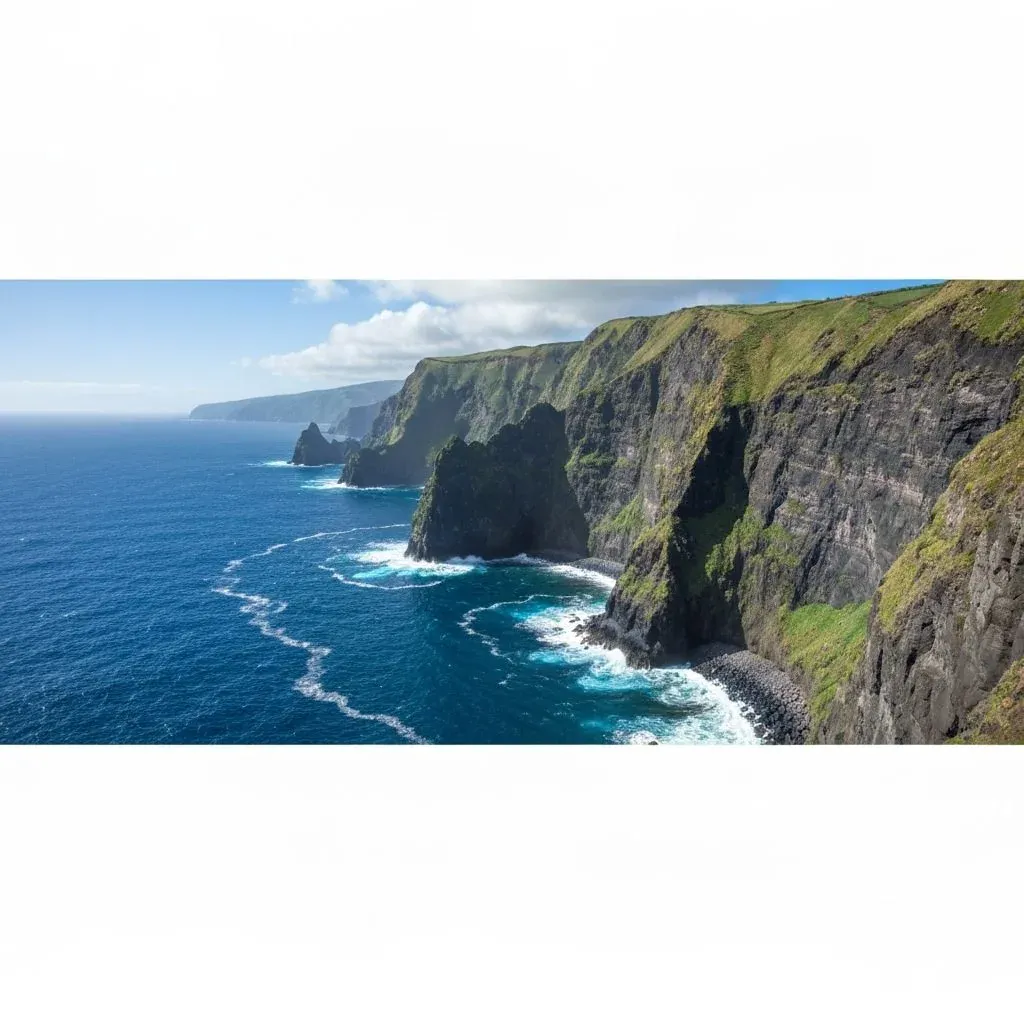
Corvo is the smallest inhabited island in the Azores — and one of the most isolated places in Europe with a permanent population. I live on São Miguel, the busiest island, and Corvo is the opposite of everything São Miguel is: 17 km², around 400 people, one village, no traffic lights, and a quiet so complete it changes the way you think.
This guide is for travellers who’ve made it as far as Flores and are deciding whether to take the final hop to Corvo. The short answer is yes — but go with the right expectations. Corvo isn’t a destination with a checklist. It’s a place you go to feel how small and remote a working community can be.
Where Corvo sits in the Azores
Corvo is the northernmost and smallest island of the Azores, sitting in the Western Group alongside Flores, just 17 km to the south. The two islands are visible from each other on a clear day.
Geographically, Corvo is a single large volcano. The whole island is essentially the cone and crater of one volcanic system, with Vila Nova do Corvo — the only settlement — built on a small lava delta at the southern tip, the one piece of flat-ish land.
Corvo is part of a UNESCO Biosphere Reserve shared with Flores, recognising the islands’ preserved landscapes and low human impact. If you’re still mapping out which islands to visit, the Azores islands map and overview covers the full nine.
How to get to Corvo
There’s no direct route to Corvo from anywhere except Flores. You fly or sail to Flores first, then transfer.
Flight from Flores (FLW → CVU)
SATA Azores Airlines runs a tiny inter-island hop:
- Flores → Corvo: 10–15 minutes, small aircraft
- Frequency varies — typically daily in summer, less in winter
- Heavily weather-dependent
Ferry from Flores
The Atlanticoline ferry connects Flores and Corvo:
- Crossing time: 30–45 minutes
- Daily in summer (June–September), reduced off-season
- Foot passengers only in practice — the crossing isn’t built for car transport
Plan a buffer. The Corvo connection is cancelled by weather more often than any other route in the Azores. If Corvo is a must-do, give yourself a flexible day on Flores. For the broader inter-island picture, see how to get to the Azores and the Flores Island guide.
Vila Nova do Corvo
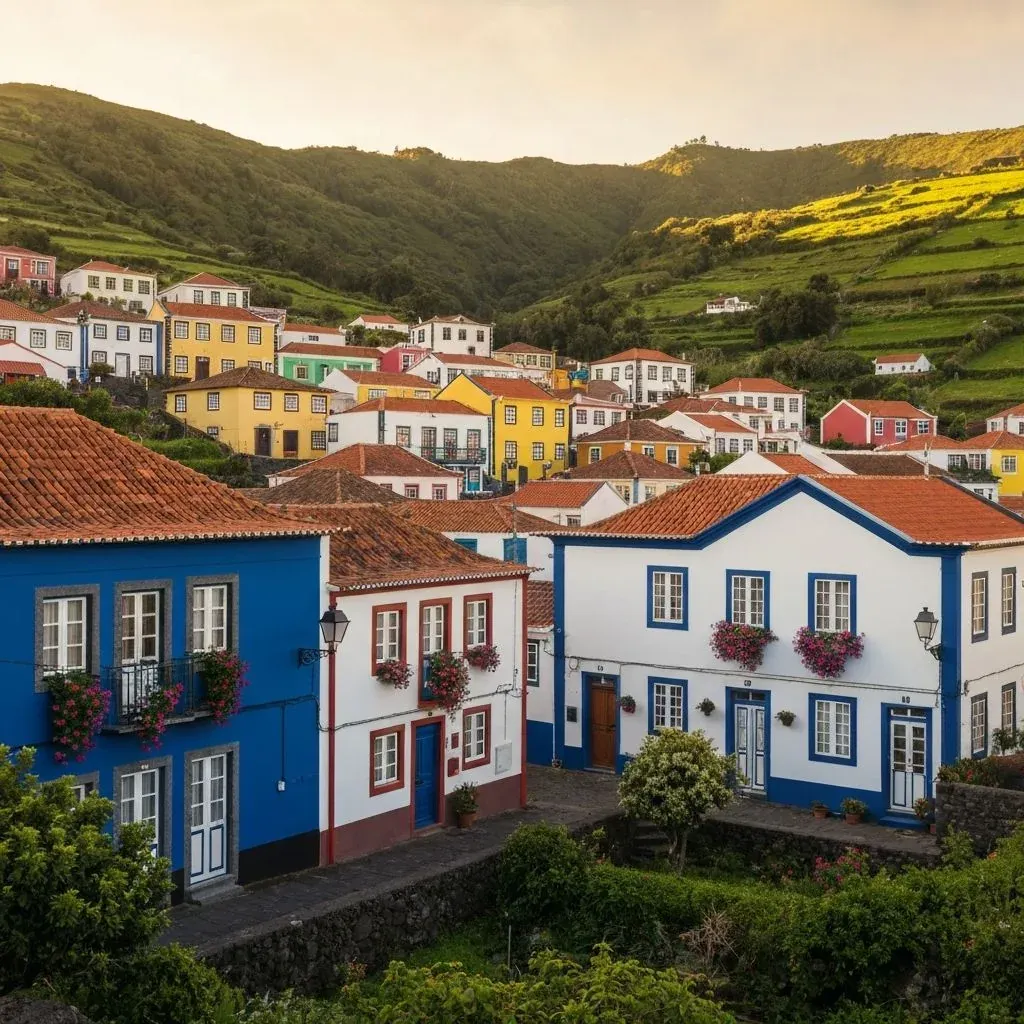
The island’s single village — and the smallest municipality in Portugal.
Vila Nova do Corvo is home to roughly 400 people, all living in a compact cluster of whitewashed houses connected by narrow cobbled lanes called canadas. The lanes are too tight for most cars, which is part of why the village feels frozen in an earlier century.
What to do here:
- Walk the canadas — the maze of lanes between the harbour and the church takes 30–40 minutes to wander properly
- Igreja de Nossa Senhora dos Milagres — the village church, simple and central
- The harbour — small, working, where the ferry docks and the local fishing boats tie up
- The windmills — a few traditional Flemish-style windmills on the village edge, a reminder of the island’s old grain economy
- Casa do Tempo / interpretation space — small displays on island life, history, and the biosphere reserve
There are a handful of cafés and a couple of small restaurants. Don’t expect choice — expect that whatever you’re served was decided by what the supply boat brought.
The Caldeirão crater
Corvo’s signature sight, and the reason most day-trippers come.
The Caldeirão is the island’s collapsed volcanic crater — a subsidence caldera roughly 2 km wide and 300m deep, formed by an eruption about 430,000 years ago. From the village, a road climbs north to the crater rim. The drive (or a guided minibus) takes 20–25 minutes.
From the rim viewpoint, you look down into a vast green bowl. Inside the crater floor are small cinder cones, peat bogs, and a scatter of lakes and islets. Local tradition says the islets form a rough map of the Azores archipelago — whether you see it depends on the light and your imagination.
The crater is often wrapped in cloud. Corvo’s weather changes fast, and the rim is high enough to make its own. If the Caldeirão is clear when you arrive, stop everything and go straight up — clear windows don’t last.
There’s a hiking trail down into the crater for those who want it — roughly 2–3 hours round trip, steep, and only advisable in settled weather. The descent passes through grazing land and the crater’s wetland edge before reaching the lakes on the floor. It’s not technical, but the climb back out is a genuine effort, and the weather can close in fast enough that a clear start is no guarantee of a clear finish. Most day-trippers are happy with the rim viewpoint alone — the crater reads best from above anyway, where the islets and lakes lay out in full.
Corvo for birdwatchers
Corvo has an outsized reputation in one specialist world: rare-bird migration.
The island’s position in the mid-Atlantic makes it a natural landing point for birds blown off their migration routes — especially North American vagrants carried east by autumn storms. Each October, Corvo becomes one of the most important rare-bird observation points in Europe, and the island fills with birdwatchers from across the continent.
For serious birders, October on Corvo is a pilgrimage. Species that should be in the Americas turn up exhausted on a 17 km² rock in the Atlantic, and the birding community logs them obsessively. If that’s your world, plan accordingly — accommodation is extremely limited and books out far ahead for October.
If you’re not a birder, just know that October is the one month Corvo gets genuinely busy.
A short history of Corvo
Corvo’s history is a story of extreme isolation. The island was uninhabited when Portuguese navigators charted the Azores in the 15th century, and settlement came late and slowly — the harsh terrain and total lack of a sheltered harbour made Corvo the least attractive island to colonise.
For most of its history, Corvo was effectively owned as a single estate. The island was granted to noble families and later to the Church, and the few hundred residents lived as a tenant community, paying rent in grain and livestock. That arrangement lasted, remarkably, into the 19th century — Corvo was one of the last places in Portugal to operate on something close to a feudal model.
The island’s isolation also made it strategically marginal but occasionally notable. Corvo sits on the historic Atlantic sailing routes, and over the centuries its waters saw passing fleets, the odd shipwreck, and — according to local lore — visits from privateers. The 16th-century English raid on the Azores brushed past Corvo, though the island had little worth taking.
What shaped modern Corvo most was emigration. Like the rest of the Azores, Corvo lost a large share of its population to North America through the 19th and 20th centuries — to the point where there are more people of Corvo descent in the United States and Canada than on the island itself. The population today, around 400, is roughly stable, sustained by fishing, small-scale farming, and the regional government’s commitment to keeping the smallest municipality in Portugal alive.
For the broader cultural context — the diaspora, the language, the festivals — the Azores culture and pronunciation guide covers the threads that connect Corvo to the rest of the archipelago.
Nature and the biosphere reserve
Corvo, together with Flores, forms a UNESCO Biosphere Reserve. The designation recognises the islands’ preserved volcanic landscapes and the low human pressure on their ecosystems — Corvo’s tiny population means most of the island is uncultivated, wind-shaped grassland and crater wetland.
The Caldeirão crater wetlands are the ecological heart of the island. The peat bogs and lakes inside the caldera are an important habitat, and the crater’s relative inaccessibility has kept it close to pristine. Walking the rim, you’re looking at one of the least disturbed volcanic interiors in the Azores.
Corvo is also a working example of small-island sustainability. The island runs increasingly on renewable energy, manages its limited fresh water carefully, and the community’s tight scale means waste and resource use are visible in a way they never are in a city. It’s the kind of place that makes you notice how much a normal town hides.
Where to stay on Corvo
Accommodation on Corvo is minimal — a handful of guesthouses and small rental rooms in Vila Nova do Corvo, totalling a few dozen beds island-wide.
- Comodoro guesthouse and similar small establishments — basic, clean, central
- Self-catering rooms — several private rentals in the village
If you want to sleep on Corvo, book well ahead — especially for summer and the October birding season. Many visitors skip the overnight entirely and do Corvo as a day trip from Flores, where the accommodation choice is wider.
The argument for staying a night: once the last ferry leaves, the island empties of day-trippers and you get Corvo at its truest — silent, dark, and entirely itself.
When to visit Corvo
| Month | Notes |
|---|---|
| Jan–Mar | Storms frequent, crossings often cancelled |
| Apr–May | Improving, shoulder season, fewer crossings |
| Jun–Sep | Best window — reliable weather, daily ferry |
| October | Peak birdwatching — busiest the island gets |
| Nov–Dec | Quiet, weather unpredictable |
For the full month-by-month weather picture across the Azores, see Azores temperature by month.
The single most important planning rule for Corvo: build in flexibility. The crossing from Flores is the most weather-vulnerable route in the archipelago. Treat a Corvo visit as a “if the weather allows” plan, not a fixed appointment.
What to expect — and what not to
Corvo rewards a specific kind of traveller. Set expectations honestly:
- Do expect: total quiet, dramatic crater scenery, a genuine working community, dark skies, the feeling of being at the edge of Europe.
- Don’t expect: restaurants with menus, shops with choice, reliable transport, nightlife, or anything resembling a tourist circuit.
- Do bring: cash, layers (the rim is cold and windy), patience with the weather, and snacks if you’re picky.
- Don’t bring: a tight schedule. Corvo runs on the island’s pace and the Atlantic’s mood, not yours.
And if you’d rather not work out the Flores connection, the crossing timing, and the weather buffer yourself — Pocket Guide Azores is the AI travel planner that does exactly that. It tracks the Corvo ferry reliability, knows when to build a buffer day into a Western Group trip, and rebuilds the plan when the crossing gets cancelled. Built by me, from São Miguel, with enough respect for Corvo’s remoteness to plan around it honestly.
The bottom line
Corvo is the final island — the smallest, the most remote, the one that completes an Azores map. It’s not a place you build a trip around. It’s the natural last step of a Western Group trip that starts on Flores.
Go for the Caldeirão crater, the car-free village, and the rare experience of standing somewhere genuinely isolated. Go in summer for the weather, or October if you’re a birder. And go with a flexible mindset — Corvo decides when it lets you in.
What to do next
- Flores Island — the gateway to Corvo, and the island you’ll base from
- Things to do in the Azores — the archipelago-wide overview
- Azores islands map and names — where Corvo fits in the nine
- How to get to the Azores — flight and ferry logistics
- Where are the Azores — the geography of the archipelago
Frequently asked questions
How do you get to Corvo Island? +
Two ways, both via Flores. SATA Azores Airlines runs a short hop from Flores Airport (FLW) to Corvo (CVU) — about 10–15 minutes, weather permitting. Or take the Atlanticoline ferry from Flores — roughly 30–45 minutes, running daily in summer and less often in winter. There is no direct connection from any other island. You fly into Flores first, then transfer.
How long do you need on Corvo Island? +
A half-day to a full day for most visitors. The island is tiny — 17 km² — and the two things you come for (the Caldeirão crater and Vila Nova do Corvo) can both be done in a few hours. Many travellers do Corvo as a day trip from Flores. If you want to stay overnight in the only village and experience the island's stillness after the day-trippers leave, one night is plenty.
What is the Caldeirão on Corvo? +
The Caldeirão is Corvo's collapsed volcanic crater — a subsidence caldera about 2 km wide and 300m deep, formed by an eruption around 430,000 years ago. Inside it are small cinder cones, peat bogs, and a cluster of lakes and islets. Local legend says the islets form a rough map of the Azores. The viewpoint on the crater rim is the island's signature sight.
Is Corvo worth visiting? +
Yes, if you value remoteness and you're already visiting Flores. Corvo is the smallest inhabited island in the Azores — and one of the most isolated places in Europe with a permanent population. There's one village, around 400 residents, no traffic lights, and a stillness you won't find anywhere else in the archipelago. It's not a destination on its own; it's the natural extension of a Flores trip.
Why is Corvo famous for birdwatching? +
Corvo's position in the mid-Atlantic makes it a landing point for migratory birds blown off course — especially American species crossing during autumn storms. Each **October**, the island becomes one of Europe's top rare-bird spots, drawing hundreds of birdwatchers hoping to log North American vagrants. If you're a serious birder, October is the month. If you're not, the birding crowd is the busiest the island ever gets.
How many people live on Corvo? +
Around 400–435 people, all in **Vila Nova do Corvo** — the island's single village and the smallest municipality in Portugal. The village is a compact maze of narrow cobbled lanes called *canadas*, with whitewashed houses and a working harbour. Daily life runs on a scale you rarely see in modern Europe — everyone knows everyone, and the island shares resources closely.
Can you do Corvo as a day trip from Flores? +
Yes — this is how most visitors do it. Take a morning ferry or flight from Flores, spend the day exploring Vila Nova do Corvo and the Caldeirão crater, and return in the late afternoon. Book the crossing in advance in summer. The catch is weather: Corvo's flights and ferries are cancelled more often than any other Azores route, so build in a buffer day if Corvo is essential to your trip.
When is the best time to visit Corvo? +
June to September for the most reliable weather and the highest crossing frequency from Flores. October if you're a birdwatcher — that's peak rare-bird season. Avoid winter unless you have flexible plans: Atlantic storms regularly cancel the Corvo connection for days at a time, and the island has minimal tourist infrastructure to fall back on.