
Also available in Português
Flores Island, Azores: A Local's Complete Guide
Flores Island in the Azores explained by a local — waterfalls, Rocha dos Bordões, where to stay, how to get there, and how many days you actually need.
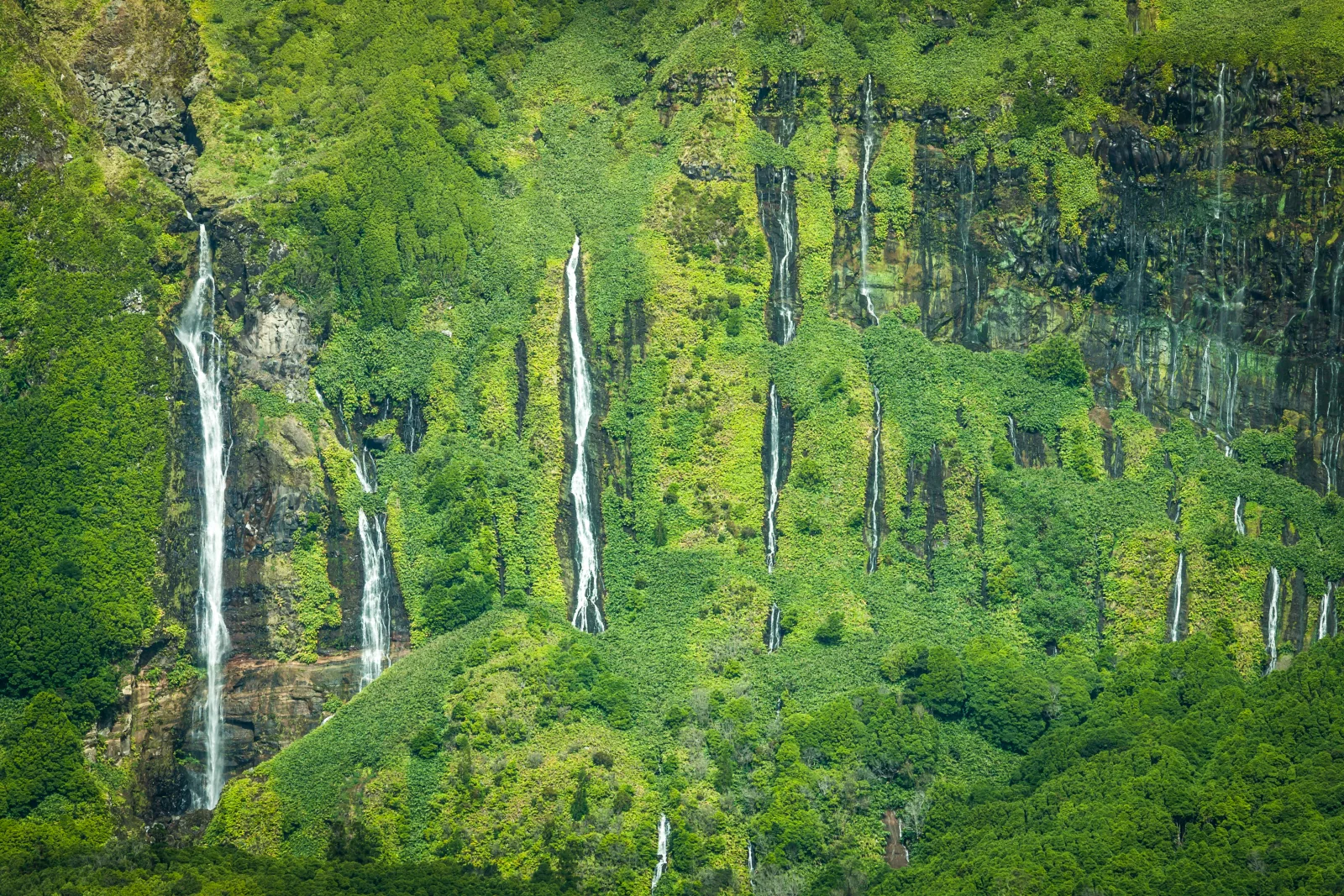
Flores Island is the westernmost place in Europe, the rainiest island in the Azores, and the closest the archipelago comes to feeling primeval. Dozens of waterfalls dropping 150 metres into crater pools. Vertical basalt columns rising from green pasture. A village so far west that the next land is Newfoundland.
Most visitors to the Azores never see Flores Island, in the Azores Western Group — it requires a separate SATA flight, weather-dependent inter-island logistics, and at least 3 extra days. For travelers who already have São Miguel and Terceira in the plan, Flores is the island that changes how you remember the Azores. This guide is the local breakdown of what’s actually there, how to get there, and how to plan around the weather.
If you’re still working out which of the nine Azores islands to visit, that prerequisite covers the geography. This one is Flores Island, Azores specifically.
Where Flores Island fits in the Azores
Flores sits in the Western Group of the Azores archipelago, alongside Corvo. It’s the second-smallest Azorean island by area (143 km²) and one of the smallest by population (~4,000 inhabitants).
The island sits 230 km west of Faial — the closest neighbouring Azorean island. The maximum distance in the archipelago, between Santa Maria in the southeast and Corvo just north of Flores, is about 600 km. Flores is firmly in the “far west” category.
What’s geologically interesting: Flores sits on the North American tectonic plate, not the Eurasian or African plates that hold the other Azorean islands. Stand at Fajã Grande on Flores’s west coast and you’re technically in North America while still officially European. The full tectonic context is in the Azores map and island names guide.
The island has three population zones:
- East coast — Santa Cruz das Flores (the capital and airport hub)
- South coast — Lajes das Flores (the second town)
- West coast — Fajã Grande, Fajãzinha, Mosteiro (smaller villages, most dramatic landscapes)
You can drive across the entire island in 45 minutes. Most attractions are on the west coast.
Why visit Flores Island
Three things define what Flores Island is famous for:
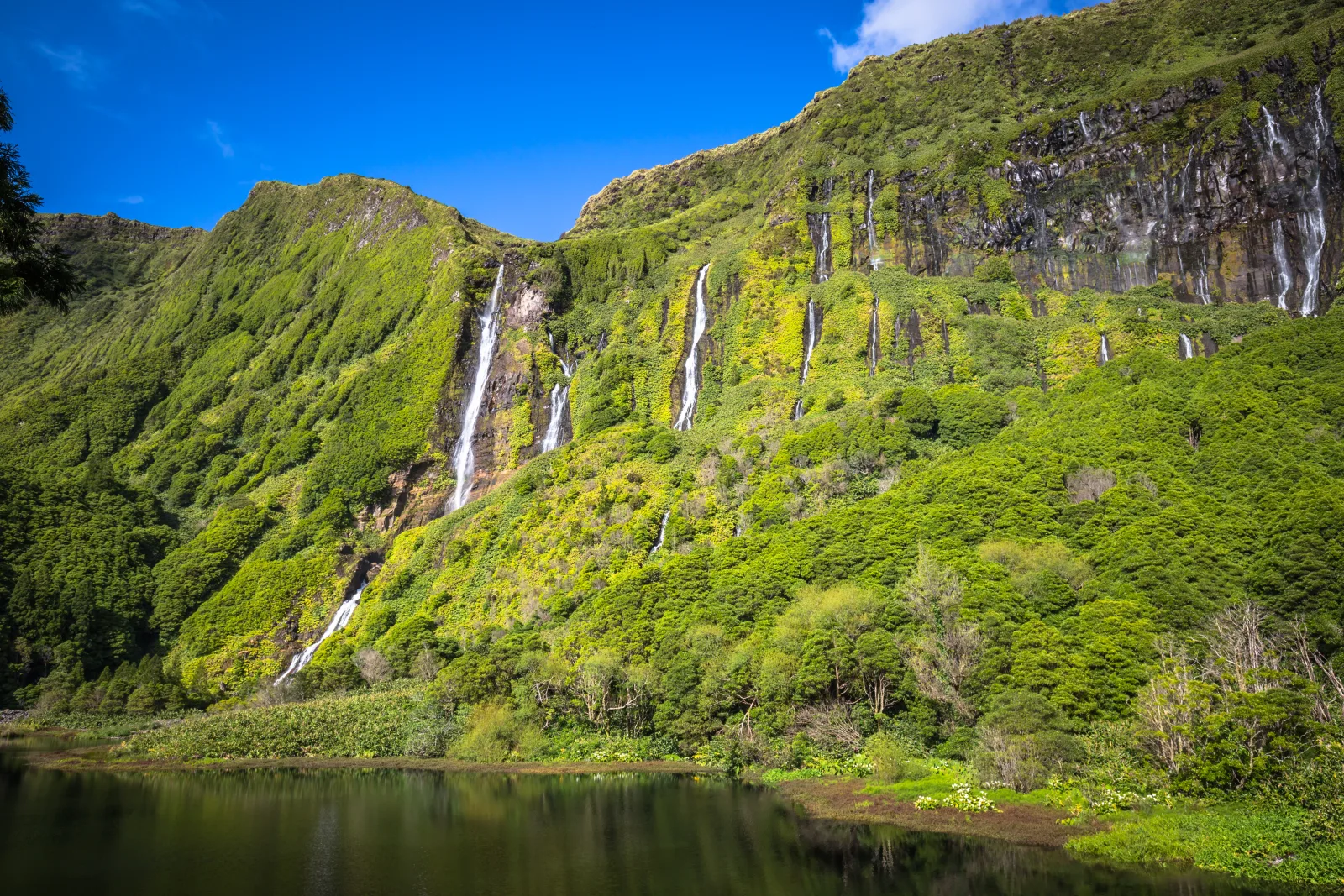
1. Waterfalls. Flores has more waterfalls per square kilometre than anywhere else in the Azores. The combination of high rainfall (~2,500 mm/year, more than double São Miguel) and steep volcanic terrain creates near-permanent cascades. The two anchor sights — Poço da Ribeira do Ferreiro and Poço do Bacalhau — are both in the top 5 most spectacular natural sights in the archipelago.
2. The basalt columns at Rocha dos Bordões. A 20-metre wall of vertical hexagonal basalt columns, formed when ancient lava cooled and crystallized. Similar to the Giant’s Causeway in Ireland but in a green pastoral setting rather than coastal.
3. The sense of being at the edge of Europe. Fajã Grande village is officially the westernmost village in Europe — the next land west is Newfoundland, 2,400 km away. Standing on the cliffs at Ponta da Faja with nothing but Atlantic to the west is genuinely affecting.
Plus: 40+ canyons (Flores is the canyoning capital of the Azores), excellent hiking trails, the UNESCO Biosphere Reserve status since 2009, and hydrangea blooms that make the roadsides surreal in July.
Poço da Ribeira do Ferreiro: the cascade amphitheatre
The single most dramatic sight on Flores Island, in my opinion. Poço da Ribeira do Ferreiro is a natural amphitheatre where dozens of waterfalls cascade simultaneously down a 150-metre vertical cliff face into a deep green pool.
| Detail | Value |
|---|---|
| Location | Fajã Grande area, west coast |
| Access | 20-minute walk from parking |
| Trail difficulty | Easy, flat, well-marked |
| Best time | Mid-morning for light + spray rainbow |
| Swimming | Not safe — strong current near falls |
| Free | Yes |
The path follows a stream through laurel forest before opening into the amphitheatre. The number of visible waterfalls varies with rainfall — after a wet week you might count 30+ cascades. In dry late summer, you’ll see 15-20. Either way, the scale is unlike anywhere else in Europe.
Cascata do Poço do Bacalhau (the 90m waterfall)
Cascata do Poço do Bacalhau is the other essential Flores waterfall. A single dramatic plunge of about 90 metres into a circular pool deep enough to swim in.
| Detail | Value |
|---|---|
| Location | Fajãzinha, west coast |
| Access | 5-minute walk from parking |
| Pool | Yes, swimmable, ~14-16°C |
| Best time | Mid-morning |
| Difficulty | Easy |
Unlike Poço da Ribeira do Ferreiro (look-only), you can swim at Poço do Bacalhau — the pool is cold but clear and deep, with the falls thundering down on one side. Bring a towel. Avoid right after heavy rain when the spray and turbidity reduce visibility and the pool current strengthens.
Rocha dos Bordões: the basalt columns
Rocha dos Bordões is Flores’s signature geological landmark — a wall of vertical basalt columns rising about 20 metres from a green pasture. The columns formed roughly 2-3 million years ago as a lava flow cooled slowly enough to crystallize into hexagonal pillars.
| Detail | Value |
|---|---|
| Location | Inland south, between Lajes and Fajã Grande |
| Viewpoint | Small parking + marked viewing area |
| Entry fee | Free |
| Best time | Late afternoon for warm light on the columns |
| Pair with | Hydrangea route Jul-Aug, viewpoints along EN1-1 |
Comparable to the Giant’s Causeway in Northern Ireland geologically, but the setting is utterly different: pastoral green hills, hydrangeas in summer, no crowds, no entrance fee, no infrastructure — just the columns and the viewpoint.
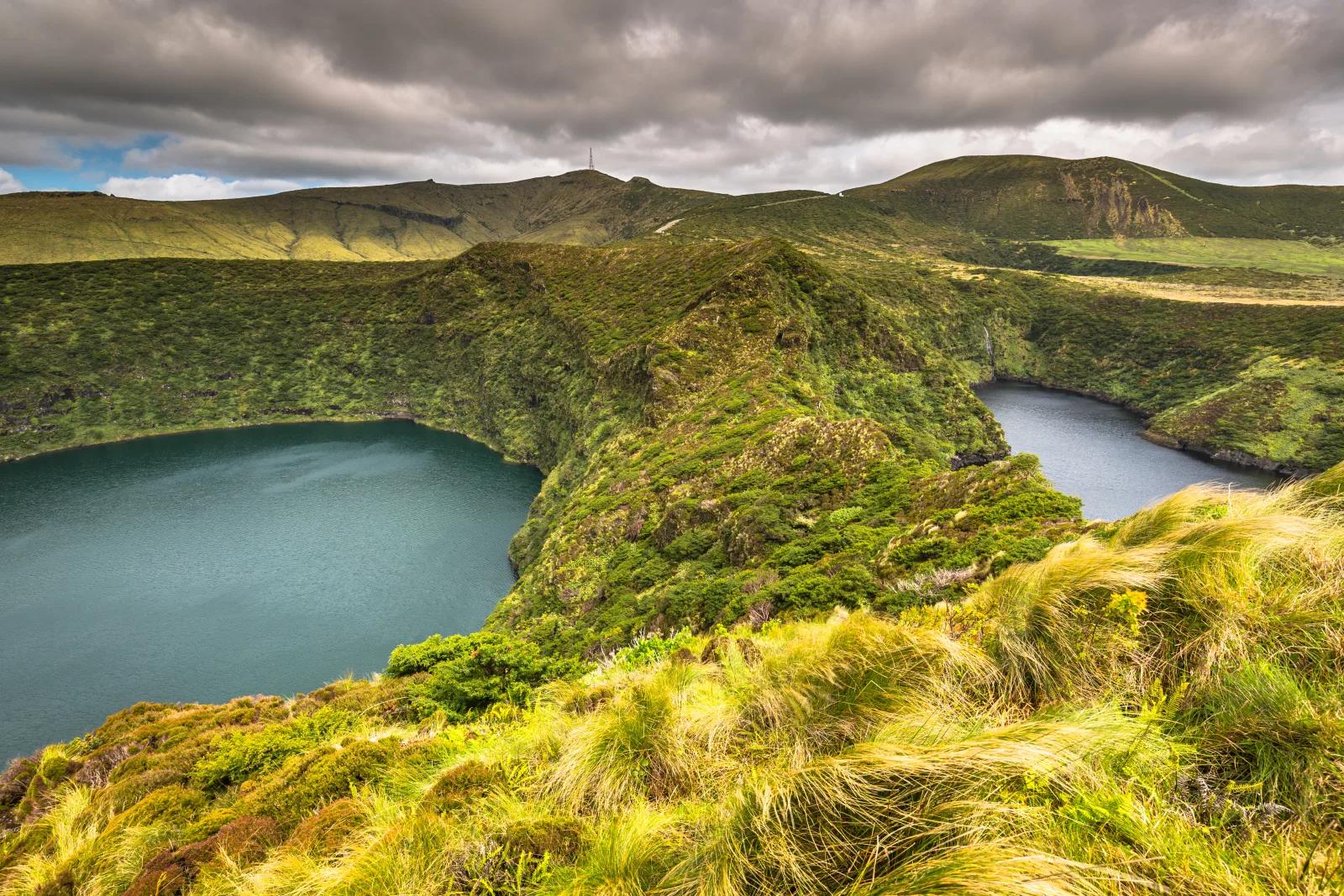
Lagoa Rasa + Lagoa Funda: the twin crater lakes
Two volcanic crater lakes at different elevations, side by side in the centre of the island.
| Lake | Elevation | Colour | Notes |
|---|---|---|---|
| Lagoa Rasa | Upper (~600m) | Pale blue | Larger surface, gentler shore |
| Lagoa Funda | Lower (~500m) | Bright green | Deeper crater, more vertical walls |
Best viewed from the Miradouro das Lagoas between them — a single viewpoint shows both lakes at once. Best on clear afternoons. Mornings often have cloud over the interior.
The colour difference between the two lakes is real (not light effect) — different mineral content from different volcanic origins.
Aldeia da Cuada: the abandoned village
Aldeia da Cuada is a 17th-century stone village on Flores’s west coast that was abandoned in the 1960s when residents emigrated en masse (mostly to the US and Canada — see the Azorean diaspora context). In the 1990s the village was restored as a self-catering rural tourism property: 16 stone cottages, connected by narrow walking paths, with one small restaurant.
It’s both an accommodation option and a sightseeing one. Even if you stay elsewhere, the village is worth visiting for its preserved 17th-century stonework, the views down to Fajã Grande, and the restaurant lunch.
Stay one night here if you’re spending 4+ days on Flores. The pace of the village is unlike anywhere else in the Azores — no through traffic, no light pollution, total quiet.
Fajã Grande: the westernmost village in Europe
Fajã Grande is the westernmost inhabited place in Europe. Beyond it, only Atlantic Ocean until Newfoundland 2,400 km away.
The village sits at sea level beneath a vertical cliff wall, with the laurel forest above and the ocean immediately below. It’s small (population ~200), with two restaurants, a handful of guesthouses, and an undeniable end-of-the-world atmosphere.
Why stay in Fajã Grande:
- Closest base to Poço da Ribeira do Ferreiro and Poço do Bacalhau
- Ocean front sunset views (no land west to block the horizon)
- Hiking access to coastal trails
- Quietest base on Flores
Why not:
- Only 2 restaurants
- 35 minutes from the airport at Santa Cruz
- Limited accommodation
For most 3-day trips: arrival night in Santa Cruz, remaining 2 nights in Fajã Grande.
Canyoning on Flores Island
Flores is the canyoning capital of the Azores. The combination of waterfalls, high rainfall, and steep terrain creates 40+ canyons suitable for canyoning — descending waterfalls in wetsuits using ropes, rappelling, jumping into pools.
The two most popular routes:
| Canyon | Difficulty | Duration | Notes |
|---|---|---|---|
| Canyon Fajã Grande | Beginner-friendly | ~3 hours | Includes the famous Salto do Tubo slide |
| Canyon Ribeira do Ferreiro | Intermediate | ~5 hours | Inside the waterfall amphitheatre |
Several operators run guided canyoning trips from Santa Cruz das Flores. Average cost: €60-€90 per person, including wetsuit, helmet, harness, and guide. Bookings recommended 1-2 weeks ahead in peak season.
How to get to Flores Island
The only way is by plane. SATA Air Açores is the sole operator.
| From | To | Frequency | Flight time |
|---|---|---|---|
| Ponta Delgada (PDL) | Santa Cruz das Flores (FLW) | 2x/week (Tue, Thu) | 1h 40m |
| Horta, Faial (HOR) | FLW | Seasonal | ~50 min |
| Lajes, Terceira (TER) | FLW | Less frequent | ~1h 30m |
Aircraft: Bombardier Dash 8 (turboprop). Capacity ~70 passengers.
Weather caveat: Flores Airport is one of the most weather-sensitive in the Azores. Fog, strong wind, or low cloud routinely cancel flights or divert them back to PDL. Build at least one buffer day before any onward international flight from PDL. Trips have been ruined by Flores weather pinning travelers on the island for an extra 2-3 days when ferries don’t run.
Full inter-island flight context is in the Azores airport guide and how to get to the Azores guide.
Where to stay on Flores Island
The three main accommodation hubs:
| Town | Pros | Cons |
|---|---|---|
| Santa Cruz das Flores | Near airport, most restaurants, most options | East coast — 35 min from the western waterfalls |
| Lajes das Flores | South coast, harbour town, quieter | Limited restaurants, away from the headline sights |
| Fajã Grande | Closest to waterfalls, sunset views, end-of-Europe atmosphere | Tiny — 2 restaurants, fewer rooms |
| Aldeia da Cuada | Restored 17th-century stone village stay | 16 cottages total, sells out months ahead |
My recommendation: Santa Cruz das Flores for the first night (arrive late, walk to dinner), then Fajã Grande or Aldeia da Cuada for the remaining nights. The west coast is where you’ll spend most of your daytime.
Booking note: Flores has very limited accommodation inventory. Book 2-3 months ahead in shoulder season, 4-6 months ahead for July-August. Some properties only take direct bookings (not via Booking.com).
For day-of-trip lodging strategy comparable to São Miguel, see the where to stay in São Miguel guide.
How many days do you need on Flores
| Trip length | What fits |
|---|---|
| 2 days | Rocha dos Bordões + one waterfall + the lakes. Rushed. Not recommended. |
| 3 days | All headline sights + Aldeia da Cuada + ferry day trip to Corvo |
| 4-5 days | Above + Fajã Grande hiking + canyoning + slow pace |
| 6+ days | The island starts to repeat — better to combine with Faial or another central-group island |
Most travelers add Flores to a multi-island Azores trip as a 3-night extension. For trip-length planning across all islands, the how many days in the Azores guide covers the realistic options.
Common mistakes when planning a Flores trip
1 — Booking only 2 days. The headline sights need 3 days minimum. Two-day trips become a marathon of driving + weather-dodging.
2 — Not building a weather buffer. Flores Airport cancels flights regularly. Don’t have an international PDL departure the morning after your Flores return — give yourself at least one buffer night on São Miguel.
3 — Skipping accommodation booking. Inventory is genuinely limited. Walk-up bookings fail in summer.
4 — Trying to do Flores + Corvo + another island in 4 days. Inter-island logistics across the Western Group eat half-days. Pick two destinations max for a Flores-focused trip.
5 — Bringing only summer clothes. Flores can be 15°C and rainy even in August. Pack a waterproof and layers in every season.
6 — Assuming you’ll see all 40 waterfalls. The big two (Poço da Ribeira do Ferreiro + Poço do Bacalhau) are essential. Many of the smaller cascades are seasonal or visible only after heavy rain.
If you’d rather have an Azores trip with Flores logistics worked out automatically — flight timing, weather buffer days, ferry to Corvo, accommodation sequencing — Pocket Guide Azores handles that with built-in local knowledge.
The bottom line
Flores Island, Azores is the trip-within-the-trip. Not for first-time Azores visitors with 5 days. Worth genuinely making time for if you have 7+ days and want the most dramatic landscapes in the archipelago. The waterfalls are like nothing else in Europe, the westernmost-Europe moment is real, and the absence of tourists changes the texture of the experience.
Three days minimum, four ideal. Stay west. Build a weather buffer. And take the ferry to Corvo if you have a half-day — it’s the smallest, strangest, and most memorable inhabited island in the Atlantic.
Tours and day trips on the island, bookable ahead — worth sorting early, because inventory here is thinner than on São Miguel and the good trips fill first:
What to read next
- Azores map and island names — where Flores fits geographically
- Things to do in the Azores — the archipelago-wide roundup of experiences
- How to get to the Azores — inter-island flight detail
- Azores airport guide — Santa Cruz das Flores (FLW) specifics
- Pico Island guide — the natural pairing if you want a multi-island west trip
- How many days in the Azores — Flores trip-length planning
Frequently asked questions
Where is Flores Island in the Azores? +
Flores is the westernmost inhabited island of the Azores archipelago, in the Western Group along with Corvo. It sits roughly 230 km west of Faial and is geologically on the North American tectonic plate — making Fajã Grande on its western coast the westernmost village in Europe. The island is small (143 km²) with around 4,000 inhabitants. The main town and airport are at Santa Cruz das Flores on the east coast. It's a UNESCO Biosphere Reserve and one of the rainiest, greenest, and most waterfall-dense places in Europe.
How do you get to Flores Island? +
By plane only. SATA Air Açores runs direct flights from Ponta Delgada (PDL, São Miguel) to Santa Cruz das Flores (FLW), typically 2x per week (Tuesdays and Thursdays), about 1h 40m flight time on a Bombardier Dash 8. SATA also runs flights from Horta (Faial) and Lajes (Terceira). There are no direct international flights — you fly into the Azores via São Miguel or Terceira first. Weather is a real factor: stormy conditions occasionally cancel or divert flights. Build a buffer day before any onward international flight.
How many days do you need on Flores Island? +
Three days minimum, four to five is ideal. Two days fits the headline sights (Rocha dos Bordões, Poço da Ribeira do Ferreiro, Poço do Bacalhau, the two lakes) but feels rushed. Three days lets you hike Fajã Grande, explore Aldeia da Cuada, and take the ferry to Corvo for a half-day trip. Four to five days adds canyoning, kayaking, the southern coast viewpoints, and the slow rural pace the island rewards. Many travelers regret booking only two days.
Where to stay on Flores Island Azores? +
Three main bases: Santa Cruz das Flores (east coast, near the airport — most restaurants, most accommodation), Lajes das Flores (south coast, second town — quieter, fewer options), and Fajã Grande (west coast — most scenic, fewest restaurants). For first-time visitors I'd recommend Santa Cruz for the first night and Fajã Grande for the rest — the western waterfalls and viewpoints all sit in the Fajã Grande zone. Aldeia da Cuada is a unique option: a restored 17th-century stone village with 16 self-catering cottages. Book accommodation 2-3 months ahead — Flores has very limited inventory.
What is Flores Island famous for? +
Three things define Flores. First, the waterfalls — Poço da Ribeira do Ferreiro has dozens of cascades dropping 150 metres into an emerald pool, and Poço do Bacalhau drops 90 metres into a swimming lake. Second, the basalt columns at Rocha dos Bordões — a geological monument of vertical lava columns surrounded by green pastures and hydrangeas. Third, the sense of being at the literal edge of Europe — Fajã Grande is the westernmost village on the continent. Flores is also a canyoning hotspot (40+ canyons) and a UNESCO Biosphere Reserve.
Is Flores Island worth visiting? +
Yes — but only if you have at least 7 days in the Azores total. Flores requires its own flight from São Miguel, an extra 2-3 days minimum, and weather-buffer planning. For a 5-day Azores trip, skip Flores and focus on São Miguel. For a 7-10 day trip wanting depth and the most dramatic landscapes in the archipelago, Flores is genuinely worth the logistical complexity. It's the closest the Azores get to feeling like a primeval island — fewer tourists, denser waterfalls, more remote. Most visitors who go say it's their favourite Azorean island.
Can you swim at Poço do Bacalhau? +
Yes, and it's one of the best swimming spots in the Azores. The waterfall feeds a natural lake at its base — cold (around 14-16°C even in summer), clear, deep enough to swim properly. The setting is dramatic: 90 metres of vertical waterfall on one side, basalt cliffs on the other, lush green vegetation around. There's a short trail from the parking area to the pool (about 5 minutes). Best visited mid-morning when light hits the falls. Avoid right after heavy rain — the spray and turbidity reduce visibility.
When is the best time to visit Flores? +
June through September. Summer brings the warmest weather (18-22°C), least rain, and most reliable inter-island flights. Hydrangeas peak in July across the island, including the famous bloom corridor near Miradouro Craveiro Lopes. Avoid winter (November-March) unless you specifically want storm watching — flights to Flores are frequently cancelled by weather, and several attractions become unsafe to visit in heavy rain. May and October are the shoulder windows: weather still workable, prices and crowds lower.