
Also available in Português
Azores Time Zone: What Time Is It in the Azores?
What time is it in the Azores? The islands run on Azores Time (UTC-1) — the time zone, daylight saving dates, and the difference from the US, UK, and Lisbon.
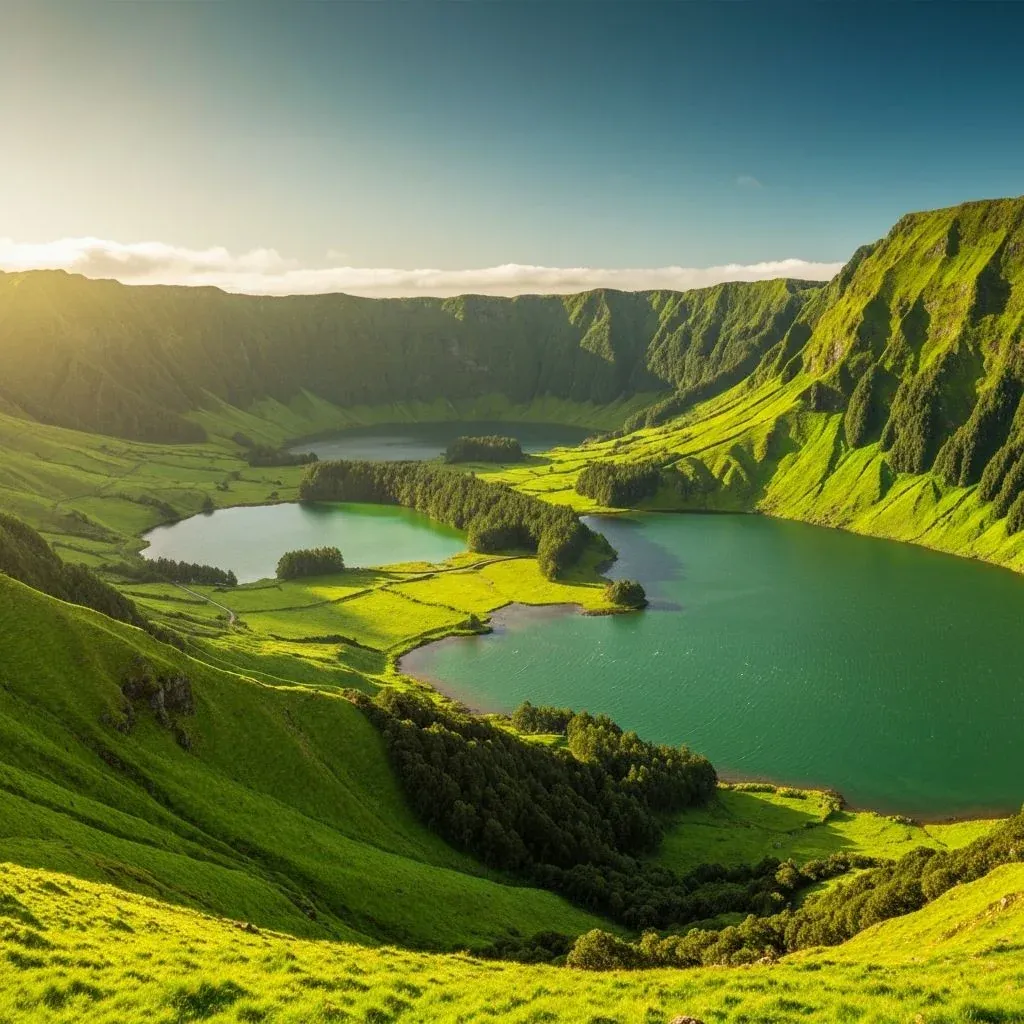
The Azores run on Azores Time — UTC-1 in winter and UTC+0 in summer. They are the only part of Portugal not on mainland time, and they sit a full hour behind Lisbon all year. I live on São Miguel, and the time zone is one of the small things that confuses visitors before they arrive — flights, calls home, and arrival times all need that one-hour mental adjustment.
This guide answers the practical question — what time is it in the Azores, and how does that compare to where you’re coming from — plus the daylight saving dates and why the islands have their own zone in the first place.
Azores time: the short answer
The Azores observe one time zone, used by all nine islands:
| Period | Zone | Offset |
|---|---|---|
| Winter (late Oct – late Mar) | AZOT — Azores Time | UTC-1 |
| Summer (late Mar – late Oct) | AZOST — Azores Summer Time | UTC+0 |
The simplest way to hold it in your head: the Azores are always one hour behind mainland Portugal, the UK, and Ireland — year-round, no exceptions. If you know the time in Lisbon or London, subtract one hour.
AZOT and AZOST — daylight saving explained
The Azores switch their clocks twice a year, on the same dates as the European Union and mainland Portugal:
- Last Sunday of March — clocks go forward one hour. The islands move from AZOT (UTC-1) to AZOST (UTC+0). Summer begins.
- Last Sunday of October — clocks go back one hour. The islands return from AZOST to AZOT (UTC-1). Winter begins.
So for roughly half the year — the summer half, which is also the main travel season — the Azores effectively run on UTC (Greenwich Mean Time). In winter they run one hour behind it.
Because the Azores and the mainland change clocks on the same dates, the 1-hour gap between the islands and Lisbon never changes. There’s no week of the year where the offset is different.
Time difference from major countries
Here’s how Azores time compares to common places travellers fly in from. These hold for most of the year — there are brief spring and autumn windows where daylight-saving changes don’t line up perfectly and the offset shifts by an hour for a week or two.
| From | Difference | When it’s noon there, in the Azores it’s… |
|---|---|---|
| Mainland Portugal (Lisbon) | Azores 1 hr behind | 11:00 |
| UK & Ireland (London, Dublin) | Azores 1 hr behind | 11:00 |
| Central Europe (Paris, Berlin, Madrid) | Azores 2 hrs behind | 10:00 |
| US Eastern (New York, Boston) | Azores 4 hrs ahead | 16:00 |
| US Central (Chicago) | Azores 5 hrs ahead | 17:00 |
| US Pacific (Los Angeles) | Azores 7 hrs ahead | 19:00 |
| Toronto / Eastern Canada | Azores 4 hrs ahead | 16:00 |
For travellers from the US East Coast and Canada — who make up a large share of Azores visitors — the islands are 4 hours ahead. That’s a manageable jet-lag gap, similar to a domestic US coast-to-coast shift, and one reason the Azores are an easier transatlantic trip than mainland Europe.
If you’re still working out flights and routing, the how to get to the Azores guide covers the airline options and journey times.
Why the Azores have their own time zone
It comes down to geography. The Azores sit roughly 1,400 km west of Lisbon, well out into the North Atlantic. That’s far enough west that the sun crosses the sky noticeably later than it does on the mainland — solar noon in the Azores is about an hour behind solar noon in Lisbon.
A separate time zone corrects for that. By running one hour behind the mainland, the Azores keep their clocks roughly aligned with the actual position of the sun, so sunrise and sunset land at sensible local hours rather than drifting an hour out of step.
It’s the same logic that gives the United States multiple time zones across its width. Portugal is a small country, but its territory stretches a long way into the Atlantic — and the Azores are far enough out to need their own clock. For more on where exactly the islands sit, see where are the Azores.
What this means for your trip
The one-hour shift is small, but it touches a few practical things.
Flight arrival times
Flight schedules are always shown in local time at each end. A flight from Lisbon that “takes 2.5 hours” will look like it only took 1.5 hours on the clock, because you’ve also moved back an hour. Flying the other way, Azores to Lisbon, the clock jumps forward. Don’t let the displayed times confuse you — the actual flight duration is what it is.
Calling and messaging home
If you’re calling family back home, remember the islands are behind Europe and ahead of the Americas:
- Calling Europe — it’s later there than where you are. A 19:00 call from the Azores reaches the UK at 20:00, Central Europe at 21:00.
- Calling the US East Coast — it’s earlier there. A 19:00 call from the Azores reaches New York at 15:00.
Jet lag
From Europe, the one-hour shift is negligible — you won’t feel it. From the US East Coast, the 4-hour shift is real but mild — most travellers adjust within a day. The trick that works: get sunlight in the morning Azores time, and try to make it to a normal local bedtime on your first night.
There’s also a quirk worth knowing for US travellers: most flights from Boston — the main North American gateway — are overnight, landing in Ponta Delgada in the early morning Azores time. You arrive having lost a night’s proper sleep and gained four hours. The local move is to treat that first day gently: don’t schedule a big hike or a long drive. Check in, get coffee and sunlight, do something low-effort like the Ponta Delgada old town, and start the real itinerary on day two. Fighting the arrival fog with an ambitious first day is the most common mistake I see.
Sunrise, sunset, and long evenings
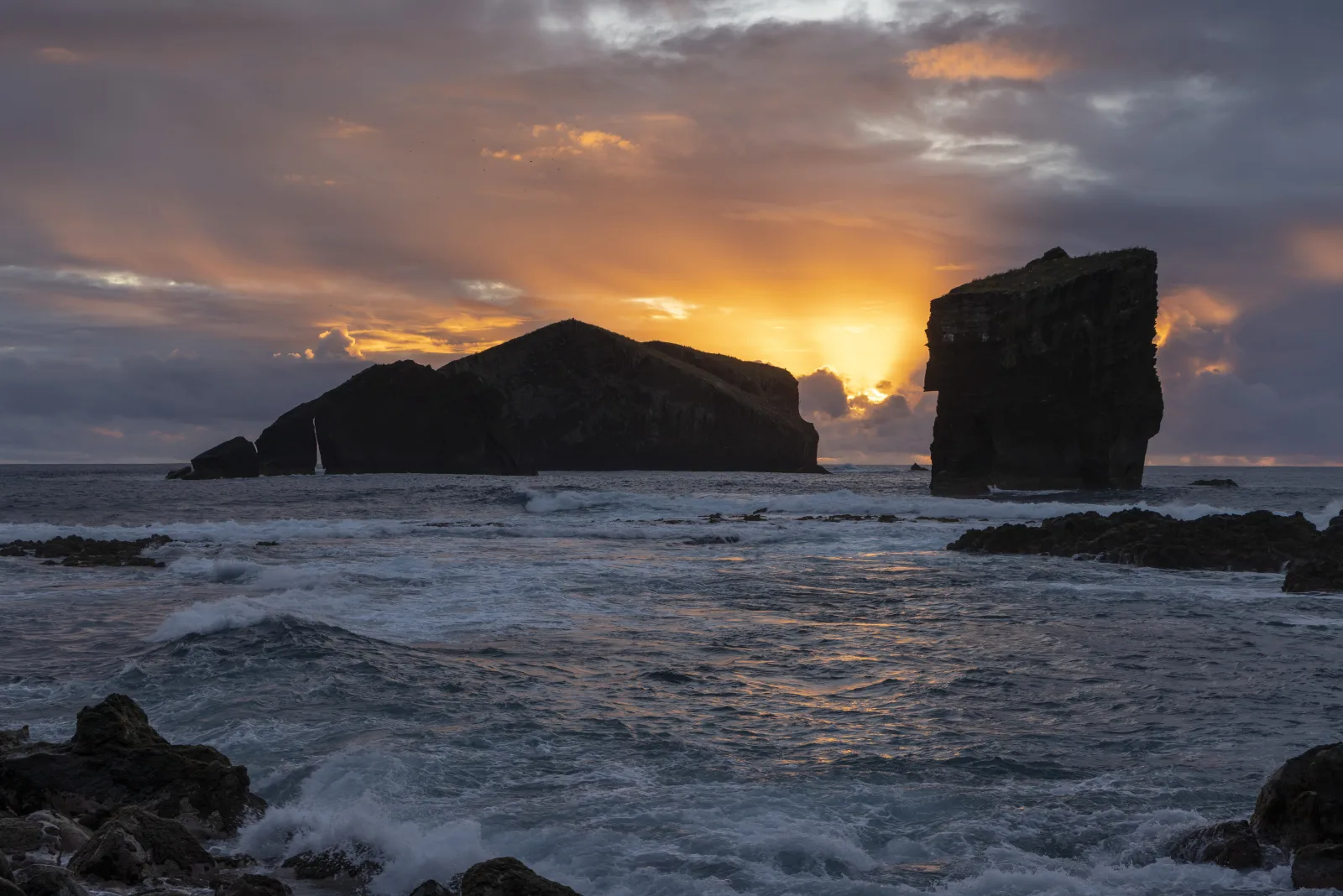
Because the islands use UTC-1/UTC+0, daylight is well-aligned to the clock. In midsummer the sun is up by about 6:30 and sets around 21:00 — long, generous evenings, ideal for after-dinner walks and sunset viewpoints. In midwinter the sun rises near 7:50 and sets around 17:50. Plan hikes and viewpoint visits with those windows in mind — and see best time to visit the Azores for how the seasons compare overall.
The same time across all nine islands
A common question from anyone planning a multi-island trip: is there a time difference between the islands?
No. All nine Azorean islands — São Miguel, Santa Maria, Terceira, Graciosa, São Jorge, Pico, Faial, Flores, and Corvo — share the single Azores time zone. When you take the ferry from Pico to Faial or fly from São Miguel to Flores, your clock does not change.
This is worth knowing because the islands span a fair distance — Santa Maria in the east to Corvo in the far west are over 600 km apart. The far-western islands actually see the sun a little later than the eastern ones, but they all keep the same clock for simplicity.
Business hours and the daily rhythm
Knowing the time zone is one thing — knowing when the islands actually operate is another. The Azores keep a relaxed, slightly southern-European daily rhythm, and it’s worth planning around.
- Shops — typically open around 09:00–10:00, and many smaller shops still close for lunch, roughly 13:00–15:00, then reopen until 18:00–19:00. Larger supermarkets in Ponta Delgada stay open through the day.
- Restaurants — lunch service runs roughly 12:00–15:00, dinner from about 19:00. Kitchens in smaller towns often stop taking orders by 21:00–21:30, earlier than mainland Portugal. Don’t plan a 22:00 dinner in a village.
- Cafés — open early, from 07:00–08:00, which suits early hikers well.
- Attractions and museums — most open 09:00–10:00 and close 17:00–18:00. Timed-entry sites like Caldeira Velha run booking blocks from 09:00.
- Sundays — quieter. Many shops close, though restaurants and tourist sites stay open.
The practical takeaway: the Azores reward an early start. Sunrise is early, cafés open early, and the best viewpoint light — and the smallest crowds — come in the first hours of the day. Build your itinerary around mornings.
How Azores time compares to Madeira and the Canaries
Travellers sometimes confuse the Atlantic archipelagos. For clarity:
| Archipelago | Time zone | Same as Azores? |
|---|---|---|
| Azores | UTC-1 / UTC+0 | — |
| Madeira | UTC+0 / UTC+1 | 1 hour ahead of the Azores |
| Canary Islands | UTC+0 / UTC+1 | 1 hour ahead of the Azores |
| Mainland Portugal | UTC+0 / UTC+1 | 1 hour ahead of the Azores |
So Madeira and the Azores are not on the same clock — Madeira runs with mainland Portugal, an hour ahead of the Azores. If you’re combining the two archipelagos on one trip, or comparing them, the Azores vs Madeira guide covers the wider differences. For the time question specifically: Madeira is one hour ahead.
Setting your devices
Modern smartphones update automatically. When you land and switch off airplane mode, the phone picks up the local network time and adjusts within a few minutes. You don’t need to do anything.
What to check manually:
- Smartwatches that sync from the phone — usually fine, but confirm
- Cameras — many don’t have network time. Set the camera clock to Azores time on arrival, or your photo timestamps will be off
- A laptop kept in airplane mode — set it manually to one hour behind mainland Portugal
- Fitness trackers and GPS watches — most update via the phone app, but check before a timed hike
The rule for anything manual: one hour behind mainland Portugal / the UK.
Quick reference
If you remember nothing else:
- The Azores use Azores Time — UTC-1 in winter, UTC+0 in summer
- Always 1 hour behind mainland Portugal, the UK, and Ireland
- About 4 hours ahead of the US East Coast and Eastern Canada
- Clocks change on the last Sunday of March and the last Sunday of October
- All nine islands share the same time — no internal time difference
And if you’d rather not track time zones, flight-time maths, and daylight hours yourself while planning — Pocket Guide Azores is the AI travel planner that handles exactly that, building your day-by-day itinerary around real local daylight and opening hours. Built by me, from São Miguel.
The bottom line
The Azores time zone is simple once you have the one rule: one hour behind mainland Portugal and the UK, year-round. From the Americas, you’re four hours behind the islands. The daylight saving switches happen on the standard EU dates, so the offsets you learn before your trip stay valid throughout it.
It’s a small adjustment — but getting it right means your flight arrival times, your calls home, and your sunset-viewpoint timing all line up from day one.
What to do next
- Where are the Azores — the geography behind the time zone
- How to get to the Azores — flights, routes, and journey times
- Best time to visit the Azores — seasons, daylight, and weather
- Azores temperature by month — month-by-month conditions
Frequently asked questions
What time zone are the Azores in? +
The Azores use Azores Time — UTC-1 in winter (AZOT) and UTC+0 in summer (AZOST, during daylight saving). This makes the Azores the only part of Portugal not on mainland time. All nine islands share the same zone. In practical terms, the Azores are always 1 hour behind mainland Portugal, the UK, and Ireland, year-round.
What time is it in the Azores right now compared to Lisbon? +
The Azores are always exactly 1 hour behind mainland Portugal, including Lisbon. When it's 14:00 in Lisbon, it's 13:00 in Ponta Delgada. This gap is constant year-round because both the mainland and the Azores switch their clocks for daylight saving on the same dates, so the 1-hour offset never changes.
How many hours ahead of New York are the Azores? +
The Azores are 4 hours ahead of US Eastern Time (New York) for most of the year. When it's 12:00 noon in New York, it's 16:00 in the Azores. The offset stays at 4 hours through almost the whole year because the Azores and the US East Coast change their clocks within a couple of weeks of each other — there's a brief window in spring and autumn when it shifts by an hour.
Do the Azores observe daylight saving time? +
Yes. The Azores switch to Azores Summer Time (AZOST, UTC+0) on the last Sunday of March and switch back to Azores Time (AZOT, UTC-1) on the last Sunday of October — the same dates as the European Union and mainland Portugal. So in summer the Azores effectively run on UTC, and in winter they run one hour behind it.
Is the time the same on all the Azores islands? +
Yes. All nine islands — São Miguel, Santa Maria, Terceira, Graciosa, São Jorge, Pico, Faial, Flores, and Corvo — are in the same time zone. There is no time difference between, say, Ponta Delgada on São Miguel and Horta on Faial. The whole archipelago changes its clocks together.
Why do the Azores have a different time zone from mainland Portugal? +
Geography. The Azores sit roughly 1,400 km west of Lisbon, far enough into the Atlantic that solar noon there is about an hour later than on the mainland. A separate time zone keeps the islands' clocks roughly aligned with the actual position of the sun, so sunrise and sunset happen at sensible local hours.
What time do the sun rise and set in the Azores? +
Because the Azores use UTC-1/UTC+0, daylight hours feel well-aligned to the clock. In midsummer the sun rises around 6:30 and sets around 21:00. In midwinter it rises around 7:50 and sets around 17:50. The islands get noticeably long summer evenings, which is good news for late hikes and sunset viewpoints.
Will my phone update to Azores time automatically? +
Yes — modern smartphones pick up the local network time when you land and adjust automatically, usually within a few minutes of switching off airplane mode. The thing to double-check is any device that doesn't use the network (some watches, cameras, or a laptop in airplane mode). Set those manually to one hour behind mainland Portugal.